Opus · 威廉·莎士比亚

哈姆雷特(中文译本)

Hamlet
1601 · 悲剧 / 中文译本

版本单页
说明
英文原文

底本:Project Gutenberg 英文原文;文脉中文导读。
版权:英文原文公版;未录入现代中译;中文导读为文脉自写。

中文导读

《哈姆雷特》常被读成复仇悲剧,但它真正改变戏剧史的地方,是把“行动为何被延迟”写成一种意识结构。鬼魂给出命令,戏中戏验证真相,墓地把一切政治和爱情都拖回肉身终点;整部剧让复仇从一条情节线变成现代主体的裂缝。

哈姆雷特与霍拉旭在埃尔西诺城堡露台上迎向披甲的亡父鬼魂

英文原文

THE TRAGEDY OF HAMLET, PRINCE OF DENMARK

by William Shakespeare

Contents

ACT I
Scene I. Elsinore. A platform before the Castle
Scene II. Elsinore. A room of state in the Castle
Scene III. A room in Polonius’s house
Scene IV. The platform
Scene V. A more remote part of the Castle

ACT II
Scene I. A room in Polonius’s house
Scene II. A room in the Castle

ACT III
Scene I. A room in the Castle
Scene II. A hall in the Castle
Scene III. A room in the Castle
Scene IV. Another room in the Castle

ACT IV
Scene I. A room in the Castle
Scene II. Another room in the Castle
Scene III. Another room in the Castle
Scene IV. A plain in Denmark
Scene V. Elsinore. A room in the Castle
Scene VI. Another room in the Castle
Scene VII. Another room in the Castle

ACT V
Scene I. A churchyard
Scene II. A hall in the Castle

Dramatis Personæ

HAMLET, Prince of Denmark
CLAUDIUS, King of Denmark, Hamlet’s uncle
The GHOST of the late king, Hamlet’s father
GERTRUDE, the Queen, Hamlet’s mother, now wife of Claudius
POLONIUS, Lord Chamberlain
LAERTES, Son to Polonius
OPHELIA, Daughter to Polonius
HORATIO, Friend to Hamlet
FORTINBRAS, Prince of Norway
VOLTEMAND, Courtier
CORNELIUS, Courtier
ROSENCRANTZ, Courtier
GUILDENSTERN, Courtier
MARCELLUS, Officer
BARNARDO, Officer
FRANCISCO, a Soldier
OSRIC, Courtier
REYNALDO, Servant to Polonius
Players
A Gentleman, Courtier
A Priest
Two Clowns, Grave-diggers
A Captain
English Ambassadors.
Lords, Ladies, Officers, Soldiers, Sailors, Messengers, and Attendants

SCENE. Elsinore.

中文译本

正文

丹麦王子哈姆雷特之悲剧

威廉·莎士比亚

目录

第一幕
第一场:埃尔西诺。城堡前的露台
第二场:埃尔西诺。城堡中的一间国事厅
第三场:波洛涅斯家中的一个房间
第四场:露台
第五场:城堡中一处更偏远的所在

第二幕
第一场:波洛涅斯家中的一个房间
第二场:城堡中的一个房间

第三幕
第一场:城堡中的一个房间
第二场:城堡中的一座大厅
第三场:城堡中的一个房间
第四场:城堡中的另一个房间

第四幕
第一场:城堡中的一个房间
第二场:城堡中的另一个房间
第三场:城堡中的另一个房间
第四场:丹麦的一处平原
第五场:埃尔西诺。城堡中的一个房间
第六场:城堡中的另一个房间
第七场:城堡中的另一个房间

第五幕
第一场:一处教堂墓地
第二场:城堡中的一座大厅

剧中人物

哈姆雷特,丹麦王子
克劳狄斯,丹麦国王,哈姆雷特的叔父
先王鬼魂,哈姆雷特的父亲
乔特鲁德,王后,哈姆雷特的母亲,现为克劳狄斯之妻
波洛涅斯,御前大臣
雷欧提斯,波洛涅斯之子
奥菲莉娅,波洛涅斯之女
霍拉旭,哈姆雷特之友
福丁布拉斯,挪威王子
伏尔提曼德,朝臣
科尼律斯,朝臣
罗森格兰兹,朝臣
吉尔登斯吞,朝臣
马塞勒斯,军官
伯纳多,军官
弗朗西斯科,一名士兵
奥斯里克,朝臣
雷纳尔多,波洛涅斯之仆
伶人
一名绅士,朝臣
一名教士
两名小丑,掘墓人
一名队长
英格兰使臣
贵族、贵妇、军官、士兵、水手、使者及侍从

场景:埃尔西诺。

ACT I / 第一幕
英文原文

ACT I

中文译本

第一幕

SCENE I. Elsinore. A platform before the Castle. / 第一场:埃尔西诺。城堡前的露台
英文原文

SCENE I. Elsinore. A platform before the Castle.

Enter Francisco and Barnardo, two sentinels.

BARNARDO.
Who’s there?

FRANCISCO.
Nay, answer me. Stand and unfold yourself.

BARNARDO.
Long live the King!

FRANCISCO.
Barnardo?

BARNARDO.
He.

FRANCISCO.
You come most carefully upon your hour.

BARNARDO.
’Tis now struck twelve. Get thee to bed, Francisco.

FRANCISCO.
For this relief much thanks. ’Tis bitter cold,
And I am sick at heart.

BARNARDO.
Have you had quiet guard?

FRANCISCO.
Not a mouse stirring.

BARNARDO.
Well, good night.
If you do meet Horatio and Marcellus,
The rivals of my watch, bid them make haste.

Enter Horatio and Marcellus.

FRANCISCO.
I think I hear them. Stand, ho! Who is there?

HORATIO.
Friends to this ground.

MARCELLUS.
And liegemen to the Dane.

FRANCISCO.
Give you good night.

MARCELLUS.
O, farewell, honest soldier, who hath reliev’d you?

FRANCISCO.
Barnardo has my place. Give you good-night.

[Exit.]

MARCELLUS.
Holla, Barnardo!

BARNARDO.
Say, what, is Horatio there?

HORATIO.
A piece of him.

BARNARDO.
Welcome, Horatio. Welcome, good Marcellus.

MARCELLUS.
What, has this thing appear’d again tonight?

BARNARDO.
I have seen nothing.

MARCELLUS.
Horatio says ’tis but our fantasy,
And will not let belief take hold of him
Touching this dreaded sight, twice seen of us.
Therefore I have entreated him along
With us to watch the minutes of this night,
That if again this apparition come
He may approve our eyes and speak to it.

HORATIO.
Tush, tush, ’twill not appear.

BARNARDO.
Sit down awhile,
And let us once again assail your ears,
That are so fortified against our story,
What we two nights have seen.

HORATIO.
Well, sit we down,
And let us hear Barnardo speak of this.

BARNARDO.
Last night of all,
When yond same star that’s westward from the pole,
Had made his course t’illume that part of heaven
Where now it burns, Marcellus and myself,
The bell then beating one—

MARCELLUS.
Peace, break thee off. Look where it comes again.

Enter Ghost.

BARNARDO.
In the same figure, like the King that’s dead.

MARCELLUS.
Thou art a scholar; speak to it, Horatio.

BARNARDO.
Looks it not like the King? Mark it, Horatio.

HORATIO.
Most like. It harrows me with fear and wonder.

BARNARDO
It would be spoke to.

MARCELLUS.
Question it, Horatio.

HORATIO.
What art thou that usurp’st this time of night,
Together with that fair and warlike form
In which the majesty of buried Denmark
Did sometimes march? By heaven I charge thee speak.

MARCELLUS.
It is offended.

BARNARDO.
See, it stalks away.

HORATIO.
Stay! speak, speak! I charge thee speak!

[Exit Ghost.]

MARCELLUS.
’Tis gone, and will not answer.

BARNARDO.
How now, Horatio! You tremble and look pale.
Is not this something more than fantasy?
What think you on’t?

HORATIO.
Before my God, I might not this believe
Without the sensible and true avouch
Of mine own eyes.

MARCELLUS.
Is it not like the King?

HORATIO.
As thou art to thyself:
Such was the very armour he had on
When he th’ambitious Norway combated;
So frown’d he once, when in an angry parle
He smote the sledded Polacks on the ice.
’Tis strange.

MARCELLUS.
Thus twice before, and jump at this dead hour,
With martial stalk hath he gone by our watch.

HORATIO.
In what particular thought to work I know not;
But in the gross and scope of my opinion,
This bodes some strange eruption to our state.

MARCELLUS.
Good now, sit down, and tell me, he that knows,
Why this same strict and most observant watch
So nightly toils the subject of the land,
And why such daily cast of brazen cannon
And foreign mart for implements of war;
Why such impress of shipwrights, whose sore task
Does not divide the Sunday from the week.
What might be toward, that this sweaty haste
Doth make the night joint-labourer with the day:
Who is’t that can inform me?

HORATIO.
That can I;
At least, the whisper goes so. Our last King,
Whose image even but now appear’d to us,
Was, as you know, by Fortinbras of Norway,
Thereto prick’d on by a most emulate pride,
Dar’d to the combat; in which our valiant Hamlet,
For so this side of our known world esteem’d him,
Did slay this Fortinbras; who by a seal’d compact,
Well ratified by law and heraldry,
Did forfeit, with his life, all those his lands
Which he stood seiz’d of, to the conqueror;
Against the which, a moiety competent
Was gaged by our King; which had return’d
To the inheritance of Fortinbras,
Had he been vanquisher; as by the same cov’nant
And carriage of the article design’d,
His fell to Hamlet. Now, sir, young Fortinbras,
Of unimproved mettle, hot and full,
Hath in the skirts of Norway, here and there,
Shark’d up a list of lawless resolutes,
For food and diet, to some enterprise
That hath a stomach in’t; which is no other,
As it doth well appear unto our state,
But to recover of us by strong hand
And terms compulsatory, those foresaid lands
So by his father lost. And this, I take it,
Is the main motive of our preparations,
The source of this our watch, and the chief head
Of this post-haste and rummage in the land.

BARNARDO.
I think it be no other but e’en so:
Well may it sort that this portentous figure
Comes armed through our watch so like the King
That was and is the question of these wars.

HORATIO.
A mote it is to trouble the mind’s eye.
In the most high and palmy state of Rome,
A little ere the mightiest Julius fell,
The graves stood tenantless and the sheeted dead
Did squeak and gibber in the Roman streets;
As stars with trains of fire and dews of blood,
Disasters in the sun; and the moist star,
Upon whose influence Neptune’s empire stands,
Was sick almost to doomsday with eclipse.
And even the like precurse of fierce events,
As harbingers preceding still the fates
And prologue to the omen coming on,
Have heaven and earth together demonstrated
Unto our climatures and countrymen.

Re-enter Ghost.

But, soft, behold! Lo, where it comes again!
I’ll cross it, though it blast me. Stay, illusion!
If thou hast any sound, or use of voice,
Speak to me.
If there be any good thing to be done,
That may to thee do ease, and grace to me,
Speak to me.
If thou art privy to thy country’s fate,
Which, happily, foreknowing may avoid,
O speak!
Or if thou hast uphoarded in thy life
Extorted treasure in the womb of earth,
For which, they say, you spirits oft walk in death,
Speak of it. Stay, and speak!

[The cock crows.]

Stop it, Marcellus!

MARCELLUS.
Shall I strike at it with my partisan?

HORATIO.
Do, if it will not stand.

BARNARDO.
’Tis here!

HORATIO.
’Tis here!

[Exit Ghost.]

MARCELLUS.
’Tis gone!
We do it wrong, being so majestical,
To offer it the show of violence,
For it is as the air, invulnerable,
And our vain blows malicious mockery.

BARNARDO.
It was about to speak, when the cock crew.

HORATIO.
And then it started, like a guilty thing
Upon a fearful summons. I have heard
The cock, that is the trumpet to the morn,
Doth with his lofty and shrill-sounding throat
Awake the god of day; and at his warning,
Whether in sea or fire, in earth or air,
Th’extravagant and erring spirit hies
To his confine. And of the truth herein
This present object made probation.

MARCELLUS.
It faded on the crowing of the cock.
Some say that ever ’gainst that season comes
Wherein our Saviour’s birth is celebrated,
The bird of dawning singeth all night long;
And then, they say, no spirit dare stir abroad,
The nights are wholesome, then no planets strike,
No fairy takes, nor witch hath power to charm;
So hallow’d and so gracious is the time.

HORATIO.
So have I heard, and do in part believe it.
But look, the morn in russet mantle clad,
Walks o’er the dew of yon high eastward hill.
Break we our watch up, and by my advice,
Let us impart what we have seen tonight
Unto young Hamlet; for upon my life,
This spirit, dumb to us, will speak to him.
Do you consent we shall acquaint him with it,
As needful in our loves, fitting our duty?

MARCELLUS.
Let’s do’t, I pray, and I this morning know
Where we shall find him most conveniently.

[Exeunt.]

中文译本

第一场:埃尔西诺。城堡前的露台

弗朗西斯科与伯纳多,两名哨兵,上。

伯纳多。
谁在那里?

弗朗西斯科。
不,回答我。站住,报上名来。

伯纳多。
国王万岁!

弗朗西斯科。
伯纳多?

伯纳多。
正是。

弗朗西斯科。
你倒来得极为准时。

伯纳多。
刚敲过十二点。去睡吧,弗朗西斯科。

弗朗西斯科。
多谢你来换岗。天冷得刺骨,
我心里也闷得慌。

伯纳多。
你守的这一班还安静吗?

弗朗西斯科。
连一只老鼠都没动过。

伯纳多。
好,晚安。
你要是遇见霍拉旭和马塞勒斯,
同我一起值夜的那两位,就叫他们快些。

霍拉旭与马塞勒斯上。

弗朗西斯科。
我好像听见他们了。站住,喂!谁在那里?

霍拉旭。
是此地的朋友。

马塞勒斯。
也是丹麦王的臣下。

弗朗西斯科。
祝你们晚安。

马塞勒斯。
哦,再会了,忠实的士兵。是谁接替了你?

弗朗西斯科。
伯纳多接了我的岗。祝你们晚安。

〔弗朗西斯科下。〕

马塞勒斯。
喂,伯纳多!

伯纳多。
说,怎么,霍拉旭在那儿吗?

霍拉旭。
他的一小部分在。

伯纳多。
欢迎,霍拉旭。欢迎,好马塞勒斯。

马塞勒斯。
怎么,那东西今晚又出现了吗?

伯纳多。
我什么也没看见。

马塞勒斯。
霍拉旭说这不过是我们的幻觉,
我们两度亲见的这骇人景象,
他一点儿也不肯相信。
所以我恳求他今夜同我们一起
守候这黑夜里的每一分钟,
这样,倘若那幻象再度来临,
他就能见证我们的眼睛,并与之说话。

霍拉旭。
得啦,得啦,它不会出现的。

伯纳多。
暂且坐下吧,
让我们再一次向您的耳朵发起进攻,
它们如此严阵以待,不肯接纳我们两夜
亲眼所见之事。

霍拉旭。
好,我们就坐下,
让我们听伯纳多讲讲这事。

伯纳多。
就在昨夜,
当那颗此刻正燃在那边天空的星辰,
那颗在北极星西边的同一颗星,
已循它的轨迹照亮那片天宇之时,
马塞勒斯和我,那时钟正敲响一点——

马塞勒斯。
别出声,停下。瞧,它又来了。

〔鬼魂上。〕

伯纳多。
正是那模样,就像已故的国王。

马塞勒斯。
你是个读书人;霍拉旭,你跟它说话。

伯纳多。
它难道不像国王吗?霍拉旭,你仔细看。

霍拉旭。
最为相似。它令我恐惧与惊异齐生。

伯纳多。
它是想要人跟它说话的。

马塞勒斯。
去问它,霍拉旭。

霍拉旭。
你是什么东西,竟敢窃据这夜晚的时刻,
偕同那既俊美而又威武的形貌,
那已入土的丹麦君王的威仪
当年出征时所披戴的身姿?我以天国的名义,命令你开口!

马塞勒斯。
它被触怒了。

伯纳多。
瞧,它昂首阔步地走开了。

霍拉旭。
站住!说话,说话!我命令你说话!

〔鬼魂下。〕

马塞勒斯。
它走了,不肯回答。

伯纳多。
怎么了,霍拉旭!您浑身发抖,脸色苍白。
这难道不仅仅是幻觉吗?
您对此作何感想?

霍拉旭。
在我的上帝面前,若非凭我双眼
那确凿无疑、真真切切的明证,
我断不肯相信这事。

马塞勒斯。
它难道不像国王吗?

霍拉旭。
正如你像你自己一样:
他当年讨伐野心勃勃的挪威时,
所穿的正是这一身甲胄;
他也曾这般皱眉紧蹙,那时在一场盛怒的谈判中,
他挥锤击打乘雪橇的波兰人于冰原之上。
真是怪异。

马塞勒斯。
先前已有两次,恰在这死寂的时辰,
他迈着威仪的步伐,走过我们的看守。

霍拉旭。
它究竟用意何在,我想不真切;
但据我大略所见,推想其大端,
这预兆着我国中,将有奇异的变故。

马塞勒斯。
好吧,请坐下,知情的人哪,告诉我,
究竟为了什么,要这般严加戒备,
夜夜叫国人如此劳苦不休,
又为何日日铸造这许多铜炮,
向外邦采买这许多军械;
为何要强征这许多造船匠,使他们重役加身,
连礼拜日也和无别,
究竟有什么事将要发生,竟需如此匆忙急切,
叫黑夜也与白昼一同流汗:
谁能给我一个说明?

霍拉旭。
我能;
至少,人们私下是这么传说。我们那位先王,
他的形象方才还向我们显现,
正如你们所知,曾被挪威王福丁布拉斯,
出于一份好胜争强的傲心,激起,
向他挑战决斗;在那场决斗中,我们英勇的哈姆雷特——
我们这边举世所知,都这般敬重他——
便斩了那福丁布拉斯;那福丁布拉斯,按照一份画押的契约,
又经法律与纹章官的郑重认可,
随着他性命,将他所占有的
一切土地,都输给了那胜者;
而对应那份赌注,我们王上也押下了
一份相当的领地;倘若胜者是福丁布拉斯,
那份领地便要归他继承;
正如这同一纸契约,按其条款所载的明文,
福丁布拉斯的领土归了哈姆雷特。如今,大人,这位小福丁布拉斯,
血气未驯,性如烈火且全无顾忌,
在挪威边境各处,这儿那儿,
已搜罗了一群亡命的无赖之徒,
以充衣食之需,去图谋一桩
必须有胆量才敢去做的事业;那桩事业,非为别事,
照我们国中清楚的情势看来,
无非是用强横的手段,
以胁迫的条款,从我们手中夺回
他父亲所丧失的那片土地。依我看,
这便是我们此番备战的
首要动机,是我们严加看守的缘由,
也是全国这般紧急匆忙、一片骚动的根源。

伯纳多。
我想这原因非此莫属了:
这也正可解释,为何那征兆可怖的身影,
全身披挂,穿过我们的守卫,活像那位国王,
那位如今正是这场战事的起因的国王。

霍拉旭。
那只是一粒微尘,搅乱心灵之眼。
在罗马那鼎盛至极的盛世,
在盖世无双的尤利乌斯陨落前夕,
坟墓尽空,裹着殓布的死尸
在罗马街头尖啸嗫嚅;
星辰拖着火尾,降下血露,
太阳出现凶兆;而那颗湿润之星——
海神之国全赖其力左右——
晦暗得几乎濒于末日之蚀。
而与此相同的惨烈变故之先兆——
犹如朕兆莅临之前必有先驱,
犹如预兆将至之前必有开场——
苍天与大地早已一同昭示于
我们这方水土与国人。

〔鬼魂重上。〕

且慢,看!瞧,它又来了!
即使将我击倒,我也要拦住它。站住,幻象!
你若有什么响动,或能运用嗓音,
对我说话吧。
若有什么善事可为,
能令你安息,令我蒙恩,
对我说话吧。
你若知晓祖国命运之秘,
幸而预知,或许可避,
啊,请说!
又或者你生前将搜刮而来的宝藏
埋藏于大地之腹,
为此,人说,你们魂灵死后常要游荡,
说出来吧。站住,说!

〔鸡鸣。〕

拦住它,马塞勒斯!

马塞勒斯。
要我用戟击打它吗?

霍拉旭。
它若不肯站住,便打。

伯纳多。
在这儿!

霍拉旭。
在这儿!

〔鬼魂下。〕

马塞勒斯。
它走了!
我们行事有亏,它如此庄严,
我们却示以暴力之状,
因为它如同空气,刀枪不入,
我们徒劳的击打不过是恶意的嘲弄。

伯纳多。
鸡鸣之时,它正要开口说话。

霍拉旭。
于是它惊起,如同一个负罪之物
听到了可怖的召唤。我听闻,
公鸡,这黎明的号角,
用它高昂而尖锐的啼鸣
唤醒白昼之神;在它的警告之下,
无论在海上火中,在土里空中,
一切游荡漂泊的魂灵都仓皇
赶回它的界域。此事之确凿,
眼前这物已作了明证。

马塞勒斯。
鸡鸣之际,它便消退了。
有人说,每逢那个时节临近——
即救主诞辰庆祝之时——
这报晓之禽会彻夜长鸣;
于是,他们说,没有魂魄敢外出游荡,
夜晚变得无害,星辰不降祸,
妖仙不惑人,巫婆无从施咒;
这时间如此神圣,又这般蒙恩。

霍拉旭。
我也听说过,而且有几分相信。
可是您看,清晨披着赭色斗篷,
已经踏上那东边高岗上的露水了。
我们散了岗吧;依我之见,
把我们今夜所见的事
去告诉年轻的哈姆雷特;
因为我敢拿性命打赌,这个对我们
守口如瓶的鬼魂,一定会对他开口。
你们是不是同意,我们该把这事告诉他,
既出于我们的爱戴,也合乎我们的职分?

马塞勒斯。
就这么办吧,我请求;而且我知道今早
在什么地方最容易找到他。

〔众人下。〕

SCENE II. Elsinore. A room of state in the Castle. / 第二场:艾尔西诺。城堡中的一间国事厅。
英文原文

SCENE II. Elsinore. A room of state in the Castle.

Enter Claudius King of Denmark, Gertrude the Queen, Hamlet, Polonius,
Laertes, Voltemand,
Cornelius, Lords and Attendant.

KING.
Though yet of Hamlet our dear brother’s death
The memory be green, and that it us befitted
To bear our hearts in grief, and our whole kingdom
To be contracted in one brow of woe;
Yet so far hath discretion fought with nature
That we with wisest sorrow think on him,
Together with remembrance of ourselves.
Therefore our sometime sister, now our queen,
Th’imperial jointress to this warlike state,
Have we, as ’twere with a defeated joy,
With one auspicious and one dropping eye,
With mirth in funeral, and with dirge in marriage,
In equal scale weighing delight and dole,
Taken to wife; nor have we herein barr’d
Your better wisdoms, which have freely gone
With this affair along. For all, our thanks.
Now follows, that you know young Fortinbras,
Holding a weak supposal of our worth,
Or thinking by our late dear brother’s death
Our state to be disjoint and out of frame,
Colleagued with this dream of his advantage,
He hath not fail’d to pester us with message,
Importing the surrender of those lands
Lost by his father, with all bonds of law,
To our most valiant brother. So much for him.
Now for ourself and for this time of meeting:
Thus much the business is: we have here writ
To Norway, uncle of young Fortinbras,
Who, impotent and bed-rid, scarcely hears
Of this his nephew’s purpose, to suppress
His further gait herein; in that the levies,
The lists, and full proportions are all made
Out of his subject: and we here dispatch
You, good Cornelius, and you, Voltemand,
For bearers of this greeting to old Norway,
Giving to you no further personal power
To business with the King, more than the scope
Of these dilated articles allow.
Farewell; and let your haste commend your duty.

CORNELIUS and VOLTEMAND.
In that, and all things, will we show our duty.

KING.
We doubt it nothing: heartily farewell.

[Exeunt Voltemand and Cornelius.]

And now, Laertes, what’s the news with you?
You told us of some suit. What is’t, Laertes?
You cannot speak of reason to the Dane,
And lose your voice. What wouldst thou beg, Laertes,
That shall not be my offer, not thy asking?
The head is not more native to the heart,
The hand more instrumental to the mouth,
Than is the throne of Denmark to thy father.
What wouldst thou have, Laertes?

LAERTES.
Dread my lord,
Your leave and favour to return to France,
From whence though willingly I came to Denmark
To show my duty in your coronation;
Yet now I must confess, that duty done,
My thoughts and wishes bend again toward France,
And bow them to your gracious leave and pardon.

KING.
Have you your father’s leave? What says Polonius?

POLONIUS.
He hath, my lord, wrung from me my slow leave
By laboursome petition; and at last
Upon his will I seal’d my hard consent.
I do beseech you give him leave to go.

KING.
Take thy fair hour, Laertes; time be thine,
And thy best graces spend it at thy will!
But now, my cousin Hamlet, and my son—

HAMLET.
[Aside.] A little more than kin, and less than kind.

KING.
How is it that the clouds still hang on you?

HAMLET.
Not so, my lord, I am too much i’ the sun.

QUEEN.
Good Hamlet, cast thy nighted colour off,
And let thine eye look like a friend on Denmark.
Do not for ever with thy vailed lids
Seek for thy noble father in the dust.
Thou know’st ’tis common, all that lives must die,
Passing through nature to eternity.

HAMLET.
Ay, madam, it is common.

QUEEN.
If it be,
Why seems it so particular with thee?

HAMLET.
Seems, madam! Nay, it is; I know not seems.
’Tis not alone my inky cloak, good mother,
Nor customary suits of solemn black,
Nor windy suspiration of forc’d breath,
No, nor the fruitful river in the eye,
Nor the dejected haviour of the visage,
Together with all forms, moods, shows of grief,
That can denote me truly. These indeed seem,
For they are actions that a man might play;
But I have that within which passeth show;
These but the trappings and the suits of woe.

KING.
’Tis sweet and commendable in your nature, Hamlet,
To give these mourning duties to your father;
But you must know, your father lost a father,
That father lost, lost his, and the survivor bound
In filial obligation, for some term
To do obsequious sorrow. But to persevere
In obstinate condolement is a course
Of impious stubbornness. ’Tis unmanly grief,
It shows a will most incorrect to heaven,
A heart unfortified, a mind impatient,
An understanding simple and unschool’d;
For what we know must be, and is as common
As any the most vulgar thing to sense,
Why should we in our peevish opposition
Take it to heart? Fie, ’tis a fault to heaven,
A fault against the dead, a fault to nature,
To reason most absurd, whose common theme
Is death of fathers, and who still hath cried,
From the first corse till he that died today,
‘This must be so.’ We pray you throw to earth
This unprevailing woe, and think of us
As of a father; for let the world take note
You are the most immediate to our throne,
And with no less nobility of love
Than that which dearest father bears his son
Do I impart toward you. For your intent
In going back to school in Wittenberg,
It is most retrograde to our desire:
And we beseech you bend you to remain
Here in the cheer and comfort of our eye,
Our chiefest courtier, cousin, and our son.

QUEEN.
Let not thy mother lose her prayers, Hamlet.
I pray thee stay with us; go not to Wittenberg.

HAMLET.
I shall in all my best obey you, madam.

KING.
Why, ’tis a loving and a fair reply.
Be as ourself in Denmark. Madam, come;
This gentle and unforc’d accord of Hamlet
Sits smiling to my heart; in grace whereof,
No jocund health that Denmark drinks today
But the great cannon to the clouds shall tell,
And the King’s rouse the heaven shall bruit again,
Re-speaking earthly thunder. Come away.

[Exeunt all but Hamlet.]

HAMLET.
O that this too too solid flesh would melt,
Thaw, and resolve itself into a dew!
Or that the Everlasting had not fix’d
His canon ’gainst self-slaughter. O God! O God!
How weary, stale, flat, and unprofitable
Seem to me all the uses of this world!
Fie on’t! Oh fie! ’tis an unweeded garden
That grows to seed; things rank and gross in nature
Possess it merely. That it should come to this!
But two months dead—nay, not so much, not two:
So excellent a king; that was to this
Hyperion to a satyr; so loving to my mother,
That he might not beteem the winds of heaven
Visit her face too roughly. Heaven and earth!
Must I remember? Why, she would hang on him
As if increase of appetite had grown
By what it fed on; and yet, within a month—
Let me not think on’t—Frailty, thy name is woman!
A little month, or ere those shoes were old
With which she followed my poor father’s body
Like Niobe, all tears.—Why she, even she—
O God! A beast that wants discourse of reason
Would have mourn’d longer,—married with mine uncle,
My father’s brother; but no more like my father
Than I to Hercules. Within a month,
Ere yet the salt of most unrighteous tears
Had left the flushing in her galled eyes,
She married. O most wicked speed, to post
With such dexterity to incestuous sheets!
It is not, nor it cannot come to good.
But break, my heart, for I must hold my tongue.

Enter Horatio, Marcellus and Barnardo.

HORATIO.
Hail to your lordship!

HAMLET.
I am glad to see you well:
Horatio, or I do forget myself.

HORATIO.
The same, my lord,
And your poor servant ever.

HAMLET.
Sir, my good friend;
I’ll change that name with you:
And what make you from Wittenberg, Horatio?—
Marcellus?

MARCELLUS.
My good lord.

HAMLET.
I am very glad to see you.—Good even, sir.—
But what, in faith, make you from Wittenberg?

HORATIO.
A truant disposition, good my lord.

HAMLET.
I would not hear your enemy say so;
Nor shall you do my ear that violence,
To make it truster of your own report
Against yourself. I know you are no truant.
But what is your affair in Elsinore?
We’ll teach you to drink deep ere you depart.

HORATIO.
My lord, I came to see your father’s funeral.

HAMLET.
I prithee do not mock me, fellow-student.
I think it was to see my mother’s wedding.

HORATIO.
Indeed, my lord, it follow’d hard upon.

HAMLET.
Thrift, thrift, Horatio! The funeral bak’d meats
Did coldly furnish forth the marriage tables.
Would I had met my dearest foe in heaven
Or ever I had seen that day, Horatio.
My father,—methinks I see my father.

HORATIO.
Where, my lord?

HAMLET.
In my mind’s eye, Horatio.

HORATIO.
I saw him once; he was a goodly king.

HAMLET.
He was a man, take him for all in all,
I shall not look upon his like again.

HORATIO.
My lord, I think I saw him yesternight.

HAMLET.
Saw? Who?

HORATIO.
My lord, the King your father.

HAMLET.
The King my father!

HORATIO.
Season your admiration for a while
With an attent ear, till I may deliver
Upon the witness of these gentlemen
This marvel to you.

HAMLET.
For God’s love let me hear.

HORATIO.
Two nights together had these gentlemen,
Marcellus and Barnardo, on their watch
In the dead waste and middle of the night,
Been thus encounter’d. A figure like your father,
Armed at point exactly, cap-à-pie,
Appears before them, and with solemn march
Goes slow and stately by them: thrice he walk’d
By their oppress’d and fear-surprised eyes,
Within his truncheon’s length; whilst they, distill’d
Almost to jelly with the act of fear,
Stand dumb, and speak not to him. This to me
In dreadful secrecy impart they did,
And I with them the third night kept the watch,
Where, as they had deliver’d, both in time,
Form of the thing, each word made true and good,
The apparition comes. I knew your father;
These hands are not more like.

HAMLET.
But where was this?

MARCELLUS.
My lord, upon the platform where we watch.

HAMLET.
Did you not speak to it?

HORATIO.
My lord, I did;
But answer made it none: yet once methought
It lifted up it head, and did address
Itself to motion, like as it would speak.
But even then the morning cock crew loud,
And at the sound it shrunk in haste away,
And vanish’d from our sight.

HAMLET.
’Tis very strange.

HORATIO.
As I do live, my honour’d lord, ’tis true;
And we did think it writ down in our duty
To let you know of it.

HAMLET.
Indeed, indeed, sirs, but this troubles me.
Hold you the watch tonight?

MARCELLUS and BARNARDO.
We do, my lord.

HAMLET.
Arm’d, say you?

Both.
Arm’d, my lord.

HAMLET.
From top to toe?

BOTH.
My lord, from head to foot.

HAMLET.
Then saw you not his face?

HORATIO.
O yes, my lord, he wore his beaver up.

HAMLET.
What, look’d he frowningly?

HORATIO.
A countenance more in sorrow than in anger.

HAMLET.
Pale, or red?

HORATIO.
Nay, very pale.

HAMLET.
And fix’d his eyes upon you?

HORATIO.
Most constantly.

HAMLET.
I would I had been there.

HORATIO.
It would have much amaz’d you.

HAMLET.
Very like, very like. Stay’d it long?

HORATIO.
While one with moderate haste might tell a hundred.

MARCELLUS and BARNARDO.
Longer, longer.

HORATIO.
Not when I saw’t.

HAMLET.
His beard was grizzled, no?

HORATIO.
It was, as I have seen it in his life,
A sable silver’d.

HAMLET.
I will watch tonight;
Perchance ’twill walk again.

HORATIO.
I warrant you it will.

HAMLET.
If it assume my noble father’s person,
I’ll speak to it, though hell itself should gape
And bid me hold my peace. I pray you all,
If you have hitherto conceal’d this sight,
Let it be tenable in your silence still;
And whatsoever else shall hap tonight,
Give it an understanding, but no tongue.
I will requite your loves. So, fare ye well.
Upon the platform ’twixt eleven and twelve,
I’ll visit you.

ALL.
Our duty to your honour.

HAMLET.
Your loves, as mine to you: farewell.

[Exeunt Horatio, Marcellus and Barnardo.]

My father’s spirit in arms! All is not well;
I doubt some foul play: would the night were come!
Till then sit still, my soul: foul deeds will rise,
Though all the earth o’erwhelm them, to men’s eyes.

[Exit.]

中文译本

第二场:艾尔西诺。城堡中的一间国事厅。

克劳狄斯丹麦国王、乔特鲁德王后、哈姆雷特、波洛涅斯、雷欧提斯、伏尔提曼德、科尼律斯、众贵族及侍从上。

克劳狄斯。
虽说朕亲爱的兄长哈姆雷特之死
记忆犹新,我们理应
心中充满哀恸,举国上下
一致紧锁愁眉;
然而理智与天性相争由来如此,
我们只得用最明达的悲伤追念他,
同时也不忘顾念我们自身。
因此,朕昔日的嫂嫂,今日的王后,
这尚武之邦的共享国柄者,
朕已娶为妻子——这近乎是强颜欢笑,
一只眼喜气洋洋,一只眼泪水汪汪,
丧礼中有欢欣,婚庆中有挽歌,
将喜悦与悲伤放在天平上等量齐观;
而朕在此事上也并未排斥
诸位的高明见教,诸位对此事
畅行不阻。这一切,朕深表感谢。
接下来,你们都已知道,年轻的福丁布拉斯,
小看了朕的威望,
或许以为自从朕亲爱的兄长去世,
我国便分崩离析、国体失调,
他仗着这种妄想,
接二连三地派来使节,
要求交还那些由他父王丧失、
根据法律条文全归我英武长兄所有的土地。
关于他,就说这么多。
现在说说朕自己,以及这次会议的要旨:
事情是这样的:朕已修书一封
给挪威王,即年轻的福丁布拉斯的叔父,
他孱弱无力,卧病在床,几乎不知
他侄儿的此种图谋,请他制止
他侄儿继续作此打算;因为征募兵员、
凡此种种,都是取自他的臣民;
为此,朕派你,贤良的科尼律斯,还有你,伏尔提曼德,
充作信使,向老挪威王转达这番致意,
你们面见国王,交涉时所受权限,
不得超过这些详细载明的条款所定范围。
再会;望你们火速前往,以示忠勤。

科尼律斯及伏尔提曼德。
此事以及诸事,臣等必示忠忱。

国王。
我毫不怀疑:衷心告别。

〔伏尔提曼德与科尼律斯下。〕

那么,雷欧提斯,你有何消息?
你提起过有所陈情。是什么,雷欧提斯?
你若对丹麦王说有理的话,
绝不会白费唇舌。你想求什么,雷欧提斯,
那不会是我未曾提议,而你才开口的?
头脑之于心不相亲,
手之于口不相助,
都胜过丹麦王座之于你父亲。
你想要什么,雷欧提斯?

雷欧提斯。
威严的君主,
请准许并赐恩于我返回法兰西,
我从该国虽甘愿来到丹麦,
为您的加冕礼尽忠示敬;
可是如今我须承认,此职既毕,
我的心愿与思绪重又向往法兰西,
并仰求您仁慈的允诺与宽宥。

国王。
你得到父亲的许可了吗?波洛涅斯怎么说?

波洛涅斯。
主上,他用法不倦的恳求,
逼使我勉强同意;最终
我不得不顺从他的心意,盖下了我艰难的赞同。
我恳请您准他离去。

国王。
把握良辰吧,雷欧提斯;时间归你,
任你的美德随心使用!
可是来,我的侄儿哈姆雷特,我的儿子——

哈姆雷特。
〔旁白。〕比亲属过了点头,却算不得亲善。

国王。
怎么,愁云依旧笼罩着你?

哈姆雷特。
并非如此,陛下,我是晒得太多了。

王后。
好哈姆雷特,抛开你夜色般的阴沉,
让你的眼睛像朋友那样看向丹麦。
不要永远垂着你的眼睑,
在尘土中找寻你高贵的父亲。
你知道这很寻常,一切有生必有死,
穿过俗世走向永恒。

哈姆雷特。
嗯,母亲,这很寻常。

王后。
既然这样,
为什么它在你身上显得如此独特?

哈姆雷特。
显得,母亲!不,它就是如此;我不懂什么“显得”。
好母亲,不光是我这墨黑的外套,
合乎风俗的庄严黑衣,
勉强吐出的呜咽叹气,
不,也不光是眼中丰沛的河流,
面容上沮丧的神情,
连同一切形态、心绪、悲伤的表现,
能真正表达我。这些确实只是“显得”,
因为它们是一个人可以扮演的行径;
但我有那超越表演的东西在内心;
这些不过是哀痛的装饰与外表罢了。

国王。
你这种尽孝守丧的哀痛,哈姆雷特,
在你天性之中确是甜美可嘉;
但你该明白,你的父亲也曾失去父亲,
那位父亲又失去过他的父亲,而存活的嗣子
必须依照孝道,在一段时日之内
恪尽服丧之礼。然而,一味坚持
恒久不变的悲悼,便成了一种
不敬神明的顽固。那是不丈夫的哀情,
它昭示了对上天极其悖逆的意志,
一颗毫不坚强的心,一副焦躁不耐的性情,
一种简单而未经教化的浅薄见识。
既然我们知道那是必然之事,而且稀松平常,
如同最庸常的感官便能感知的事物一般,
我们又何必以一意孤行的倔强对抗
将它耿耿于怀?呸!这是对上天的过失,
对这死者本人的过失,对天理的过失,
在理性面前更是极其荒谬,毕竟,理性一贯的主题
便是父亲终有一死,它从世上第一具尸体起
直到今日刚落气的人,始终高喊:
“此事理当如此。”我们恳请你,把这份
无济于事的哀恸抛于尘土,并把我
视作你的父亲;让世人尽皆知晓,
你是离我这王座最近之人;
而我将以绝不逊于
最慈爱的父亲对待他亲子的那份挚情,
向你倾注我的爱。至于你打算
返回威登堡继续求学的想望,
则与我们的心愿大相违背。
我们恳请你,勉为其难,留在
我们眼中足以愉悦欣慰的近处,
做我们最亲近的廷臣、外甥和儿子。

王后。
别让你的母亲白白祈求,哈姆雷特。
我请你,与我们待在一起;别去威登堡。

哈姆雷特。
我定当竭尽所能,听从您,母亲。

国王。
好啊,这才是一句仁爱而美好的答复。
在丹麦,你便如同朕自己一般。夫人,来吧;
哈姆雷特这番温和而毫不勉强的允诺,
对着我的心灵粲然微笑;为了庆贺此事,
今日丹麦王大杯饮下的每一回欢宴,
巨炮都要向云端高声宣告,
而君王的祝饮引动的天之回响,
也将再度宏亮地答报大地震恸的雷鸣。来吧。

〔除哈姆雷特外,众人同下。〕

哈姆雷特。
啊,但愿这太坚实的肉体会融解、
消散,化成一滴露水!
或者那永生的神未曾定下
禁止自杀的戒律。上帝啊!上帝啊!
这世间一切的常行惯事,
在我看多么陈腐、乏味、平淡又无益!
呸!呸!那是一座荒芜的花园,
只管结籽,蔓生恶臭的草木
把它整个儿盘踞。事情竟到这步田地!
才死了两个月——不,不到,还不满两个月:
那样一位卓越的君王,比起这一位,
恰似许珀里翁比萨堤尔;对母亲那样恩爱,
甚至不让天风太粗鲁地
吹痛她的面庞。苍天与大地啊!
难道我还得记着?嘿,她依偎着他,
仿佛越吃越增胃口;
可短短一个月之内——别再想了——
脆弱啊,你的名字就是女人!——
短短一个月,她给我那可怜的父亲送葬时
穿的鞋子还没有旧,她哭得像尼俄柏一般,
只不停地淌泪——怎么,她,就是她——
上帝啊!一头没有理性的畜生,
也会哀悼得更长久——竟嫁给了我的叔父,
我父亲的弟弟;可一点也不像我父亲,
正如我不像赫拉克勒斯。短短一个月,
那最虚伪的眼泪的咸涩
还未消去她哭红的眼眶,
她就嫁了。唉,多么邪恶的匆忙,这样乖巧地
奔向乱伦的床帏!
这绝非好事,也不会有好结局。
可是我的心啊,碎了吧,因为我必须闭嘴。

〔霍拉旭、马塞勒斯及伯纳多上。〕

霍拉旭。
拜见殿下!

哈姆雷特。
看见你好好的,我很高兴:
霍拉旭——我没有认错人吧。

霍拉旭。
正是,殿下,永远是您卑微的仆人。

哈姆雷特。
先生,我的好朋友;
我跟你换一个称呼;
你怎么离开威登堡了,霍拉旭?——
马塞勒斯?

马塞勒斯。
殿下。

哈姆雷特。
见到你非常高兴。——晚上好,先生。——
老实说,你为什么离开威登堡?

霍拉旭。
不过是偷懒逃学,好殿下。

哈姆雷特。
我不愿听你的仇家这么说;
你也不能这样强逼我的耳朵,
让我信你亲口所说的
不利于你自己的话。我知道你不是偷懒的人。
可是你到艾尔西诺来有什么事?
走之前,我们要好好教你痛饮。

霍拉旭。
殿下,我原是为参加您父王的葬礼而来。

哈姆雷特。
我请你别取笑我,老同学。
我想你是来看我母后的婚礼的。

霍拉旭。
的确,殿下,这两件事挨得太紧了。

哈姆雷特。
省,真省啊,霍拉旭!葬礼上烤好的肉,
凉冰冰地端上了婚宴的餐桌。
我宁愿在天堂里遇见我最痛恨的仇敌,
也不愿看到那一天,霍拉旭。
我的父亲——我觉得我看见了父亲。

霍拉旭。
在哪儿,殿下?

哈姆雷特。
在我心灵的眼睛里,霍拉旭。

霍拉旭。
我见过他一次;他是个堂堂的君王。

哈姆雷特。
他是个完人,从各方面看都是,
我再也见不到他那样的人物了。

霍拉旭。
殿下,我想我昨天夜里看见了他。

哈姆雷特。
看见?谁?

霍拉旭。
殿下,您的父王。

哈姆雷特。
我的父王!

霍拉旭。
请您暂且压下您的惊奇,
凝神细听,容我依据这两位绅士
的见证,向您禀报
这件奇事。

哈姆雷特。
看在上帝分上,快让我听。

霍拉旭。
一连两个夜晚,这两位绅士,
马塞勒斯和伯纳多,在他们值夜时,
在死寂荒凉、深更半夜之中,
遇见了这样一件事。一个酷似您父亲的身影,
从头到脚,全副精良武装,
在他们面前出现,以庄严的步伐,
缓慢而堂皇地走过他们;他三次走过
他们惊恐万分、骇然瞪视的眼前,
近得只隔他手中一根短杖的距离;而他们,由于恐惧
几乎熬成了浆汁,
呆立在那里,一句话也不敢跟他说。他们
极度秘密地把这事告诉了我,
于是第三夜我陪他们一同守夜,
就在他们说定的时间,原原本本,分毫不爽,
无论时间、形象,一字一句全都印证,
那幽灵果然出现了。我认识您的父亲;
这两只手,也没有这般相似。

哈姆雷特。
但这发生在哪里?

马塞勒斯。
殿下,就在我们守望的平台上。

哈姆雷特。
你们没有跟它说话吗?

霍拉旭。
殿下,我说了;
但它没有回答。不过有一刻,我觉得
它抬起了头,身体微动,
好像就要开口说话了。
可就在那时,晨鸡高声啼叫,
它一听到这声音,就慌忙瑟缩,
从我们眼前消失不见。

哈姆雷特。
这真是非常奇怪。

霍拉旭。
我以生命起誓,尊贵的殿下,这是真的;
我们都觉得,禀告您这件事,
是我们分内应尽之责。

哈姆雷特。
确实,确实,诸位,只是这事令我心烦。
你们今晚还当值守夜吗?

马塞勒斯和伯纳多。
是的,殿下。

哈姆雷特。
你们说它披着铠甲?

两人。
披着铠甲,殿下。

哈姆雷特。
从头到脚?

两人。
殿下,从头到脚。

哈姆雷特。
那你们没看见它的脸吗?

霍拉旭。
哦,看见了,殿下,它把面甲掀起来了。

哈姆雷特。
怎么,它皱着眉头吗?

霍拉旭。
那神情,悲哀多于愤怒。

哈姆雷特。
脸色苍白,还是通红?

霍拉旭。
非常苍白。

哈姆雷特。
眼睛一直盯着你们?

霍拉旭。
目不转睛。

哈姆雷特。
我真希望当时我也在场。

霍拉旭。
您一定会大吃一惊。

哈姆雷特。
多半会的,多半会的。它停留了很久吗?

霍拉旭。
大概够一个人不紧不慢数到一百。

马塞勒斯与伯纳多。
还要久,还要久。

霍拉旭。
我看见的那次没那么久。

哈姆雷特。
他的胡须花白,不是吗?

霍拉旭。
正如他生前我曾见过的,
墨黑里夹着银丝。

哈姆雷特。
今夜我站岗;
也许它还会出现。

霍拉旭。
我保证它会的。

哈姆雷特。
如果它化成了我高贵父亲的模样,
我就跟它说话,哪怕地狱张开裂口,
喝令我闭嘴。我恳请各位,
既然你们至今没把这事说出去,
就让它继续封在你们的沉默里;
但凡今夜再有什么动静,
心里明白就好,嘴上什么也别说。
你们的情谊,我一定会报答。那么,别过了。
十一点到十二点之间,在露台上,
我去找你们。

众人。
愿为殿下效犬马之劳。

哈姆雷特。
是情谊,我对你们也是那样:再会。

〔霍拉旭、马塞勒斯与伯纳多下。〕

我父亲的魂灵披甲而立!此事不妙;
我疑心其中有肮脏的勾当:但愿黑夜快快降临!
在此之前,沉住气,我的灵魂:肮脏的恶行终会露头,
哪怕整个大地把它们压住,也遮不住世人的眼睛。

〔下。〕

SCENE III. A room in Polonius’s house. / 第三场:波洛涅斯家中一室
英文原文

SCENE III. A room in Polonius’s house.

Enter Laertes and Ophelia.

LAERTES.
My necessaries are embark’d. Farewell.
And, sister, as the winds give benefit
And convoy is assistant, do not sleep,
But let me hear from you.

OPHELIA.
Do you doubt that?

LAERTES.
For Hamlet, and the trifling of his favour,
Hold it a fashion and a toy in blood;
A violet in the youth of primy nature,
Forward, not permanent, sweet, not lasting;
The perfume and suppliance of a minute;
No more.

OPHELIA.
No more but so?

LAERTES.
Think it no more.
For nature crescent does not grow alone
In thews and bulk; but as this temple waxes,
The inward service of the mind and soul
Grows wide withal. Perhaps he loves you now,
And now no soil nor cautel doth besmirch
The virtue of his will; but you must fear,
His greatness weigh’d, his will is not his own;
For he himself is subject to his birth:
He may not, as unvalu’d persons do,
Carve for himself; for on his choice depends
The sanctity and health of this whole state;
And therefore must his choice be circumscrib’d
Unto the voice and yielding of that body
Whereof he is the head. Then if he says he loves you,
It fits your wisdom so far to believe it
As he in his particular act and place
May give his saying deed; which is no further
Than the main voice of Denmark goes withal.
Then weigh what loss your honour may sustain
If with too credent ear you list his songs,
Or lose your heart, or your chaste treasure open
To his unmaster’d importunity.
Fear it, Ophelia, fear it, my dear sister;
And keep you in the rear of your affection,
Out of the shot and danger of desire.
The chariest maid is prodigal enough
If she unmask her beauty to the moon.
Virtue itself ’scapes not calumnious strokes:
The canker galls the infants of the spring
Too oft before their buttons be disclos’d,
And in the morn and liquid dew of youth
Contagious blastments are most imminent.
Be wary then, best safety lies in fear.
Youth to itself rebels, though none else near.

OPHELIA.
I shall th’effect of this good lesson keep
As watchman to my heart. But good my brother,
Do not as some ungracious pastors do,
Show me the steep and thorny way to heaven;
Whilst like a puff’d and reckless libertine
Himself the primrose path of dalliance treads,
And recks not his own rede.

LAERTES.
O, fear me not.
I stay too long. But here my father comes.

Enter Polonius.

A double blessing is a double grace;
Occasion smiles upon a second leave.

POLONIUS.
Yet here, Laertes? Aboard, aboard, for shame.
The wind sits in the shoulder of your sail,
And you are stay’d for. There, my blessing with you.

[Laying his hand on Laertes’s head.]

And these few precepts in thy memory
Look thou character. Give thy thoughts no tongue,
Nor any unproportion’d thought his act.
Be thou familiar, but by no means vulgar.
Those friends thou hast, and their adoption tried,
Grapple them unto thy soul with hoops of steel;
But do not dull thy palm with entertainment
Of each new-hatch’d, unfledg’d comrade. Beware
Of entrance to a quarrel; but being in,
Bear’t that th’opposed may beware of thee.
Give every man thine ear, but few thy voice:
Take each man’s censure, but reserve thy judgement.
Costly thy habit as thy purse can buy,
But not express’d in fancy; rich, not gaudy:
For the apparel oft proclaims the man;
And they in France of the best rank and station
Are of a most select and generous chief in that.
Neither a borrower nor a lender be:
For loan oft loses both itself and friend;
And borrowing dulls the edge of husbandry.
This above all: to thine own self be true;
And it must follow, as the night the day,
Thou canst not then be false to any man.
Farewell: my blessing season this in thee.

LAERTES.
Most humbly do I take my leave, my lord.

POLONIUS.
The time invites you; go, your servants tend.

LAERTES.
Farewell, Ophelia, and remember well
What I have said to you.

OPHELIA.
’Tis in my memory lock’d,
And you yourself shall keep the key of it.

LAERTES.
Farewell.

[Exit.]

POLONIUS.
What is’t, Ophelia, he hath said to you?

OPHELIA.
So please you, something touching the Lord Hamlet.

POLONIUS.
Marry, well bethought:
’Tis told me he hath very oft of late
Given private time to you; and you yourself
Have of your audience been most free and bounteous.
If it be so,—as so ’tis put on me,
And that in way of caution,—I must tell you
You do not understand yourself so clearly
As it behoves my daughter and your honour.
What is between you? Give me up the truth.

OPHELIA.
He hath, my lord, of late made many tenders
Of his affection to me.

POLONIUS.
Affection! Pooh! You speak like a green girl,
Unsifted in such perilous circumstance.
Do you believe his tenders, as you call them?

OPHELIA.
I do not know, my lord, what I should think.

POLONIUS.
Marry, I’ll teach you; think yourself a baby;
That you have ta’en these tenders for true pay,
Which are not sterling. Tender yourself more dearly;
Or,—not to crack the wind of the poor phrase,
Running it thus,—you’ll tender me a fool.

OPHELIA.
My lord, he hath importun’d me with love
In honourable fashion.

POLONIUS.
Ay, fashion you may call it; go to, go to.

OPHELIA.
And hath given countenance to his speech, my lord,
With almost all the holy vows of heaven.

POLONIUS.
Ay, springes to catch woodcocks. I do know,
When the blood burns, how prodigal the soul
Lends the tongue vows: these blazes, daughter,
Giving more light than heat, extinct in both,
Even in their promise, as it is a-making,
You must not take for fire. From this time
Be something scanter of your maiden presence;
Set your entreatments at a higher rate
Than a command to parley. For Lord Hamlet,
Believe so much in him that he is young;
And with a larger tether may he walk
Than may be given you. In few, Ophelia,
Do not believe his vows; for they are brokers,
Not of that dye which their investments show,
But mere implorators of unholy suits,
Breathing like sanctified and pious bawds,
The better to beguile. This is for all:
I would not, in plain terms, from this time forth
Have you so slander any moment leisure
As to give words or talk with the Lord Hamlet.
Look to’t, I charge you; come your ways.

OPHELIA.
I shall obey, my lord.

[Exeunt.]

中文译本

第三场:波洛涅斯家中一室

雷欧提斯与奥菲莉娅上。

雷欧提斯。
我的行李已经上船。再会。
妹妹,风顺的时候,
只要有便船带信,你别偷懒,
务必让我知道你的消息。

奥菲莉娅。
这你还信不过吗?

雷欧提斯。
至于哈姆雷特,以及他那些轻淡的情意,
只当它是风流时尚,一时冲动;
天性初开的年纪里一朵紫罗兰,
早开而不长久,甜美却不持久;
片刻的芬芳,片刻的迎合;
仅此而已。

奥菲莉娅。
仅仅如此?

雷欧提斯。
别再想它了。
天性之生长,不单是筋腱与躯干;
随着这座殿堂日渐扩充,
内心对心智与灵魂的奉侍
也随之扩展。或许他现在爱你,
此刻既无污秽也无诡诈来玷染
他意愿的纯洁;可是你得恐惧,
掂量他的尊位,他的意愿并非他自身所有;
因为他自己也受他出身的制约:
他不能像无足轻重的人那样
为自己随意雕琢;因为他的选择
维系着整个邦国的神圣与康泰;
因此他的选择必得受到限制,
须听从那个身体的声音和首肯,
而他正是那身体的头。那么,就算他说他爱你,
你的明智也只宜于这般相信:
看他在他特殊的行事与地位上
能否让他的言语付诸行动;而这,
不能超出丹麦整体的声音所容许的范围。
然后你掂量一下,你的名誉会蒙受何等损失,
倘若你以过于轻信的耳朵去听他的歌,
或者交出了你的心,或者把你贞洁的宝藏
敞开给他那不受节制的强求。
恐惧它,奥菲莉娅,恐惧它,我亲爱的妹妹;
把你留在你的情欲的后方,
远离开欲望的射击与危险。
最矜持的少女,若是向月亮揭开她的美,
便已经够挥霍了。
美德本身也难逃诽谤的攻讦:
蛀虫侵蚀春天的嫩蕊,
往往在它们的花苞还未舒展之前,
而在青春的朝晨与莹亮的露水中,
传染的疫气最为迫近。
所以要谨慎,最好的安全就在于恐惧。
青春会反叛它自己,哪怕旁边没有旁人。

奥菲莉娅。
我会把这番良好教诲的效力,
像守望者一样守住我的心。可是,我的好哥哥,
不要像一些不良的牧师那样,
指给我通向天国的陡峭多棘的路;
自己却像一个浮夸而放浪的浪荡子,
踏上樱草花般的嬉游小径,
全不理会他自己的劝诫。

雷欧提斯。
哦,别为我担心。
我耽搁太久了。可父亲来了。

〔波洛涅斯上。〕

双重祝福便是双重恩典;
机缘对着第二次告别微笑。

波洛涅斯。
还在这儿,雷欧提斯?上船,上船,真不像话。
风正坐在你船帆的肩头,
人家都在等你。来,我的祝福与你同在。

〔把手放在雷欧提斯头上。〕

这些教诲你要铭记于心。
三思而后行,勿使言语脱口,
莫让轻率的念头化为行动。
待人随和,但绝不流于鄙俗。
既已交下朋友,经受过考验,
就要用钢箍把他们锁在心上;
但不要滥施结交来消磨手掌,
逢迎每一个新孵出、未长羽的同伴。
提防卷入争吵;可一旦卷入,
就要让对手对你心存忌惮。
多听人言,少对人言:
听人评说,但保留自家判断。
衣着要尽力置办上乘,
但不要浮华花哨;贵而不俗:
因为衣着往往能标出一个人的品性;
法国的上等人物在这一层上
最是考究,风范超群。
不向人借贷,也不借钱与人:
因为借贷常常既丢了钱又失了朋友;
借入也足以磨钝持家的锋芒。
最要紧的是:忠于你自己;
要像黑夜跟随白昼一样必然,
你才不会对任何人虚伪。
再会吧:愿我的祝福使这番话在你身上成熟。

雷欧提斯。
我恭恭敬敬地告退了,大人。

波洛涅斯。
时候催你动身了;去吧,仆人都在等候。

雷欧提斯。
再会了,奥菲莉娅,好好记住
我对你说过的话。

奥菲莉娅。
那话已锁在我的记忆里,
而钥匙由你自己保管。

雷欧提斯。
再会。

〔下。〕

波洛涅斯。
奥菲莉娅,他对你说了什么?

奥菲莉娅。
回您的话,谈到了一些关于哈姆雷特殿下的事。

波洛涅斯。
凭圣母,你提醒得好:
听说他近来常常私下与你见面;
而你也毫不吝惜地慷慨接见。
倘若果真如此——正如别人向我提醒时
所说,意含警告——那我必须告诉你,
你对自己并不像做我的女儿、做一位体面姑娘
所该有的那样明白认识。
你们之间究竟如何?把实情告诉我。

奥菲莉娅。
大人,他近来屡屡向我表白他的情意。

波洛涅斯。
情意!呸!你说起话来还像个不懂事的丫头,
全没见识过这等凶险的处境。
你相信他那些所谓“表白”吗?

奥菲莉娅。
大人,我不知道我该怎样想。

波洛涅斯。
听着,我来教你:把自己当成个婴儿;
你把那些表白当作了真金收了,
其实它们根本不是纯银。要更珍贵地“表”现你自己;
不然——别让这话白白跑断了气,
赶到这步田地——你就要把我“表”成一个傻瓜了。

奥菲莉娅。
殿下,他曾多次向我求爱,
态度倒是十分庄重。

波洛涅斯。
唉,庄重,你倒会说话;罢了,罢了。

奥菲莉娅。
而且他为了使自己的话显得诚恳,父亲,
几乎用尽了上天所有神圣的誓言。

波洛涅斯。
哼,捕捉呆鸟的罗网罢了。我知道得很,
当春心燃烧的时候,灵魂会如何慷慨
借给舌头各种誓言。这些一时的光亮,女儿,
光多热少,往往在承诺出口的同时
就已光消热散,你千万不可
把这当作真火。从今往后,
你要更加爱惜自己的闺秀之身,
把你的见面之礼定得更高一些,
免得呼之即来。至于哈姆雷特殿下,
你只须相信他还年轻,他行动的自由
远比你所能享有的更为广阔。简而言之,奥菲莉娅,
不要相信他的誓言;那不过是掮客,
外表的色泽与内里的货色并不相符,
只是替非礼的私情说合的中间人,
声气装得像圣洁虔诚的王婆,
正为了便于哄骗。总之一句话:
从今以后,我不希望你
再糟蹋片刻的闲暇时光,
去同哈姆雷特殿下搭话交谈。
留心这点,我嘱咐你;走吧。

奥菲莉娅。
我听您的就是了,父亲。

〔二人同下。〕

SCENE IV. The platform. / 第四场:露台
英文原文

SCENE IV. The platform.

Enter Hamlet, Horatio and Marcellus.

HAMLET.
The air bites shrewdly; it is very cold.

HORATIO.
It is a nipping and an eager air.

HAMLET.
What hour now?

HORATIO.
I think it lacks of twelve.

MARCELLUS.
No, it is struck.

HORATIO.
Indeed? I heard it not. It then draws near the season
Wherein the spirit held his wont to walk.

[A flourish of trumpets, and ordnance shot off within.]

What does this mean, my lord?

HAMLET.
The King doth wake tonight and takes his rouse,
Keeps wassail, and the swaggering upspring reels;
And as he drains his draughts of Rhenish down,
The kettle-drum and trumpet thus bray out
The triumph of his pledge.

HORATIO.
Is it a custom?

HAMLET.
Ay marry is’t;
And to my mind, though I am native here,
And to the manner born, it is a custom
More honour’d in the breach than the observance.
This heavy-headed revel east and west
Makes us traduc’d and tax’d of other nations:
They clepe us drunkards, and with swinish phrase
Soil our addition; and indeed it takes
From our achievements, though perform’d at height,
The pith and marrow of our attribute.
So oft it chances in particular men
That for some vicious mole of nature in them,
As in their birth, wherein they are not guilty,
Since nature cannot choose his origin,
By their o’ergrowth of some complexion,
Oft breaking down the pales and forts of reason;
Or by some habit, that too much o’erleavens
The form of plausive manners;—that these men,
Carrying, I say, the stamp of one defect,
Being Nature’s livery or Fortune’s star,—
His virtues else,—be they as pure as grace,
As infinite as man may undergo,
Shall in the general censure take corruption
From that particular fault. The dram of evil
Doth all the noble substance of a doubt
To his own scandal.

HORATIO.
Look, my lord, it comes!

Enter Ghost.

HAMLET.
Angels and ministers of grace defend us!
Be thou a spirit of health or goblin damn’d,
Bring with thee airs from heaven or blasts from hell,
Be thy intents wicked or charitable,
Thou com’st in such a questionable shape
That I will speak to thee. I’ll call thee Hamlet,
King, father, royal Dane. O, answer me!
Let me not burst in ignorance; but tell
Why thy canoniz’d bones, hearsed in death,
Have burst their cerements; why the sepulchre,
Wherein we saw thee quietly inurn’d,
Hath op’d his ponderous and marble jaws
To cast thee up again! What may this mean,
That thou, dead corse, again in complete steel,
Revisit’st thus the glimpses of the moon,
Making night hideous, and we fools of nature
So horridly to shake our disposition
With thoughts beyond the reaches of our souls?
Say, why is this? Wherefore? What should we do?

[Ghost beckons Hamlet.]

HORATIO.
It beckons you to go away with it,
As if it some impartment did desire
To you alone.

MARCELLUS.
Look with what courteous action
It waves you to a more removed ground.
But do not go with it.

HORATIO.
No, by no means.

HAMLET.
It will not speak; then will I follow it.

HORATIO.
Do not, my lord.

HAMLET.
Why, what should be the fear?
I do not set my life at a pin’s fee;
And for my soul, what can it do to that,
Being a thing immortal as itself?
It waves me forth again. I’ll follow it.

HORATIO.
What if it tempt you toward the flood, my lord,
Or to the dreadful summit of the cliff
That beetles o’er his base into the sea,
And there assume some other horrible form
Which might deprive your sovereignty of reason,
And draw you into madness? Think of it.
The very place puts toys of desperation,
Without more motive, into every brain
That looks so many fathoms to the sea
And hears it roar beneath.

HAMLET.
It waves me still.
Go on, I’ll follow thee.

MARCELLUS.
You shall not go, my lord.

HAMLET.
Hold off your hands.

HORATIO.
Be rul’d; you shall not go.

HAMLET.
My fate cries out,
And makes each petty artery in this body
As hardy as the Nemean lion’s nerve.

[Ghost beckons.]

Still am I call’d. Unhand me, gentlemen.

[Breaking free from them.]

By heaven, I’ll make a ghost of him that lets me.
I say, away!—Go on, I’ll follow thee.

[Exeunt Ghost and Hamlet.]

HORATIO.
He waxes desperate with imagination.

MARCELLUS.
Let’s follow; ’tis not fit thus to obey him.

HORATIO.
Have after. To what issue will this come?

MARCELLUS.
Something is rotten in the state of Denmark.

HORATIO.
Heaven will direct it.

MARCELLUS.
Nay, let’s follow him.

[Exeunt.]

中文译本

第四场:露台

哈姆雷特、霍拉旭及马塞勒斯上。

哈姆雷特。
寒气刺骨,好冷啊。

霍拉旭。
是凛冽刺骨的寒风。

哈姆雷特。
现在什么时辰了?

霍拉旭。
我看还不到十二点。

马塞勒斯。
不,已经敲过了。

霍拉旭。
当真?我没听见。这样的话,就快到
那鬼魂惯常出来走动的时刻了。

〔内喇叭齐鸣,并鸣炮。〕

这是什么意思,殿下?

哈姆雷特。
国王今夜要通宵宴饮,
纵酒狂欢,跳那喧嚣的舞步,东倒西歪;
每当他灌下一口莱茵河的葡萄酒,
铜鼓和喇叭就这样轰然作响,
庆贺他祝酒得胜。

霍拉旭。
这是这里的风俗吗?

哈姆雷特。
唉,可不是嘛;
依我看,虽然我是本地生,
生来就习惯这风气,可这种风俗,
遵守倒不如违背更受人尊敬。
这些昏头昏脑的纵饮狂欢,东也闹西也闹,
叫我们受尽别国的指摘和责难:
他们管我们叫醉鬼,用猪狗般的秽语
玷污我们的名声;这的确会
从我们的丰功伟绩里,即便干得再出色,
抽掉精髓和核心的品德。
个人身上也常常有这样的情形:
由于他们天性中的某种丑恶的缺陷——
比如出生,这倒怪不得他们本人,
因为天性本不能选择自己的来历——
由于某种脾气的过度膨胀,
常常冲垮了理性的栅栏和堡垒;
或是由于某种积习,过分发酵了
那些本该得体的举止风度;——这些人,
我说,带着这一个缺点的烙印,
不管是天生的标记还是命运的星宿,——
他其他的德行,——哪怕纯洁如天恩,
哪怕浩荡如人力所能承受的极限,
也会在世人普遍的指责中,受这一个别缺点的
腐蚀而败坏。一小滴恶
就能使所有高贵品质受到猜疑,
落得身败名裂。

霍拉旭。
瞧,殿下,它来了!

〔鬼魂上场。〕

哈姆雷特。
愿天使和一切施恩的神灵保佑我们!
无论你是护佑的神灵,还是万劫不复的妖魔,
无论你带来的是天上的和风,还是地狱的狂飙,
无论你心怀恶念,还是慈悲为怀,
你既以这般可疑的形状到来,
我就要开口对你说话。我要叫你哈姆雷特,
君王,父亲,丹麦的至尊。哦,回答我!
别让我在无知中煎熬;告诉我
为什么你那已受封圣的骸骨,在棺木里入殓,
竟冲破了裹尸布;为什么那坟墓,
我们亲眼见你安然葬入其中,
竟张开它沉重的大理石巨口,
把你又吐了出来!这究竟是什么意思,
你这死去的尸身,重又全身披挂,
在月光下徘徊,重游此地,
使黑夜变得狰狞,叫我们这些自然的蠢物
魂不附体,心惊肉跳,
尽想些超出我们灵魂所能及的事?
说,这是为什么?什么缘故?我们该怎么办?

〔鬼魂向哈姆雷特招手。〕

霍拉旭。
它在招手,要你跟它走,
仿佛有什么讯息想要
单独告诉您一人。

马塞勒斯。
瞧,它用多么文雅的动作
招呼您到更偏僻的地方去。
但您千万别跟它去。

霍拉旭。
对,万万不可。

哈姆雷特。
它不肯说话;那我就只好跟它去。

霍拉旭。
别去,殿下。

哈姆雷特。
嘿,那有什么好怕的?
我把性命看得不值一根针;
至于我的灵魂,它又能把它怎样,
既然它跟它一样是不朽之物?
它又在招手叫我往前了。我要跟它去。

霍拉旭。
万一它把您诱向潮水呢,殿下,
或者诱向那可怕的悬崖之巅,
那崖顶俯瞰崖脚,高悬在海面上,
在那里现出另一种狰狞的形貌,
使您丧失了理性的主宰,
把您逼疯,那可怎么办?您想想。
光是那地方,就能叫每一个脑子
生出不顾死活的荒唐念头,用不着别的理由,
只消往底下看那么多寻深的海水,
又听见它在底下咆哮。

哈姆雷特。
它还一直在招手呢。
走吧,我跟你去。

马塞勒斯。
您不能去,殿下。

哈姆雷特。
放开你们的手。

霍拉旭。
听劝吧;您不能去。

哈姆雷特。
我的命运在呼叫,
叫我这周身上下每一根细小的血管
都硬得像尼米亚雄狮的筋腱。

〔鬼魂招手。〕

它还在叫我呢。放开我,诸位。

〔挣脱他们。〕

凭老天起誓,谁拦我,我就叫谁变鬼。
我说,走开!——走吧,我跟你去。

〔鬼魂与哈姆雷特下。〕

霍拉旭。
他凭着一股想象,越来越不顾死活了。

马塞勒斯。
咱们跟上去吧;这样听他的话可不对。

霍拉旭。
跟着去吧。——这事情会闹出什么结果来呢?

马塞勒斯。
丹麦国里,有些事已经发臭了。

霍拉旭。
上天自会指引。

马塞勒斯。
不,咱们跟上去吧。

〔同下。〕

SCENE V. A more remote part of the Castle. / 第五场:城堡中一处更僻远的地方
英文原文

SCENE V. A more remote part of the Castle.

Enter Ghost and Hamlet.

HAMLET.
Whither wilt thou lead me? Speak, I’ll go no further.

GHOST.
Mark me.

HAMLET.
I will.

GHOST.
My hour is almost come,
When I to sulph’rous and tormenting flames
Must render up myself.

HAMLET.
Alas, poor ghost!

GHOST.
Pity me not, but lend thy serious hearing
To what I shall unfold.

HAMLET.
Speak, I am bound to hear.

GHOST.
So art thou to revenge, when thou shalt hear.

HAMLET.
What?

GHOST.
I am thy father’s spirit,
Doom’d for a certain term to walk the night,
And for the day confin’d to fast in fires,
Till the foul crimes done in my days of nature
Are burnt and purg’d away. But that I am forbid
To tell the secrets of my prison-house,
I could a tale unfold whose lightest word
Would harrow up thy soul; freeze thy young blood,
Make thy two eyes like stars start from their spheres,
Thy knotted and combined locks to part,
And each particular hair to stand on end
Like quills upon the fretful porpentine.
But this eternal blazon must not be
To ears of flesh and blood. List, list, O, list!
If thou didst ever thy dear father love—

HAMLET.
O God!

GHOST.
Revenge his foul and most unnatural murder.

HAMLET.
Murder!

GHOST.
Murder most foul, as in the best it is;
But this most foul, strange, and unnatural.

HAMLET.
Haste me to know’t, that I, with wings as swift
As meditation or the thoughts of love
May sweep to my revenge.

GHOST.
I find thee apt;
And duller shouldst thou be than the fat weed
That rots itself in ease on Lethe wharf,
Wouldst thou not stir in this. Now, Hamlet, hear.
’Tis given out that, sleeping in my orchard,
A serpent stung me; so the whole ear of Denmark
Is by a forged process of my death
Rankly abus’d; but know, thou noble youth,
The serpent that did sting thy father’s life
Now wears his crown.

HAMLET.
O my prophetic soul!
Mine uncle!

GHOST.
Ay, that incestuous, that adulterate beast,
With witchcraft of his wit, with traitorous gifts,—
O wicked wit, and gifts, that have the power
So to seduce!—won to his shameful lust
The will of my most seeming-virtuous queen.
O Hamlet, what a falling off was there,
From me, whose love was of that dignity
That it went hand in hand even with the vow
I made to her in marriage; and to decline
Upon a wretch whose natural gifts were poor
To those of mine. But virtue, as it never will be mov’d,
Though lewdness court it in a shape of heaven;
So lust, though to a radiant angel link’d,
Will sate itself in a celestial bed
And prey on garbage.
But soft! methinks I scent the morning air;
Brief let me be. Sleeping within my orchard,
My custom always of the afternoon,
Upon my secure hour thy uncle stole
With juice of cursed hebenon in a vial,
And in the porches of my ears did pour
The leperous distilment, whose effect
Holds such an enmity with blood of man
That swift as quicksilver it courses through
The natural gates and alleys of the body;
And with a sudden vigour it doth posset
And curd, like eager droppings into milk,
The thin and wholesome blood. So did it mine;
And a most instant tetter bark’d about,
Most lazar-like, with vile and loathsome crust
All my smooth body.
Thus was I, sleeping, by a brother’s hand,
Of life, of crown, of queen at once dispatch’d:
Cut off even in the blossoms of my sin,
Unhous’led, disappointed, unanel’d;
No reckoning made, but sent to my account
With all my imperfections on my head.
O horrible! O horrible! most horrible!
If thou hast nature in thee, bear it not;
Let not the royal bed of Denmark be
A couch for luxury and damned incest.
But howsoever thou pursu’st this act,
Taint not thy mind, nor let thy soul contrive
Against thy mother aught; leave her to heaven,
And to those thorns that in her bosom lodge,
To prick and sting her. Fare thee well at once!
The glow-worm shows the matin to be near,
And ’gins to pale his uneffectual fire.
Adieu, adieu, adieu. Remember me.

[Exit.]

HAMLET.
O all you host of heaven! O earth! What else?
And shall I couple hell? O, fie! Hold, my heart;
And you, my sinews, grow not instant old,
But bear me stiffly up. Remember thee?
Ay, thou poor ghost, while memory holds a seat
In this distracted globe. Remember thee?
Yea, from the table of my memory
I’ll wipe away all trivial fond records,
All saws of books, all forms, all pressures past,
That youth and observation copied there;
And thy commandment all alone shall live
Within the book and volume of my brain,
Unmix’d with baser matter. Yes, by heaven!
O most pernicious woman!
O villain, villain, smiling damned villain!
My tables. Meet it is I set it down,
That one may smile, and smile, and be a villain!
At least I am sure it may be so in Denmark.

[Writing.]

So, uncle, there you are. Now to my word;
It is ‘Adieu, adieu, remember me.’
I have sworn’t.

HORATIO and MARCELLUS.
[Within.] My lord, my lord.

MARCELLUS.
[Within.] Lord Hamlet.

HORATIO.
[Within.] Heaven secure him.

HAMLET.
So be it!

MARCELLUS.
[Within.] Illo, ho, ho, my lord!

HAMLET.
Hillo, ho, ho, boy! Come, bird, come.

Enter Horatio and Marcellus.

MARCELLUS.
How is’t, my noble lord?

HORATIO.
What news, my lord?

HAMLET.
O, wonderful!

HORATIO.
Good my lord, tell it.

HAMLET.
No, you’ll reveal it.

HORATIO.
Not I, my lord, by heaven.

MARCELLUS.
Nor I, my lord.

HAMLET.
How say you then, would heart of man once think it?—
But you’ll be secret?

HORATIO and MARCELLUS.
Ay, by heaven, my lord.

HAMLET.
There’s ne’er a villain dwelling in all Denmark
But he’s an arrant knave.

HORATIO.
There needs no ghost, my lord, come from the grave
To tell us this.

HAMLET.
Why, right; you are i’ the right;
And so, without more circumstance at all,
I hold it fit that we shake hands and part:
You, as your business and desire shall point you,—
For every man hath business and desire,
Such as it is;—and for my own poor part,
Look you, I’ll go pray.

HORATIO.
These are but wild and whirling words, my lord.

HAMLET.
I’m sorry they offend you, heartily;
Yes faith, heartily.

HORATIO.
There’s no offence, my lord.

HAMLET.
Yes, by Saint Patrick, but there is, Horatio,
And much offence too. Touching this vision here,
It is an honest ghost, that let me tell you.
For your desire to know what is between us,
O’ermaster’t as you may. And now, good friends,
As you are friends, scholars, and soldiers,
Give me one poor request.

HORATIO.
What is’t, my lord? We will.

HAMLET.
Never make known what you have seen tonight.

HORATIO and MARCELLUS.
My lord, we will not.

HAMLET.
Nay, but swear’t.

HORATIO.
In faith, my lord, not I.

MARCELLUS.
Nor I, my lord, in faith.

HAMLET.
Upon my sword.

MARCELLUS.
We have sworn, my lord, already.

HAMLET.
Indeed, upon my sword, indeed.

GHOST.
[Cries under the stage.] Swear.

HAMLET.
Ha, ha boy, sayst thou so? Art thou there, truepenny?
Come on, you hear this fellow in the cellarage.
Consent to swear.

HORATIO.
Propose the oath, my lord.

HAMLET.
Never to speak of this that you have seen.
Swear by my sword.

GHOST.
[Beneath.] Swear.

HAMLET.
Hic et ubique? Then we’ll shift our ground.
Come hither, gentlemen,
And lay your hands again upon my sword.
Never to speak of this that you have heard.
Swear by my sword.

GHOST.
[Beneath.] Swear.

HAMLET.
Well said, old mole! Canst work i’ th’earth so fast?
A worthy pioner! Once more remove, good friends.

HORATIO.
O day and night, but this is wondrous strange.

HAMLET.
And therefore as a stranger give it welcome.
There are more things in heaven and earth, Horatio,
Than are dreamt of in your philosophy. But come,
Here, as before, never, so help you mercy,
How strange or odd soe’er I bear myself,—
As I perchance hereafter shall think meet
To put an antic disposition on—
That you, at such times seeing me, never shall,
With arms encumber’d thus, or this head-shake,
Or by pronouncing of some doubtful phrase,
As ‘Well, we know’, or ‘We could and if we would’,
Or ‘If we list to speak’; or ‘There be and if they might’,
Or such ambiguous giving out, to note
That you know aught of me:—this not to do.
So grace and mercy at your most need help you,
Swear.

GHOST.
[Beneath.] Swear.

HAMLET.
Rest, rest, perturbed spirit. So, gentlemen,
With all my love I do commend me to you;
And what so poor a man as Hamlet is
May do t’express his love and friending to you,
God willing, shall not lack. Let us go in together,
And still your fingers on your lips, I pray.
The time is out of joint. O cursed spite,
That ever I was born to set it right.
Nay, come, let’s go together.

[Exeunt.]

中文译本

第五场:城堡中一处更僻远的地方

鬼魂与哈姆雷特上。

哈姆雷特。
你要把我带到哪儿去?说吧,我不往前走了。

鬼魂。
你听着。

哈姆雷特。
我听着。

鬼魂。
我的时限差不多要到了,
再过片刻,我就得把我自己
交付给硫磺烈火,受那煎熬的痛苦。

哈姆雷特。
唉,可怜的鬼魂!

鬼魂。
不要可怜我,只消认真听
我要披露的事。

哈姆雷特。
说吧,我听着是理所应当。

鬼魂。
等你听完了,你报仇也是理所应当。

哈姆雷特。
什么?

鬼魂。
我是你父亲的灵魂,
被判在夜间游荡一段时日,
白昼则被囚禁在火焰中斋戒,
直至我生前所犯的秽行罪孽
被烧尽涤清。若非我被禁止
吐露我这牢狱中的秘密,
我便可讲出一段故事,它最轻微的一个字
都会叫你灵魂翻腾,冻结你年轻的血液,
使你双眼如星辰般从眼眶中迸出,
使你紧紧编结的发辫散开,
使你每一根头发直竖起来,
像暴躁的豪猪身上的尖刺。
但这永恒的秘密绝不能
向血肉之耳宣示。听着,听着,啊,听着!
你若曾爱你亲爱的父亲——

哈姆雷特。
天哪!

鬼魂。
就为他那卑劣无比、逆天背理的谋杀复仇。

哈姆雷特。
谋杀!

鬼魂。
谋杀最是卑劣,纵然谋杀无不卑劣;
但这一桩最卑劣、最离奇、最逆天背理。

哈姆雷特。
赶快告诉我,让我插上翅膀,
快如沉思遐想,或如爱情的诗思,
飞扑向我的复仇。

鬼魂。
我看你果然准备着;
你若对这事无动于衷,那你定比那
在忘川岸边安逸中朽烂的肥草还要迟钝。
现在,哈姆雷特,听好。
外面传说,我在果园里睡觉时,
被一条蛇蜇咬一口;于是全丹麦的耳朵
被一个关于我死因的捏造说法
狠狠欺骗了;可是,你要知道,高贵的少年,
那蜇了你父亲性命的蛇,
如今正戴着他的王冠。

哈姆雷特。
啊,我预知未来的灵魂!
我的叔父!

鬼魂。
正是,那乱伦的、那淫乱的畜生,
凭着他诡诈的才智,叛逆的礼物——
啊,邪恶的才智与礼物,竟有这般
蛊惑的力量!——诱使我那最端庄的王后
那貌似坚贞的意志,屈从了他可耻的淫欲。
哈姆雷特啊,那是何等的堕落!
撇下我,我的爱是何等高洁,
它堪与我当初向她缔结婚姻时
所起的誓言并驾齐驱;她竟俯身
委身一个可怜虫,他的天赋
比起我来何等贫乏。
可是,正如美德,纵使淫邪扮作天仙模样
来向它求欢,它也绝不摇动;
情欲,哪怕跟一位光芒四射的天使结合,
终会在天国般的床榻上餍足之后,
反去啃食腐尸。
且慢!我仿佛嗅到了清晨的气息;
让我简短说来。我正在我的花园里睡觉,
每天下午我照例如此,
你那叔父趁我不备之际,悄悄溜了进来,
手持一瓶受咒的乌头汁,
把那引发麻风的毒浆
灌进我的耳腔里去;
这毒液与人的血液水火不容,
快如水银一般,穿行过
身体的天然通路与管道;
以猝然之力,使那清稀健全的血
凝结起来,如同酸液滴进牛乳一般。
我的血也正是这样凝住了;
顿时一片疹疱,像麻风病人似的,
披着可憎可恶的痂皮,
布满我光滑的全身。
就这样,我在梦中被我亲兄弟的手
一下子夺去了性命、王冠和王后;
就在罪孽正盛的时候,被摧折了,
没有忏悔,没有领圣餐,没有受临终涂油;
没结清账目,便身负我一生的重重罪过,
被遣去接受审判。
啊,可怕!啊,可怕!啊,可怕之极!
你若也有为人之情,就别隐忍;
决不可让丹麦的御床
变作骄奢淫逸与万恶乱伦的卧榻。
可是,不论你如何采取行动,
不要玷污你的心志,也别让你的灵魂
谋划伤害你的母亲;把她交付给天廷,
交付给那些扎根在她胸中的荆棘,
任其刺她,螫她。就此告别吧!
那萤火虫,已露出晨光将至的微芒,
它那暗淡无力的火光渐渐褪去。
别了,别了,别了。记着我。

〔鬼魂下。〕

哈姆雷特。
啊,天上地下所有的神灵啊!还有呢?
难道还要扯上地狱吗?呸!稳住,我的心;
还有你们,我的筋肉,不要骤然衰老,
硬朗地支撑着我。记住你?
唉,你这可怜的鬼魂,只要记忆还在这错乱的
地球之上据有一席之地,我就会记住你。记住你?
是的,我要从我记忆的记事板上
擦去一切琐碎痴愚的记录,
一切书本上的格言,一切形相,一切过去的印象,
那些少年和阅历所抄录下的东西
而你的训令将独自存留
在我头脑的书册卷帙之中,
不与任何鄙陋之物混杂。是的,指天为誓!
啊,最恶毒的女人!
啊,恶棍,恶棍,笑盈盈的该死的恶棍!
我的记事板。我该把它记下,
一个人可以微笑,微笑,然后是个恶棍;
至少在丹麦我确信这是办得到的。

〔写。〕

好了,叔叔,你在这儿了。现在记下我的暗语;
那就是“再见,再见,要记住我。”
我已经立下誓言。

霍拉旭 与 马塞勒斯。
〔自内。〕殿下,殿下。

马塞勒斯。
〔自内。〕哈姆雷特殿下。

霍拉旭。
〔自内。〕上天保佑他。

哈姆雷特。
但愿如此!

马塞勒斯。
〔自内。〕喂,嗬,嗬,殿下!

哈姆雷特。
喂,嗬,嗬,小子!来,鸟儿,来吧。

霍拉旭与马塞勒斯上。

马塞勒斯。
您可好,高贵的殿下?

霍拉旭。
殿下,有什么消息?

哈姆雷特。
啊,奇妙极了!

霍拉旭。
好殿下,告诉我们吧。

哈姆雷特。
不,你们会泄露出去。

霍拉旭。
我不会,殿下,指天为誓。

马塞勒斯。
我也不会,殿下。

哈姆雷特。
那么你们说,凡人的心可曾想到过这种事?——
但你们会保守秘密?

霍拉旭 与 马塞勒斯。
是的,指天为誓,殿下。

哈姆雷特。
在丹麦,从来不曾有一个恶棍,
而不曾是一个大坏蛋。

霍拉旭。
殿下,这何须鬼魂
从坟墓里出来告诉我们。

哈姆雷特。
唔,对;你说得完全对;
那么,就无须再多敷衍了,
我认为我们应该握手而别:
你们,各自顺着自己的事务和心愿去吧,——
因为人人都有自己的事务和心愿,
不管事情如何;——至于我这可怜的人,
瞧着吧,我要去祈祷。

霍拉旭。
殿下,您说的都是些颠三倒四的胡话。

哈姆雷特。
我很抱歉这些话冒犯了你们,真心地;
是的,真心地,真心地。

霍拉旭。
殿下,这谈不上冒犯。

哈姆雷特。 是的,凭圣帕特里克起誓,确实有,霍拉旭,
而且冒犯还不小。说起刚才这异象,
它是个诚实的鬼魂,这我可以告诉你们。
至于你们想知道我们之间的事,
就尽量克制住这份好奇吧。好了,好朋友们,
既然你们是朋友、学者,又是军人,
请答应我一个微不足道的请求。

霍拉旭。 什么请求,殿下?我们一定答应。

哈姆雷特。 永远不要说出你们今晚所见到的。

霍拉旭与马塞勒斯。 殿下,我们不说。

哈姆雷特。 不行,必须发誓。

霍拉旭。 凭信仰起誓,殿下,我不说。

马塞勒斯。 我也不说,殿下,凭信仰起誓。

哈姆雷特。 按着我的剑发誓。

马塞勒斯。 我们已经发过誓了,殿下。

哈姆雷特。 当真要按着我的剑,当真要。

鬼魂。 〔在舞台下呼喊。〕 发誓。

哈姆雷特。 哈哈,小家伙,你这么说吗?你在那儿吗,诚实的好汉?
来吧,你们听见地窖里这位朋友了。
答应发誓吧。

霍拉旭。 请您提出誓词,殿下。

哈姆雷特。 绝不谈起你们所见到的这一切。
按着我的剑发誓。

鬼魂。 〔在下方。〕 发誓。

哈姆雷特。 到处都在?那我们就换个地方。
到这儿来,两位先生,
再把你们的手放在我的剑上。
绝不谈起你们所听到的这一切。
按着我的剑发誓。

鬼魂。 〔在下方。〕 发誓。

哈姆雷特。 说得好,老田鼠!你在地下钻得这么快?
真是个能干的工兵!再挪个地方,好朋友们。

霍拉旭。 喔,白天黑夜啊,这事可真是奇怪得离奇。

哈姆雷特。 那就当它是一个异乡人,好好欢迎它吧。
霍拉旭,天地之间有许多事,
是你们的哲学做梦也想不到的。不过来吧,
在这里,就像刚才一样,愿上帝慈悲保佑你们:
无论我往后的行为显得多么古怪、离奇——
因为我今后也许会觉得需要
披上一副疯疯癫癫的外衣——
你们见到我那样的时候,绝不可这样双臂交叉,
或是这样摇摇头,
或是说些暧昧难解的话,
比如“哦,我们心里有数”,或者“只要我们愿意,我们就能说”,
或者“要是我们能开口的话”,或者“要是有人能,那就会如何如何”,
或是这类含糊其辞的暗示,
来表明你们知道我有什么隐情:——绝不能这样做。
愿上帝在他最需要时赐你们恩典与慈悲,
发誓。

鬼魂。 〔在下方。〕 发誓。

哈姆雷特。
安息吧,安息吧,不安的魂灵。好了,各位,
我怀着满腔热爱将自己托付给诸位;
一个如哈姆雷特这样贫乏的人
所能向你们表达的爱意与友睦,
上天为证,绝不会短缺。我们一同进去吧,
我请你们,还是把手指按在唇上。
这时代脱了节。啊,可诅咒的命运,
竟叫我生来去把它纠正。
不,来吧,我们一同走。

〔同下。〕

ACT II / 第二幕
英文原文

ACT II

中文译本

第二幕

SCENE I. A room in Polonius’s house. / 第一场:波洛涅斯家中一室
英文原文

SCENE I. A room in Polonius’s house.

Enter Polonius and Reynaldo.

POLONIUS.
Give him this money and these notes, Reynaldo.

REYNALDO.
I will, my lord.

POLONIUS.
You shall do marvellous wisely, good Reynaldo,
Before you visit him, to make inquiry
Of his behaviour.

REYNALDO.
My lord, I did intend it.

POLONIUS.
Marry, well said; very well said. Look you, sir,
Enquire me first what Danskers are in Paris;
And how, and who, what means, and where they keep,
What company, at what expense; and finding
By this encompassment and drift of question,
That they do know my son, come you more nearer
Than your particular demands will touch it.
Take you as ’twere some distant knowledge of him,
As thus, ‘I know his father and his friends,
And in part him’—do you mark this, Reynaldo?

REYNALDO.
Ay, very well, my lord.

POLONIUS.
‘And in part him, but,’ you may say, ‘not well;
But if’t be he I mean, he’s very wild;
Addicted so and so;’ and there put on him
What forgeries you please; marry, none so rank
As may dishonour him; take heed of that;
But, sir, such wanton, wild, and usual slips
As are companions noted and most known
To youth and liberty.

REYNALDO.
As gaming, my lord?

POLONIUS.
Ay, or drinking, fencing, swearing,
Quarrelling, drabbing. You may go so far.

REYNALDO.
My lord, that would dishonour him.

POLONIUS.
Faith no, as you may season it in the charge.
You must not put another scandal on him,
That he is open to incontinency;
That’s not my meaning: but breathe his faults so quaintly
That they may seem the taints of liberty;
The flash and outbreak of a fiery mind,
A savageness in unreclaimed blood,
Of general assault.

REYNALDO.
But my good lord—

POLONIUS.
Wherefore should you do this?

REYNALDO.
Ay, my lord, I would know that.

POLONIUS.
Marry, sir, here’s my drift,
And I believe it is a fetch of warrant.
You laying these slight sullies on my son,
As ’twere a thing a little soil’d i’ th’ working,
Mark you,
Your party in converse, him you would sound,
Having ever seen in the prenominate crimes
The youth you breathe of guilty, be assur’d
He closes with you in this consequence;
‘Good sir,’ or so; or ‘friend,’ or ‘gentleman’—
According to the phrase or the addition
Of man and country.

REYNALDO.
Very good, my lord.

POLONIUS.
And then, sir, does he this,—
He does—What was I about to say?
By the mass, I was about to say something. Where did I leave?

REYNALDO.
At ‘closes in the consequence.’
At ‘friend or so,’ and ‘gentleman.’

POLONIUS.
At ‘closes in the consequence’ ay, marry!
He closes with you thus: ‘I know the gentleman,
I saw him yesterday, or t’other day,
Or then, or then, with such and such; and, as you say,
There was he gaming, there o’ertook in’s rouse,
There falling out at tennis’: or perchance,
‘I saw him enter such a house of sale’—
Videlicet, a brothel, or so forth. See you now;
Your bait of falsehood takes this carp of truth;
And thus do we of wisdom and of reach,
With windlasses, and with assays of bias,
By indirections find directions out.
So by my former lecture and advice
Shall you my son. You have me, have you not?

REYNALDO.
My lord, I have.

POLONIUS.
God b’ wi’ you, fare you well.

REYNALDO.
Good my lord.

POLONIUS.
Observe his inclination in yourself.

REYNALDO.
I shall, my lord.

POLONIUS.
And let him ply his music.

REYNALDO.
Well, my lord.

POLONIUS.
Farewell.

[Exit Reynaldo.]

Enter Ophelia.

How now, Ophelia, what’s the matter?

OPHELIA.
Alas, my lord, I have been so affrighted.

POLONIUS.
With what, in the name of God?

OPHELIA.
My lord, as I was sewing in my chamber,
Lord Hamlet, with his doublet all unbrac’d,
No hat upon his head, his stockings foul’d,
Ungart’red, and down-gyved to his ankle,
Pale as his shirt, his knees knocking each other,
And with a look so piteous in purport
As if he had been loosed out of hell
To speak of horrors, he comes before me.

POLONIUS.
Mad for thy love?

OPHELIA.
My lord, I do not know, but truly I do fear it.

POLONIUS.
What said he?

OPHELIA.
He took me by the wrist and held me hard;
Then goes he to the length of all his arm;
And with his other hand thus o’er his brow,
He falls to such perusal of my face
As he would draw it. Long stay’d he so,
At last,—a little shaking of mine arm,
And thrice his head thus waving up and down,
He rais’d a sigh so piteous and profound
As it did seem to shatter all his bulk
And end his being. That done, he lets me go,
And with his head over his shoulder turn’d
He seem’d to find his way without his eyes,
For out o’ doors he went without their help,
And to the last bended their light on me.

POLONIUS.
Come, go with me. I will go seek the King.
This is the very ecstasy of love,
Whose violent property fordoes itself,
And leads the will to desperate undertakings,
As oft as any passion under heaven
That does afflict our natures. I am sorry,—
What, have you given him any hard words of late?

OPHELIA.
No, my good lord; but as you did command,
I did repel his letters and denied
His access to me.

POLONIUS.
That hath made him mad.
I am sorry that with better heed and judgement
I had not quoted him. I fear’d he did but trifle,
And meant to wreck thee. But beshrew my jealousy!
It seems it is as proper to our age
To cast beyond ourselves in our opinions
As it is common for the younger sort
To lack discretion. Come, go we to the King.
This must be known, which, being kept close, might move
More grief to hide than hate to utter love.

[Exeunt.]

中文译本

第一场:波洛涅斯家中一室

波洛涅斯及雷纳尔多上。

波洛涅斯。
把这笔钱和这些信件交给他,雷纳尔多。

雷纳尔多。
我会的,大人。

波洛涅斯。
你要做得极其精明,好雷纳尔多,
在去见他之前,先去打听
他的行为。

雷纳尔多。
大人,我正有此意。

波洛涅斯。
好,说得好;说得很好。你听好,先生,
先替我打听清楚,巴黎有哪些丹麦人;
他们如何生活,是什么人,靠什么进项,住在何处,
与什么人交往,花销多少;这样用
迂回曲折的盘问探知
他们确实认识我儿子,你就更近一步,
比直接追问更容易触及要害。
你要装作只是对他略有所知,
比方说,“我认识他的父亲和他的朋友,
对他本人也略知一二”——你记住没有,雷纳尔多?

雷纳尔多。
是,记得很清楚,大人。

波洛涅斯。
“对他本人也略知一二,”不过你还可以说,“并不太熟;
但若他就是我说的那位,那可相当放浪;
染上了这样那样的毛病;”然后随你高兴
给他编些罪名;不过,那些罪名不可太过粗鄙,
以免玷污他的名誉;当心这一点;
但是,先生,你要拿那些放纵、野性而常见的过失,
那些人人皆知、伴随着青春和自由的
习气来说事。

雷纳尔多。
比如赌钱,大人?

波洛涅斯。
对,或者饮酒、斗剑、赌咒、
争吵、嫖妓。你可以说到这个份上。

雷纳尔多。
大人,那会玷污他的名誉。

波洛涅斯。
不,绝不会,只要你在指控时拿捏好分寸。
你不可再给他加上另一桩丑事,
说他公然耽于淫欲;
那不是我的意思:你须得把他的过错说得这般轻巧,
让它们看来不过是自由身上的斑点;
一颗暴躁心灵的火光与爆发,
未加驯服的血气中的一股野性,
谁人都会有的冲动。

雷纳尔多。
可是,好大人——

波洛涅斯。
为什么要这样做?

雷纳尔多。
是啊,大人,我很想知道。

波洛涅斯。
哎呀,先生,这就是我的打算,
我相信这是个有把握的妙计。
你把这些轻描淡写的污点加在我儿子身上,
仿佛只是做事时沾了一点脏,
你注意,
你那谈话的对象,你要试探的那个人,
要是你见过你所说的那个年轻人犯过
你提到的那些过错,你放心,
他准会用这样的话来附和你:
“好先生”也好,“朋友”也好,“绅士”也好——
全看对方那人的称呼
和他的国家习惯而定。

雷纳尔多。
很好,大人。

波洛涅斯。
然后,先生,他就会这样——
他就——我刚才想说什么来着?
凭弥撒起誓,我本来有话要说。我说到哪儿了?

雷纳尔多。
说到“用这样的话来附和”。
说到“朋友”也好,“绅士”也好。

波洛涅斯。
说到“用这样的话来附和”——对,没错!
他就会这样附和你:“我认识那位绅士,
我昨天,或是前几天,还见过他,
或是某个时候,同某某人在一起;正如你所说,
他在那儿赌钱,在那儿喝得酩酊大醉,
在那儿打网球吵了起来”:或者说不定,
“我看见他进了那么一家卖场”——
就是说,一家窑子,诸如此类。
你瞧;
你用那假话作饵,就能钓上这真话的鲤鱼;
我们这些有见识、有远虑的人,
就是这样用旁敲侧击、迂回试探的手法,
由迂回间接找出直路来。
你就照我先前教你的那番话,
去打听我儿子。你懂了吗,懂了没有?

雷纳尔多。
大人,我懂了。

波洛涅斯。
上帝保佑你,再会吧。

雷纳尔多。
告辞了,大人。

波洛涅斯。
你自己也要留心观察他的倾向。

雷纳尔多。
我会的,大人。

波洛涅斯。
叫他好好练他的音乐。

雷纳尔多。
是,大人。

波洛涅斯。
再会。

〔雷纳尔多下。〕

奥菲莉娅上。

波洛涅斯。
怎么啦,奥菲莉娅,出了什么事?

奥菲莉娅。
唉,父亲,我真是吓坏了。

波洛涅斯。
上帝在上,被什么吓坏了?

奥菲莉娅。
父亲,我正在房里做针线,
哈姆雷特殿下,他的紧身衣全敞着,
头上没戴帽子,长袜污秽不堪,
没有袜带,褪到脚踝上;
脸色苍白得像他的衬衫,两个膝盖互相碰撞,
神情那么凄惨可怜,
仿佛是刚从地狱里放出来,
要讲述那里的恐怖——他来到了我跟前。

波洛涅斯。
是因为爱慕你而疯了吗?

奥菲莉娅。
父亲,我不知道,可是我真的怕是这样。

波洛涅斯。
他说了什么?

奥菲莉娅。
他抓住我的手腕,紧紧地抓着;
然后把整条手臂伸直;
用另一只手这样按着眉头,
他死死端详着我的脸,
好像要把它描摹下来。他这样站了很久,
最后——轻轻摇了一下我的手臂,
把头这样上上下下点了三遍,
发出一声叹息,那么可怜,那么深长,
仿佛要将他的整个身体震碎,
就此结束他的生命。做完这些,他放开了我,
把头扭过肩膀往后望着,
似乎不用眼睛也能找到路,
因为他没用眼睛就迈出了房门,
直到最后都把它们的光芒投注在我身上。

波洛涅斯。
来,跟我走。我要去找国王。
这正是爱情的痴狂,
其暴烈的本性会毁掉自身,
把意志引向不顾一切的举动,
其频繁程度不亚于天底下
任何折磨我们本性的狂热。我感到遗憾,——
怎么,你最近对他说过什么重话吗?

奥菲莉娅。
没有,我的好父亲;但按照您的吩咐,
我退还了他的书信,拒绝
他接近我。

波洛涅斯。
这就把他逼疯了。
我后悔当初没有用更周全的考虑和判断
去观察他。我担心他不过是逢场作戏,
存心要毁掉你。可是,诅咒我的猜疑!
看来,像我们这般年纪的人,
在见地上自以为是、越出本分,
乃是常有的事,
就如年轻人往往缺乏审慎一样。
来,我们去找国王。
这事必须让人知道,如果秘而不宣,可能
引发更多悲伤,远不如公开吐露爱情会招致的怨恨。

〔同下。〕

SCENE II. A room in the Castle. / 第二场:城堡中的一室
英文原文

SCENE II. A room in the Castle.

Enter King, Queen, Rosencrantz, Guildenstern and Attendants.

KING.
Welcome, dear Rosencrantz and Guildenstern.
Moreover that we much did long to see you,
The need we have to use you did provoke
Our hasty sending. Something have you heard
Of Hamlet’s transformation; so I call it,
Since nor th’exterior nor the inward man
Resembles that it was. What it should be,
More than his father’s death, that thus hath put him
So much from th’understanding of himself,
I cannot dream of. I entreat you both
That, being of so young days brought up with him,
And since so neighbour’d to his youth and humour,
That you vouchsafe your rest here in our court
Some little time, so by your companies
To draw him on to pleasures and to gather,
So much as from occasion you may glean,
Whether aught to us unknown afflicts him thus
That, open’d, lies within our remedy.

QUEEN.
Good gentlemen, he hath much talk’d of you,
And sure I am, two men there are not living
To whom he more adheres. If it will please you
To show us so much gentry and good will
As to expend your time with us awhile,
For the supply and profit of our hope,
Your visitation shall receive such thanks
As fits a king’s remembrance.

ROSENCRANTZ.
Both your majesties
Might, by the sovereign power you have of us,
Put your dread pleasures more into command
Than to entreaty.

GUILDENSTERN.
We both obey,
And here give up ourselves, in the full bent,
To lay our service freely at your feet
To be commanded.

KING.
Thanks, Rosencrantz and gentle Guildenstern.

QUEEN.
Thanks, Guildenstern and gentle Rosencrantz.
And I beseech you instantly to visit
My too much changed son. Go, some of you,
And bring these gentlemen where Hamlet is.

GUILDENSTERN.
Heavens make our presence and our practices
Pleasant and helpful to him.

QUEEN.
Ay, amen.

[Exeunt Rosencrantz, Guildenstern and some Attendants.]

Enter Polonius.

POLONIUS.
Th’ambassadors from Norway, my good lord,
Are joyfully return’d.

KING.
Thou still hast been the father of good news.

POLONIUS.
Have I, my lord? Assure you, my good liege,
I hold my duty, as I hold my soul,
Both to my God and to my gracious King:
And I do think,—or else this brain of mine
Hunts not the trail of policy so sure
As it hath us’d to do—that I have found
The very cause of Hamlet’s lunacy.

KING.
O speak of that, that do I long to hear.

POLONIUS.
Give first admittance to th’ambassadors;
My news shall be the fruit to that great feast.

KING.
Thyself do grace to them, and bring them in.

[Exit Polonius.]

He tells me, my sweet queen, that he hath found
The head and source of all your son’s distemper.

QUEEN.
I doubt it is no other but the main,
His father’s death and our o’erhasty marriage.

KING.
Well, we shall sift him.

Enter Polonius with Voltemand and Cornelius.

Welcome, my good friends!
Say, Voltemand, what from our brother Norway?

VOLTEMAND.
Most fair return of greetings and desires.
Upon our first, he sent out to suppress
His nephew’s levies, which to him appear’d
To be a preparation ’gainst the Polack;
But better look’d into, he truly found
It was against your Highness; whereat griev’d,
That so his sickness, age, and impotence
Was falsely borne in hand, sends out arrests
On Fortinbras; which he, in brief, obeys,
Receives rebuke from Norway; and in fine,
Makes vow before his uncle never more
To give th’assay of arms against your Majesty.
Whereon old Norway, overcome with joy,
Gives him three thousand crowns in annual fee,
And his commission to employ those soldiers
So levied as before, against the Polack:
With an entreaty, herein further shown,
[Gives a paper.]
That it might please you to give quiet pass
Through your dominions for this enterprise,
On such regards of safety and allowance
As therein are set down.

KING.
It likes us well;
And at our more consider’d time we’ll read,
Answer, and think upon this business.
Meantime we thank you for your well-took labour.
Go to your rest, at night we’ll feast together:.
Most welcome home.

[Exeunt Voltemand and Cornelius.]

POLONIUS.
This business is well ended.
My liege and madam, to expostulate
What majesty should be, what duty is,
Why day is day, night night, and time is time
Were nothing but to waste night, day and time.
Therefore, since brevity is the soul of wit,
And tediousness the limbs and outward flourishes,
I will be brief. Your noble son is mad.
Mad call I it; for to define true madness,
What is’t but to be nothing else but mad?
But let that go.

QUEEN.
More matter, with less art.

POLONIUS.
Madam, I swear I use no art at all.
That he is mad, ’tis true: ’tis true ’tis pity;
And pity ’tis ’tis true. A foolish figure,
But farewell it, for I will use no art.
Mad let us grant him then. And now remains
That we find out the cause of this effect,
Or rather say, the cause of this defect,
For this effect defective comes by cause.
Thus it remains, and the remainder thus. Perpend,
I have a daughter—have whilst she is mine—
Who in her duty and obedience, mark,
Hath given me this. Now gather, and surmise.
[Reads.]
To the celestial, and my soul’s idol, the most beautified Ophelia
That’s an ill phrase, a vile phrase; ‘beautified’ is a vile
phrase: but you shall hear.
[Reads.]
these; in her excellent white bosom, these, &c.

QUEEN.
Came this from Hamlet to her?

POLONIUS.
Good madam, stay awhile; I will be faithful.
[Reads.]
Doubt thou the stars are fire,
Doubt that the sun doth move,
Doubt truth to be a liar,
But never doubt I love.
O dear Ophelia, I am ill at these numbers. I have not art to reckon my
groans. But that I love thee best, O most best, believe it. Adieu.
Thine evermore, most dear lady, whilst this machine is to him,
HAMLET.

This in obedience hath my daughter show’d me;
And more above, hath his solicitings,
As they fell out by time, by means, and place,
All given to mine ear.

KING.
But how hath she receiv’d his love?

POLONIUS.
What do you think of me?

KING.
As of a man faithful and honourable.

POLONIUS.
I would fain prove so. But what might you think,
When I had seen this hot love on the wing,
As I perceiv’d it, I must tell you that,
Before my daughter told me, what might you,
Or my dear Majesty your queen here, think,
If I had play’d the desk or table-book,
Or given my heart a winking, mute and dumb,
Or look’d upon this love with idle sight,
What might you think? No, I went round to work,
And my young mistress thus I did bespeak:
‘Lord Hamlet is a prince, out of thy star.
This must not be.’ And then I precepts gave her,
That she should lock herself from his resort,
Admit no messengers, receive no tokens.
Which done, she took the fruits of my advice,
And he, repulsed,—a short tale to make—
Fell into a sadness, then into a fast,
Thence to a watch, thence into a weakness,
Thence to a lightness, and, by this declension,
Into the madness wherein now he raves,
And all we wail for.

KING.
Do you think ’tis this?

QUEEN.
It may be, very likely.

POLONIUS.
Hath there been such a time, I’d fain know that,
That I have positively said ‘’Tis so,’
When it prov’d otherwise?

KING.
Not that I know.

POLONIUS.
Take this from this, if this be otherwise.
[Points to his head and shoulder.]
If circumstances lead me, I will find
Where truth is hid, though it were hid indeed
Within the centre.

KING.
How may we try it further?

POLONIUS.
You know sometimes he walks four hours together
Here in the lobby.

QUEEN.
So he does indeed.

POLONIUS.
At such a time I’ll loose my daughter to him.
Be you and I behind an arras then,
Mark the encounter. If he love her not,
And be not from his reason fall’n thereon,
Let me be no assistant for a state,
But keep a farm and carters.

KING.
We will try it.

Enter Hamlet, reading.

QUEEN.
But look where sadly the poor wretch comes reading.

POLONIUS.
Away, I do beseech you, both away
I’ll board him presently. O, give me leave.

[Exeunt King, Queen and Attendants.]

How does my good Lord Hamlet?

HAMLET.
Well, God-a-mercy.

POLONIUS.
Do you know me, my lord?

HAMLET.
Excellent well. You are a fishmonger.

POLONIUS.
Not I, my lord.

HAMLET.
Then I would you were so honest a man.

POLONIUS.
Honest, my lord?

HAMLET.
Ay sir, to be honest, as this world goes, is to be one man picked out
of ten thousand.

POLONIUS.
That’s very true, my lord.

HAMLET.
For if the sun breed maggots in a dead dog, being a good kissing
carrion,—
Have you a daughter?

POLONIUS.
I have, my lord.

HAMLET.
Let her not walk i’ th’ sun. Conception is a blessing, but not as your
daughter may conceive. Friend, look to’t.

POLONIUS.
How say you by that? [Aside.] Still harping on my daughter. Yet he
knew me not at first; he said I was a fishmonger. He is far gone, far
gone. And truly in my youth I suffered much extremity for love; very
near this. I’ll speak to him again.—What do you read, my lord?

HAMLET.
Words, words, words.

POLONIUS.
What is the matter, my lord?

HAMLET.
Between who?

POLONIUS.
I mean the matter that you read, my lord.

HAMLET.
Slanders, sir. For the satirical slave says here that old men have grey
beards; that their faces are wrinkled; their eyes purging thick amber
and plum-tree gum; and that they have a plentiful lack of wit, together
with most weak hams. All which, sir, though I most powerfully and
potently believe, yet I hold it not honesty to have it thus set down.
For you yourself, sir, should be old as I am, if like a crab you could
go backward.

POLONIUS.
[Aside.] Though this be madness, yet there is method in’t.—
Will you walk out of the air, my lord?

HAMLET.
Into my grave?

POLONIUS.
Indeed, that is out o’ the air. [Aside.] How pregnant sometimes his
replies are! A happiness that often madness hits on, which reason and
sanity could not so prosperously be delivered of. I will leave him and
suddenly contrive the means of meeting between him and my daughter.
My honourable lord, I will most humbly take my leave of you.

HAMLET.
You cannot, sir, take from me anything that I will more willingly part
withal, except my life, except my life, except my life.

POLONIUS.
Fare you well, my lord.

HAMLET.
These tedious old fools.

Enter Rosencrantz and Guildenstern.

POLONIUS.
You go to seek the Lord Hamlet; there he is.

ROSENCRANTZ.
[To Polonius.] God save you, sir.

[Exit Polonius.]

GUILDENSTERN.
My honoured lord!

ROSENCRANTZ.
My most dear lord!

HAMLET.
My excellent good friends! How dost thou, Guildenstern? Ah,
Rosencrantz. Good lads, how do ye both?

ROSENCRANTZ.
As the indifferent children of the earth.

GUILDENSTERN.
Happy in that we are not over-happy;
On Fortune’s cap we are not the very button.

HAMLET.
Nor the soles of her shoe?

ROSENCRANTZ.
Neither, my lord.

HAMLET.
Then you live about her waist, or in the middle of her favours?

GUILDENSTERN.
Faith, her privates we.

HAMLET.
In the secret parts of Fortune? O, most true; she is a strumpet. What’s
the news?

ROSENCRANTZ.
None, my lord, but that the world’s grown honest.

HAMLET.
Then is doomsday near. But your news is not true. Let me question more
in particular. What have you, my good friends, deserved at the hands of
Fortune, that she sends you to prison hither?

GUILDENSTERN.
Prison, my lord?

HAMLET.
Denmark’s a prison.

ROSENCRANTZ.
Then is the world one.

HAMLET.
A goodly one; in which there are many confines, wards, and dungeons,
Denmark being one o’ th’ worst.

ROSENCRANTZ.
We think not so, my lord.

HAMLET.
Why, then ’tis none to you; for there is nothing either good or bad but
thinking makes it so. To me it is a prison.

ROSENCRANTZ.
Why, then your ambition makes it one; ’tis too narrow for your mind.

HAMLET.
O God, I could be bounded in a nutshell, and count myself a king of
infinite space, were it not that I have bad dreams.

GUILDENSTERN.
Which dreams, indeed, are ambition; for the very substance of the
ambitious is merely the shadow of a dream.

HAMLET.
A dream itself is but a shadow.

ROSENCRANTZ.
Truly, and I hold ambition of so airy and light a quality that it is
but a shadow’s shadow.

HAMLET.
Then are our beggars bodies, and our monarchs and outstretch’d heroes
the beggars’ shadows. Shall we to th’ court? For, by my fay, I cannot
reason.

ROSENCRANTZ and GUILDENSTERN.
We’ll wait upon you.

HAMLET.
No such matter. I will not sort you with the rest of my servants; for,
to speak to you like an honest man, I am most dreadfully attended. But,
in the beaten way of friendship, what make you at Elsinore?

ROSENCRANTZ.
To visit you, my lord, no other occasion.

HAMLET.
Beggar that I am, I am even poor in thanks; but I thank you. And sure,
dear friends, my thanks are too dear a halfpenny. Were you not sent
for? Is it your own inclining? Is it a free visitation? Come, deal
justly with me. Come, come; nay, speak.

GUILDENSTERN.
What should we say, my lord?

HAMLET.
Why, anything. But to the purpose. You were sent for; and there is a
kind of confession in your looks, which your modesties have not craft
enough to colour. I know the good King and Queen have sent for you.

ROSENCRANTZ.
To what end, my lord?

HAMLET.
That you must teach me. But let me conjure you, by the rights of our
fellowship, by the consonancy of our youth, by the obligation of our
ever-preserved love, and by what more dear a better proposer could
charge you withal, be even and direct with me, whether you were sent
for or no.

ROSENCRANTZ.
[To Guildenstern.] What say you?

HAMLET.
[Aside.] Nay, then I have an eye of you. If you love me, hold not
off.

GUILDENSTERN.
My lord, we were sent for.

HAMLET.
I will tell you why; so shall my anticipation prevent your discovery,
and your secrecy to the King and Queen moult no feather. I have of
late, but wherefore I know not, lost all my mirth, forgone all custom
of exercises; and indeed, it goes so heavily with my disposition that
this goodly frame the earth, seems to me a sterile promontory; this
most excellent canopy the air, look you, this brave o’erhanging
firmament, this majestical roof fretted with golden fire, why, it
appears no other thing to me than a foul and pestilent congregation of
vapours. What a piece of work is man, how noble in reason, how infinite
in faculties, in form and moving, how express and admirable; in action
how like an angel, in apprehension, how like a god: the beauty of the
world, the paragon of animals. And yet, to me, what is this
quintessence of dust? Man delights not me; no, nor woman neither,
though by your smiling you seem to say so.

ROSENCRANTZ.
My lord, there was no such stuff in my thoughts.

HAMLET.
Why did you laugh then, when I said ‘Man delights not me’?

ROSENCRANTZ.
To think, my lord, if you delight not in man, what Lenten entertainment
the players shall receive from you. We coted them on the way, and
hither are they coming to offer you service.

HAMLET.
He that plays the king shall be welcome,—his Majesty shall have tribute
of me; the adventurous knight shall use his foil and target; the lover
shall not sigh gratis, the humorous man shall end his part in peace;
the clown shall make those laugh whose lungs are tickle o’ th’ sere;
and the lady shall say her mind freely, or the blank verse shall halt
for’t. What players are they?

ROSENCRANTZ.
Even those you were wont to take such delight in—the tragedians of the
city.

HAMLET.
How chances it they travel? Their residence, both in reputation and
profit, was better both ways.

ROSENCRANTZ.
I think their inhibition comes by the means of the late innovation.

HAMLET.
Do they hold the same estimation they did when I was in the city? Are
they so followed?

ROSENCRANTZ.
No, indeed, they are not.

HAMLET.
How comes it? Do they grow rusty?

ROSENCRANTZ.
Nay, their endeavour keeps in the wonted pace; but there is, sir, an
aerie of children, little eyases, that cry out on the top of question,
and are most tyrannically clapped for’t. These are now the fashion, and
so berattle the common stages—so they call them—that many wearing
rapiers are afraid of goose-quills and dare scarce come thither.

HAMLET.
What, are they children? Who maintains ’em? How are they escoted? Will
they pursue the quality no longer than they can sing? Will they not say
afterwards, if they should grow themselves to common players—as it is
most like, if their means are no better—their writers do them wrong to
make them exclaim against their own succession?

ROSENCRANTZ.
Faith, there has been much to do on both sides; and the nation holds it
no sin to tarre them to controversy. There was for a while, no money
bid for argument unless the poet and the player went to cuffs in the
question.

HAMLET.
Is’t possible?

GUILDENSTERN.
O, there has been much throwing about of brains.

HAMLET.
Do the boys carry it away?

ROSENCRANTZ.
Ay, that they do, my lord. Hercules and his load too.

HAMLET.
It is not very strange; for my uncle is King of Denmark, and those that
would make mouths at him while my father lived, give twenty, forty,
fifty, a hundred ducats apiece for his picture in little. ’Sblood,
there is something in this more than natural, if philosophy could find
it out.

[Flourish of trumpets within.]

GUILDENSTERN.
There are the players.

HAMLET.
Gentlemen, you are welcome to Elsinore. Your hands, come. The
appurtenance of welcome is fashion and ceremony. Let me comply with you
in this garb, lest my extent to the players, which I tell you must show
fairly outward, should more appear like entertainment than yours. You
are welcome. But my uncle-father and aunt-mother are deceived.

GUILDENSTERN.
In what, my dear lord?

HAMLET.
I am but mad north-north-west. When the wind is southerly, I know a
hawk from a handsaw.

Enter Polonius.

POLONIUS.
Well be with you, gentlemen.

HAMLET.
Hark you, Guildenstern, and you too, at each ear a hearer. That great
baby you see there is not yet out of his swaddling clouts.

ROSENCRANTZ.
Happily he’s the second time come to them; for they say an old man is
twice a child.

HAMLET.
I will prophesy he comes to tell me of the players. Mark it.—You say
right, sir: for a Monday morning ’twas so indeed.

POLONIUS.
My lord, I have news to tell you.

HAMLET.
My lord, I have news to tell you. When Roscius was an actor in Rome—

POLONIUS.
The actors are come hither, my lord.

HAMLET.
Buzz, buzz.

POLONIUS.
Upon my honour.

HAMLET.
Then came each actor on his ass—

POLONIUS.
The best actors in the world, either for tragedy, comedy, history,
pastoral, pastoral-comical, historical-pastoral, tragical-historical,
tragical-comical-historical-pastoral, scene individable, or poem
unlimited. Seneca cannot be too heavy, nor Plautus too light, for the
law of writ and the liberty. These are the only men.

HAMLET.
O Jephthah, judge of Israel, what a treasure hadst thou!

POLONIUS.
What treasure had he, my lord?

HAMLET.
Why—
’One fair daughter, and no more,
The which he loved passing well.’

POLONIUS.
[Aside.] Still on my daughter.

HAMLET.
Am I not i’ th’ right, old Jephthah?

POLONIUS.
If you call me Jephthah, my lord, I have a daughter that I love passing
well.

HAMLET.
Nay, that follows not.

POLONIUS.
What follows then, my lord?

HAMLET.
Why,
As by lot, God wot,
and then, you know,
It came to pass, as most like it was.
The first row of the pious chanson will show you more. For look where
my abridgement comes.

Enter four or five Players.

You are welcome, masters, welcome all. I am glad to see thee well.
Welcome, good friends. O, my old friend! Thy face is valanc’d since I
saw thee last. Com’st thou to beard me in Denmark? What, my young lady
and mistress! By’r lady, your ladyship is nearer to heaven than when I
saw you last, by the altitude of a chopine. Pray God your voice, like a
piece of uncurrent gold, be not cracked within the ring. Masters, you
are all welcome. We’ll e’en to’t like French falconers, fly at anything
we see. We’ll have a speech straight. Come, give us a taste of your
quality. Come, a passionate speech.

FIRST PLAYER.
What speech, my lord?

HAMLET.
I heard thee speak me a speech once, but it was never acted, or if it
was, not above once, for the play, I remember, pleased not the million,
’twas caviare to the general. But it was—as I received it, and others,
whose judgements in such matters cried in the top of mine—an excellent
play, well digested in the scenes, set down with as much modesty as
cunning. I remember one said there were no sallets in the lines to make
the matter savoury, nor no matter in the phrase that might indite the
author of affectation, but called it an honest method, as wholesome as
sweet, and by very much more handsome than fine. One speech in it, I
chiefly loved. ’Twas Aeneas’ tale to Dido, and thereabout of it
especially where he speaks of Priam’s slaughter. If it live in your
memory, begin at this line, let me see, let me see:
The rugged Pyrrhus, like th’ Hyrcanian beast,—
It is not so: it begins with Pyrrhus—
The rugged Pyrrhus, he whose sable arms,
Black as his purpose, did the night resemble
When he lay couched in the ominous horse,
Hath now this dread and black complexion smear’d
With heraldry more dismal. Head to foot
Now is he total gules, horridly trick’d
With blood of fathers, mothers, daughters, sons,
Bak’d and impasted with the parching streets,
That lend a tyrannous and a damned light
To their vile murders. Roasted in wrath and fire,
And thus o’ersized with coagulate gore,
With eyes like carbuncles, the hellish Pyrrhus
Old grandsire Priam seeks.

So, proceed you.

POLONIUS.
’Fore God, my lord, well spoken, with good accent and good discretion.

FIRST PLAYER.
Anon he finds him,
Striking too short at Greeks. His antique sword,
Rebellious to his arm, lies where it falls,
Repugnant to command. Unequal match’d,
Pyrrhus at Priam drives, in rage strikes wide;
But with the whiff and wind of his fell sword
Th’unnerved father falls. Then senseless Ilium,
Seeming to feel this blow, with flaming top
Stoops to his base, and with a hideous crash
Takes prisoner Pyrrhus’ ear. For lo, his sword,
Which was declining on the milky head
Of reverend Priam, seem’d i’ th’air to stick.
So, as a painted tyrant, Pyrrhus stood,
And like a neutral to his will and matter,
Did nothing.
But as we often see against some storm,
A silence in the heavens, the rack stand still,
The bold winds speechless, and the orb below
As hush as death, anon the dreadful thunder
Doth rend the region; so after Pyrrhus’ pause,
Aroused vengeance sets him new a-work,
And never did the Cyclops’ hammers fall
On Mars’s armour, forg’d for proof eterne,
With less remorse than Pyrrhus’ bleeding sword
Now falls on Priam.
Out, out, thou strumpet Fortune! All you gods,
In general synod, take away her power;
Break all the spokes and fellies from her wheel,
And bowl the round nave down the hill of heaven,
As low as to the fiends.

POLONIUS.
This is too long.

HAMLET.
It shall to the barber’s, with your beard.—Prithee say on.
He’s for a jig or a tale of bawdry, or he sleeps.
Say on; come to Hecuba.

FIRST PLAYER.
But who, O who, had seen the mobled queen,—

HAMLET.
‘The mobled queen’?

POLONIUS.
That’s good! ‘Mobled queen’ is good.

FIRST PLAYER.
Run barefoot up and down, threat’ning the flames
With bisson rheum. A clout upon that head
Where late the diadem stood, and for a robe,
About her lank and all o’erteemed loins,
A blanket, in th’alarm of fear caught up—
Who this had seen, with tongue in venom steep’d,
’Gainst Fortune’s state would treason have pronounc’d.
But if the gods themselves did see her then,
When she saw Pyrrhus make malicious sport
In mincing with his sword her husband’s limbs,
The instant burst of clamour that she made,—
Unless things mortal move them not at all,—
Would have made milch the burning eyes of heaven,
And passion in the gods.

POLONIUS.
Look, where he has not turn’d his colour, and has tears in’s eyes. Pray
you, no more.

HAMLET.
’Tis well. I’ll have thee speak out the rest of this soon.—Good my
lord, will you see the players well bestowed? Do you hear, let them be
well used; for they are the abstracts and brief chronicles of the time.
After your death you were better have a bad epitaph than their ill
report while you live.

POLONIUS.
My lord, I will use them according to their desert.

HAMLET.
God’s bodikin, man, much better. Use every man after his desert, and who
should ’scape whipping? Use them after your own honour and dignity. The
less they deserve, the more merit is in your bounty. Take them in.

POLONIUS.
Come, sirs.

HAMLET.
Follow him, friends. We’ll hear a play tomorrow.

[Exeunt Polonius with all the Players but the First.]

Dost thou hear me, old friend? Can you play The Murder of Gonzago?

FIRST PLAYER.
Ay, my lord.

HAMLET.
We’ll ha’t tomorrow night. You could for a need study a speech of some
dozen or sixteen lines, which I would set down and insert in’t, could
you not?

FIRST PLAYER.
Ay, my lord.

HAMLET.
Very well. Follow that lord, and look you mock him not.

[Exit First Player.]

[To Rosencrantz and Guildenstern] My good friends, I’ll leave you
till night. You are welcome to Elsinore.

ROSENCRANTZ.
Good my lord.

[Exeunt Rosencrantz and Guildenstern.]

HAMLET.
Ay, so, God b’ wi’ ye. Now I am alone.
O what a rogue and peasant slave am I!
Is it not monstrous that this player here,
But in a fiction, in a dream of passion,
Could force his soul so to his own conceit
That from her working all his visage wan’d;
Tears in his eyes, distraction in’s aspect,
A broken voice, and his whole function suiting
With forms to his conceit? And all for nothing!
For Hecuba?
What’s Hecuba to him, or he to Hecuba,
That he should weep for her? What would he do,
Had he the motive and the cue for passion
That I have? He would drown the stage with tears
And cleave the general ear with horrid speech;
Make mad the guilty, and appal the free,
Confound the ignorant, and amaze indeed,
The very faculties of eyes and ears. Yet I,
A dull and muddy-mettled rascal, peak
Like John-a-dreams, unpregnant of my cause,
And can say nothing. No, not for a king
Upon whose property and most dear life
A damn’d defeat was made. Am I a coward?
Who calls me villain, breaks my pate across?
Plucks off my beard and blows it in my face?
Tweaks me by the nose, gives me the lie i’ th’ throat
As deep as to the lungs? Who does me this?
Ha! ’Swounds, I should take it: for it cannot be
But I am pigeon-liver’d, and lack gall
To make oppression bitter, or ere this
I should have fatted all the region kites
With this slave’s offal. Bloody, bawdy villain!
Remorseless, treacherous, lecherous, kindless villain!
Oh vengeance!
Why, what an ass am I! This is most brave,
That I, the son of a dear father murder’d,
Prompted to my revenge by heaven and hell,
Must, like a whore, unpack my heart with words
And fall a-cursing like a very drab,
A scullion! Fie upon’t! Foh!
About, my brain! I have heard
That guilty creatures sitting at a play,
Have by the very cunning of the scene,
Been struck so to the soul that presently
They have proclaim’d their malefactions.
For murder, though it have no tongue, will speak
With most miraculous organ. I’ll have these players
Play something like the murder of my father
Before mine uncle. I’ll observe his looks;
I’ll tent him to the quick. If he but blench,
I know my course. The spirit that I have seen
May be the devil, and the devil hath power
T’assume a pleasing shape, yea, and perhaps
Out of my weakness and my melancholy,
As he is very potent with such spirits,
Abuses me to damn me. I’ll have grounds
More relative than this. The play’s the thing
Wherein I’ll catch the conscience of the King.

[Exit.]
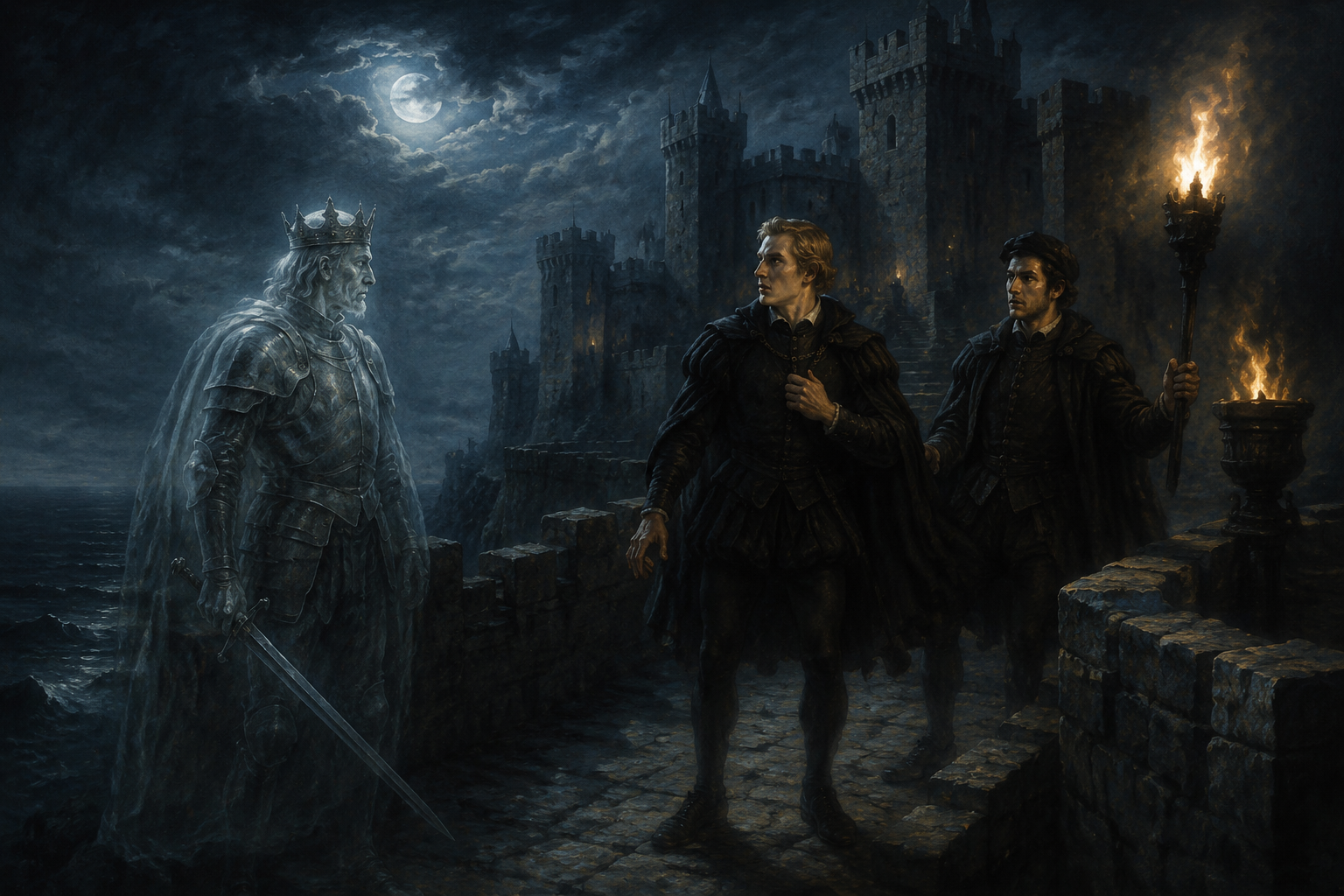
中文译本

第二场:城堡中的一室

国王、王后、罗森格兰兹、吉尔登斯吞及侍从等上。

国王。
欢迎,亲爱的罗森格兰兹和吉尔登斯吞!
我们不但非常渴望见到你们,
更因为需要倚重你们,才如此
仓促派人相请。你们必定已听说
哈姆雷特的变化;我这么称呼它,
是因为他外表也好,内心也好,
都不再是原来的模样。除了他父亲的死,
究竟还有什么能把他
如此推出自我认知之外,
我实在无从猜想。我恳求二位,
既然你们自幼和他一同长大,
对他的少年性情又是如此熟谙,
请不辞在此,在我们的宫廷中
稍作逗留,借你们的陪伴,
引他转向欢乐,并且尽可能
趁合适的机会去探知,
是否有什么我们未知之事在折磨着他,
一旦查明,就属于我们补救的范围。

乔特鲁德。
两位好先生,他常常说起你们,
我敢说,这世上再没有两个人
能让他更亲近。若你们肯赏光,
对我们表示这般殷勤与美意,
陪我们消磨片刻光阴,
为我们的期盼增些助益与收获,
你们的探望必将得到恰如
国王铭记般的谢意。

罗森格兰兹。
二位陛下
凭你们对我们拥有的至上权力,
大可将你们的旨意直接吩咐下来,
不必用请。

吉尔登斯吞。
我们二人遵命,
在此全心全意,把我们的效力
自由地奉献在你们脚下,
听凭差遣。

国王。
多谢,罗森格兰兹和温良的吉尔登斯吞。

乔特鲁德。
多谢,吉尔登斯吞和温良的罗森格兰兹。
我恳请你们立刻去看看
我那变得太厉害的儿子。你们几个,
领这两位先生到哈姆雷特那儿去。

吉尔登斯吞。
愿上天使我们此行与我们的作为,
于他愉快而有益。

乔特鲁德。
嗯,阿门。

〔罗森格兰兹、吉尔登斯吞及数侍从下。〕

波洛涅斯上。

波洛涅斯。
出使挪威的使臣,我的好主公,
欣然回来了。

国王。
你从来都是好消息的父亲。

波洛涅斯。
是吗,主公?请您相信,我的好君王,
我守着我的本分,正如我守着我的灵魂,
一并对上帝、一并对我仁慈的国王:
而且我想,——否则我这副头脑
追踪韬略的路径,便不如
它从前那般精准了——我已经找到了
哈姆雷特发疯的真正根由。

国王。
哦,快说那个,我正盼着听。

波洛涅斯。
先接见使臣吧;
我的消息将是那盛宴后的佳果。

国王。
你亲自去礼遇他们,带他们进来。

〔波洛涅斯下。〕

他告诉我,我亲爱的王后,他已经找到
你儿子一切心病的总源头。

乔特鲁德。
我疑心不是别的,就是那桩主因——
他父亲的死,和我们过于仓促的婚姻。

国王。
好,我们且细细盘问他。

波洛涅斯率伏尔提曼德与科尼律斯上。

欢迎,我的好朋友!
说吧,伏尔提曼德,我们的挪威兄长有何答复?

伏尔提曼德。
敬祝洪福与心愿圆满达成。
甫一接信,他便传令制止
他侄子所征募的兵员,因在他看来,
那些军备原是针对波兰人;
然而细加查察,他方知那确乎
是对准陛下而来;痛心于自己
病弱、老迈、无能竟遭人欺罔,
便下令将福丁布拉斯拘押;他当下遵从,
领受了挪威王的训斥;最后
在他叔父面前立誓,永不再
对陛下妄动干戈。
老挪威王大喜之下,
赐他岁俸三千克朗,
并委任他将前所征募的士卒
转用于征讨波兰人;
随信附有一纸恳请,写在此处,
〔递上一纸文书。〕
伏望陛下应允大军
借道贵国疆域,以行此举,
一切安全之规与通融之约,
俱依其中所列条款。

国王。
朕甚悦之;
待更得闲时,再细读、
答复并权衡此事。
当下有劳贤卿奔走,不胜感激。
先去歇息,今晚我们共宴相庆:
欢迎归国。

〔伏尔提曼德与科尼律斯下。〕

波洛涅斯。
此事已了结得甚好。
主上,娘娘,若去细论
威仪何为,臣职何谓,
白昼何以是白昼,黑夜何以是黑夜,光阴何以是光阴,
那便是徒耗黑夜、白昼与光阴了。
故而,既然简洁乃机智之魂,
而冗长则如四肢与浮饰,
我便简短说之。你们的贤郎是疯了。
我称其为疯;因若去说清什么是真疯,
那岂不就是除了疯,别无他物?
但此事暂且按下不表。

王后。
多些实在,少些铺排。

波洛涅斯。
娘娘,我发誓我全无铺排。
他疯了,这是实话:实话便是可惜;
而可惜之处在于它是实话。一句蠢话,
随它去吧,我决不再铺排一字。
且认他疯了便是。如此,所剩之事,
便是找出此果之因,
或更当说,此失之因,
因此番缺损之果,必有起因。
这便是所剩之事,而所剩之事如此。细听,
我有一女——是说女儿尚在我所管之时,就在此刻——
她谨守孝道与顺从,听好,
给了我这个。如今请揣摩,请猜度。
〔展信念诵。〕
致天仙,我灵魂的偶像,最是清丽无双的奥菲莉娅——
那是句坏话,一句粗鄙话;“清丽无双”是句粗鄙
话:但你们且听下去。
〔续诵。〕
这些;在她洁白佳美的酥胸前,这些,等等。

乔特鲁德。
这是哈姆雷特写给她的?

波洛涅斯。
好娘娘,请稍待片刻,我定如实禀告。
〔读信。〕
纵然你怀疑星辰是火,
怀疑太阳不曾移挪,
怀疑真理惯会说谎,
切莫怀疑我的衷肠。

哦,亲爱的奥菲莉娅,我不擅长摆弄这些诗律,也没有才情去计算我的叹息。但我最爱你,哦,最最好的人,请相信这一点。再会。
永远属于你的,最亲爱的小姐,只要这副躯壳还属于他,
哈姆雷特。
这是小女出于恭顺呈与我看的;此外,她还将他如何追求、何时何地、用什么方法、说了哪些言语,都一一告诉了我。

国王。
那么她是怎么对待他的爱的?

波洛涅斯。
您看我是什么样的人?

国王。
一个忠信可敬的人。

波洛涅斯。
我正乐于证明如此。可是,您会作何感想,要是我眼见这份火热的爱情已经展翅翱翔——我确实早已察觉——并且,我必须告诉您,那是在小女禀告我之前,您,或者我恭顺的娘娘,陛下的王后,会作何感想,要是我自甘作那书桌或记事板,或是对此闭眼锁心,哑口无言,又或者是漠不关心地坐视这段恋情,您会作何感想?不,我立刻便行动起来,这样对我家年轻的小姐开了口:’哈姆雷特殿下是一位王子,绝非你的星辰。此事断不可行。‘然后我给她定下规矩,要她深锁闺中,不可再去会他,不可接待信使,不可收受礼物。她听从了我的劝诫,领受了果实。而他遭到拒绝之后,——长话短说——便坠入了忧愁,继而食不下咽,继而彻夜不眠,继而萎靡不振,继而神魂颠倒,就这样每况愈下,陷入如今我们大家都在哀叹的癫狂之中。

国王。
你以为就是这个原因?

乔特鲁德。
很可能是的,极有可能。

波洛涅斯。
我可曾有过这样的时刻,我很想知道,就是我斩钉截铁地说’事情就是这样‘,结果却证明并非如此?

国王。
据我所知,并没有。

波洛涅斯。
把这个从这个上拿掉,如果事情并非如此。
〔指自己的头和肩膀。〕
只要抓住线索,我定会找出真相所在,即便那真相真真藏在中心。

国王。
我们怎样才能再试一试?

波洛涅斯。
您知道,他有时会一连四个小时,就在这殿廊里走来走去。

乔特鲁德。
他确实如此。

波洛涅斯。
到时候我就放我女儿来见他。
你我二人且躲在挂毡后面,
细看他们相会。他若是不爱她,
若不是因此失去了理智,
那我也别做什么辅政大臣了,
不如回乡下去种地赶车。

国王。
我们就试试看。

〔哈姆雷特上,手持书卷阅读。〕

王后。
可是瞧,那可怜的人满脸愁容,读着书来了。

波洛涅斯。
请回避,我恳请二位都请回避,
我这就去跟他攀谈。哦,请容我行事。

〔国王、王后及侍从下。〕

您好吗,我的好哈姆雷特殿下?

哈姆雷特。
好,多谢上帝。

波洛涅斯。
殿下,您认得我吗?

哈姆雷特。
认得再清楚不过。你是个卖鱼的。

波洛涅斯。
我不是,殿下。

哈姆雷特。
那我倒希望你是个那么老实的人。

波洛涅斯。
老实,殿下?

哈姆雷特。
是啊,先生,在这世上,要做个老实人,一万人里头才挑得出一个来。

波洛涅斯。
这话千真万确,殿下。

哈姆雷特。
因为要是太阳在一条死狗身上养出蛆来,那可是一块好得能让人亲嘴的臭肉——
你有个女儿吧?

波洛涅斯。
有的,殿下。

哈姆雷特。
别让她在太阳底下走路。怀胎是福气,可别让你女儿怀上。朋友,当心着点。

波洛涅斯。
您这话从何说起?〔旁白。〕还在一个劲儿地提我女儿。可他起初并没有认出我来;竟说我是个卖鱼的。他病得不轻,病得不轻。说真的,我年轻的时候也为了爱情受过不少极端的苦楚,差不多也跟他这样子。我再跟他谈谈。——殿下,您读的是什么?

哈姆雷特。
字,字,字。

波洛涅斯。
我是说内容,殿下,什么内容?

哈姆雷特。
谁跟谁交手?

波洛涅斯。
我是说您读的书里讲的是什么内容,殿下。

哈姆雷特。
全是诽谤,先生。因为这个刻薄的家伙说,老年人长着灰白胡子,脸上布满皱纹,眼睛里淌出浓浓的琥珀和梅树胶,还说他们满脑子空空,外加两条腿软得不行。这些,先生,虽然我极有力量、极有把握地深信不疑,但把这些话白纸黑字写下来,我觉得终究不够体面。因为您自己,先生,总有一天也会跟我一样老——假如您能像螃蟹一样倒着走的话。

波洛涅斯。
〔旁白。〕这虽是疯狂,却有条理。——殿下,您要不要到外边去走走,透透气?

哈姆雷特。
走进我的坟墓里去?

波洛涅斯。
确实,这话倒是不着边际。〔旁白〕他的回答有时多么意味深长!那是疯狂常能碰巧撞上的妙语,而理智和清醒反倒不能这样巧妙地表达出来。我要离开他,然后立刻设法让他和我女儿见面。尊贵的大人,我谨此极谦卑地向您告辞。

哈姆雷特。
先生,您无法从我这里拿去任何我更乐意舍弃的东西了,除了我的生命,除了我的生命,除了我的生命。

波洛涅斯。
再会,大人。

哈姆雷特。
这些缠人的老傻瓜。

〔罗森格兰兹与吉尔登斯吞上。〕

波洛涅斯。
你们去找哈姆雷特大人;他就在那边。

罗森格兰兹。
〔对波洛涅斯。〕上帝保佑您,先生。

〔波洛涅斯下。〕

吉尔登斯吞。
尊贵的大人!

罗森格兰兹。
我最亲爱的大人!

哈姆雷特。
我的好朋友们!你好吗,吉尔登斯吞?啊,罗森格兰兹。好小子们,你们俩都好吗?

罗森格兰兹。
像大地上一群寻常的凡人

吉尔登斯吞。
我们庆幸自己不过分庆幸;
在命运女神的帽子上,我们不是最顶端的那颗纽扣。

哈姆雷特。
也不是她鞋底上的东西

罗森格兰兹。
也不是,大人。

哈姆雷特。
那么你们住在她腰部的地方,或者在她恩宠的中央?

吉尔登斯吞。
说实话,我们是她的私处。

哈姆雷特。
在命运女神的私处?啊,完全正确;她是个婊子。有什么消息?

罗森格兰兹。
没有,大人,只是世界变得诚实了。

哈姆雷特。
那么末日审判近了。可你们的消息不真实。让我更具体地问问:我的好朋友们,你们在命运女神手里犯了什么过错,让她把你们送到这监狱里来?

吉尔登斯吞。
监狱,大人?

哈姆雷特。
丹麦是个监狱。

罗森格兰兹。
那整个世界也是一个。

哈姆雷特。
不错的一个;里面有许多间牢房、监禁室和地牢,丹麦是其中最坏的一间。

罗森格兰兹。
我们不这么想,大人。

哈姆雷特。
那么对你们来说就不是了;因为世间本无所谓善恶,全凭思想所定。对我来说它是个监狱。

罗森格兰兹。
那么,是您的野心使它成了监狱;它对于您的心胸过于狭窄了。

哈姆雷特。
上帝啊,我本可以束缚在一只胡桃壳里,自命为拥有无限空间的君王,要不是我老做噩梦的话。

吉尔登斯吞。
那些梦,其实正是野心;因为野心家自身的本质,不过是一个梦的影子。

哈姆雷特。
一个梦本身也不过是一个影子。

罗森格兰兹。
确实,我觉得野心这东西,轻飘飘的空空荡荡,充其量不过是影子的影子罢了。

哈姆雷特。
那么,我们的乞丐倒是实在的身体,而我们的君王和那些趾高气扬的英雄,反倒是乞丐的影子了。我们到宫里去好吗?因为我跟你们说实在话,我没法讲道理了。

罗森格兰兹与吉尔登斯吞。
我们愿意伺候您。

哈姆雷特。
哪来的话。我不会把你们列为我其余的仆人一类;因为,跟你们说句老实人的话,我身边那帮伺候的人,真是糟糕透顶。不过,凭着我们交情的老路,你们到埃尔西诺来做什么?

罗森格兰兹。
来拜访您,殿下,没有别的事。

哈姆雷特。
我是个叫化子,连感谢的话也穷得很;但我还是谢谢你们。当然,亲爱的朋友,我这感谢恐怕连半便士都值不上。你们不是被召来的吧?是你们自己的意思吗?是出于自愿的拜访吗?来,老老实实对待我。来,来;别这样,说吧。

吉尔登斯吞。
我们该说什么呢,殿下?

哈姆雷特。
咦,随便什么,只要说到点子上。你们是被召来的;而且你们的神情里就透着一股招认的味道,你们这几分忠厚,还没本事把它遮掩过去。我知道,好国王和王后是差人把你们召来的。

罗森格兰兹。
为了什么目的呢,殿下?

哈姆雷特。
这个得由你们来告诉我。不过,我要恳求你们,凭着我们交情的本分,凭着我们青年时代意气相投,凭着我们的友情长存这点义务,凭着一个比我会说话的人所能拿来劝你们的其他更宝贵的交情,对我直截了当,明白说出来,你们究竟是被召来的,还是不是。

罗森格兰兹。
〔向吉尔登斯吞。〕你怎么说?

哈姆雷特。
〔旁白。〕嗯,那么,我可盯着你们了。你们要是还顾念我,就别闪躲。

吉尔登斯吞。
殿下,我们是奉命被召来的。

哈姆雷特。
我就告诉你为什么吧;这样我先把话挑明,你就不用费心套我的话,你们对国王和王后的保密工夫也一根羽毛都不用掉。近来——也不知是什么缘故——我失掉了一切欢乐,搁下了所有日常的锻炼;确实,我心境沉重得厉害,以至于这大好的大地,在我看来,也不过是一块荒凉的海角;这顶最卓越的苍穹,你瞧,这壮丽高悬的晴空,这镶嵌着金色火焰的庄严屋顶,哎,在我眼里,无非是一团乌烟瘴气的、叫人恶心的蒸气罢了。人是多么了不起的一件作品啊,理性多么高贵,能力多么无穷,仪态和举止多么修整端丽、令人赞叹;行动上多么像天使,智慧上多么像神明:世间的美景,万物的典范。可是,对我来说,这尘土的精华又算什么呢?人不能使我欢喜;不,女人也不能,虽然你那么笑着,好像是在说女人能。

罗森格兰兹。
殿下,我心里可没有这种念头。

哈姆雷特。
那我说“人不能使我欢喜”的时候,你为什么笑呢?

罗森格兰兹。
我是在想,殿下,要是人不讨你喜欢,那些伶人要从你这儿得到的款待可就像斋期的饮食一样寒碜了。我们在路上赶过了他们,他们这就到这儿来,要为您献艺。

哈姆雷特。
那演国王的将受到欢迎——他的陛下会从我这儿得到贡品;冒险的骑士可以挥他的剑盾;情郎不会白白叹气;脾气古怪的角色可以平平安安把他的戏份演完;小丑可以把那些肺活量浅薄的人逗得发笑;演小姐的可以痛痛快快说她的心事,要不然素体诗的韵脚可要一瘸一拐的了。他们是哪一班伶人

罗森格兰兹。
就是您从前那么喜欢的那一班——城里的悲剧班子。

哈姆雷特。
他们怎么跑起江湖来了?在一个固定的地方待着,论名声论收益,不是都更好吗?

罗森格兰兹。
我觉得,他们被禁演,是由于最近那桩新花样的缘故。

哈姆雷特。
他们还像我当年在城里时那样受人看重吗?还有那么多人追捧他们吗?

罗森格兰兹。
不,说真的,不行了。

哈姆雷特。
怎么回事?他们生锈了吗?

罗森格兰兹。
不,他们的演出倒还保持着一贯的水准;可是,殿下,如今有一窝孩子,一群小雏鹰,扯着嗓子尖声叫嚷,专在节骨眼儿上嚎叫,反而博得最蛮横的喝彩。眼下这些正当时兴,他们把那些普通戏台——他们就这么叫——糟蹋得不成样子,害得许多佩剑的爷们都怕了鹅毛笔,几乎不敢再往那儿去。

哈姆雷特。
怎么,他们是孩子吗?谁养着他们?他们的戏份儿是怎么算的?等他们嗓子一倒,不能再唱了,他们就不干这一行了吗?日后他们自己长大成人,也当了普通戏子——要是他们没有更好的出路,十有八九会这样——那时他们会不会说,那些写戏的害了他们,让他们当年破口大骂自己将来的营生?

罗森格兰兹。
说实话,两边闹得可厉害了;全国上下都不怕煽风点火,挑着他们斗。有一段日子,没人肯出钱买剧本,除非那诗人跟戏子在台本上先干上一架。

哈姆雷特。
这怎么可能?

吉尔登斯吞。
哦,可没少绞尽脑汁呢。

哈姆雷特。
那些孩子占了上风吗?

罗森格兰兹。
是啊,殿下,他们赢了;连赫拉克勒斯和他扛着的天球一块儿都给他们搬走了。

哈姆雷特。
这也并不算太稀奇;因为我叔父如今是丹麦国王了,那些当年我父亲在世时对着他做鬼脸的人,现在肯花二十、四十、五十、一百枚金币抢着买他一幅小小的画像。该死,这里头冥冥之中自有蹊跷,要是哲学能把它找出来就好了。

〔内喇叭奏花腔。〕

吉尔登斯吞。
戏子们到了。

哈姆雷特。
两位先生,欢迎你们来到艾尔西诺。来,把手伸给我。欢迎的排场总少不了礼数和客套;让我照这规矩向你们表示一番,免得我待会儿对戏子们的款待——告诉你们,我待会儿必定要对他们格外殷勤——在外人眼里显得比待你们更隆重。你们是受欢迎的。只不过我那叔父父亲和婶母母亲却上当了。

吉尔登斯吞。
在哪方面上当了,亲爱的殿下?

哈姆雷特。
我不过是西北偏北的那一点疯。风向正南的时候,我分得清笼子里的鹰跟路边的鹭。

波洛涅斯上。

波洛涅斯。
两位先生,祝你们安好。

哈姆雷特。
听着,吉尔登斯吞,还有你,——一边一只耳朵听好了。你们在那儿看见的那个大号婴儿,还没脱掉他的襁褓呢。

罗森格兰兹。
也许他是第二回裹进襁褓里去了;因为人家说,老人是第二次做孩子。

哈姆雷特。
我敢预言,他是来告诉我戏子们到了的消息。你们瞧着吧。——您说得对,先生;星期一早上,确实是那样来着。

波洛涅斯。
大人,我有消息要禀告您。

哈姆雷特。
大人,我有消息要禀告您。当年罗歇斯在罗马做伶人时——

波洛涅斯。
那些戏子已经到这儿了,大人。

哈姆雷特。
嗡嗡,嗡嗡。

波洛涅斯。
凭我的荣誉起誓。

哈姆雷特。
于是每个戏子都骑着驴子来了——

波洛涅斯。
世上最好的戏子,无论演悲剧、喜剧、历史剧、田园剧、田园喜剧、历史田园剧、悲剧历史剧、悲剧喜剧历史田园剧,还是演那不分幕的戏,或是那不受限制的诗篇。塞内加的沉重不嫌过,普劳图斯的轻巧也不嫌过,对于规矩和自由他们都拿捏自如。只有这些人。

哈姆雷特。
啊,耶弗他,以色列的士师,你曾有过何等珍宝!

波洛涅斯。
他有什么珍宝,大人?

哈姆雷特。
怎么——
“一个美丽的女儿,别无其他,
那女儿他爱得无比深切。”

波洛涅斯。
〔旁白。〕还是惦记着我的女儿。

哈姆雷特。
我不是说得对吗,老耶弗他?

波洛涅斯。
如果您叫我耶弗他,大人,那么我确实有一个女儿,我爱她无比深切。

哈姆雷特。
不,这可不合逻辑。

波洛涅斯。
那么什么合逻辑,大人?

哈姆雷特。
怎么,
天知道,全凭运数,
然后,你也知道,
事情就这么发生了,大概就是这样。
那首圣歌的头一行会告诉你更多。瞧,我的节略过来了。

〔四五个伶人上。〕

欢迎你们,各位师傅,欢迎所有人。看到你好我真高兴。欢迎,好朋友们。啊,我的老朋友!自从上次见你,你的脸已经加了胡须。你是到丹麦来要剔我的胡子吗?怎么,我的年轻小姐和情妇!圣母在上,小姐您比上次见面时离天更近了,足有一双厚底鞋的高度。祈祷上帝您的嗓门儿别像一枚不能流通的金币,在声音的圈里裂了缝。师傅们,全都欢迎。我们立刻就像法国放鹰人一样,见什么就扑什么。我们马上来一段台词。来,让我们尝尝你们的本事。来,来一段激昂的台词。

伶人甲。
哪一段台词,大人?

哈姆雷特。
我曾听你念过一段台词,可它从没上演过,就算演过,也不超过一次,因为那出戏,我记得,并不讨大众的喜欢,对一般人来说,那是鱼子酱。可是它——照我看来,以及那些在鉴赏力上比我更有权威的人看来——是一出极好的戏,场次安排妥帖,写得既质朴又巧妙。记得有人说过,台词里没有加佐料让词句变得油腻,字句之间也没有什么东西能让人指责作者矫揉造作,却称之为一种正派的手法,既健康又甜美,远胜于精雕细琢,漂亮得多。其中有一段台词,我特别喜欢。那是埃涅阿斯对狄多讲的故事,尤其是他讲到普里阿摩斯被杀的那一段。要是你还记得,就从这一行开始,让我想想,让我想想:
狰狞的皮洛斯,像希尔卡尼亚的猛兽——
不对,不是这样;是从皮洛斯开始——
狰狞的皮洛斯,他那乌黑的臂膀,
黑得像他的居心,当他蜷伏在
那不详的木马之中时,像是黑夜,
如今又把这片可怕黝黑的面目
涂上了更悲惨的纹章。从头到脚,
他浑身赤红,溅满了
父亲、母亲、女儿、儿子的鲜血,
被干裂的街道烘烤得凝结成块,
那街道还借出它们暴虐的、该死的火光
照亮那些卑鄙的杀戮。他烘烤在怒火与烈焰中,
浑身披着凝结的血块,
两眼像红宝石一般,这地狱般的皮洛斯
直寻那老祖宗普里阿摩斯。

就这样,你往下接吧。

波洛涅斯。
当着上帝的面,殿下,您念得真是好,字正腔圆,又有分寸。

伶人甲。
转眼间,剑锋只差希腊人毫厘。他那柄古剑,
不听手臂使唤,坠落在地,
抗拒号令。强弱悬殊,
皮洛斯直扑普里阿摩斯,盛怒之下,一剑劈空;
然而那致命剑刃挟带的风声,
已叫那失魂的老王仆倒。于是,无知的伊利昂,
仿佛感应了这一击,带着燃烧的冠顶
坍向基座,随着一声骇人的轰响
攫住了皮洛斯的耳朵。看啊,他那柄剑,
正朝德高望重的普里阿摩斯
皓白的头颅落下,竟似悬在半空。
于是,皮洛斯像个画里的暴君,伫立不动,
仿佛置身事外,既无意志,也无行动,
一无所为。
可正如我们常见,一场风暴来临之前,
天穹沉默,浮云停滞,
狂风喑哑,下界的大地
死一般沉寂,霎时间,骇人的雷霆
便撕裂长空;皮洛斯的停顿也是如此,
那被激醒的复仇驱他重新动作,
昔日独眼巨人的铁锤,砸向
那铸造了永恒坚韧的战神铠甲,
也不及皮洛斯那把淌血的剑刃
此刻劈在普里阿摩斯身上那般毫不留情。
滚开,滚开,你这婊子般的命运!天上众神啊,
开一场大会,剥夺她的权柄;
砸碎她的车轮,拆去所有辐条辋圈,
把那圆圆的轮毂从天堂山上滚下,
直落恶魔中间!_

波洛涅斯。
这太长了。

哈姆雷特。
它会跟你的胡子一道送去理发铺的。——请说下去。
他只想听段淫曲小调,要么讲个下流故事,不然就睡觉。
说下去;讲到赫卡柏。

伶人甲。
可是,啊,谁要是看见了那位蒙着头的王后,——

哈姆雷特。
“蒙着头的王后”?

波洛涅斯。
这词妙!“蒙着头的王后”真是妙。

伶人甲。
赤着脚奔来跑去,用泛滥的泪眼
威胁着火焰。一块破布裹着头
昔日戴过王冠的头颅;当作长袍,
围着她那干瘦而多产过度的腰身的,
是一条在惊惶中胡乱抓起的毡毯——
谁见此景,都会用饱蘸毒液的舌头
对命运之神发出叛逆的诅咒。
可是,倘若天神们亲眼看见她,
当她看见皮洛斯恶意地嬉戏,
用剑把他的丈夫的肢体砍成碎块,
她发出的那一声突然迸发的哀号,——
除非凡尘俗事完全不能打动他们,——
也定会叫天上炽热的星眸流出泪水,
让众神心生悲悯。

波洛涅斯。
瞧,他脸色都变了,眼里还含着泪呢。请你们,别再演下去了。

哈姆雷特。
好了。我很快会让你把剩下的部分念出来。——好大人,请您好好安置这些伶人,听见了吗,务必好好款待他们;因为他们可是这个时代的缩影和简史。您死后落个糟糕的墓志铭,也强过生前被他们非议。

波洛涅斯。
大人,我会按他们应得的份儿来对待他们。

哈姆雷特。
老天爷,老兄,得更好才行!要是按每个人应得的份儿来对待,那谁能逃得过一顿鞭子?按您自己的荣誉和尊严来款待他们吧。他们越是不配,您的慷慨就越是显出美德。带他们进去吧。

波洛涅斯。
来吧,各位。

哈姆雷特。
跟他去吧,朋友们。我们明天要听一出戏。

〔波洛涅斯率众伶人下,仅留伶人甲。〕

你听见了吗,老朋友?你们能演《贡扎古之死》吗?

伶人甲。
能演,大人。

哈姆雷特。
我们明晚就来演这出。要是我写一段大概十二行或十六行的台词,需要时插进去,你能背得下来吗?

伶人甲。
能,大人。

哈姆雷特。
很好。跟上那位大人,注意别取笑他。

伶人甲下。〕

〔对罗森格兰兹及吉尔登斯吞。〕我的好朋友们,我们晚上再见。欢迎你们来到艾尔西诺。

罗森格兰兹。
好大人。

〔罗森格兰兹与吉尔登斯吞下。〕

哈姆雷特。
嗯,就这样,上帝保佑你们。现在只剩我一个人了。
哦,我真是个混账,是个乡愿的奴才!
这难道不怪异吗,单单这个伶人
不过是在一段虚构中,在激情的梦幻里,
就能把自己的灵魂逼得跟他那幻想合而为一,
以致于他的整个面容都因这激情的运作而惨白;
眼里噙着泪,神色恍恍惚惚,
声音断断续续,整个人的举止
全都配合着他的幻想?而这一切全不为什么!
就为了赫卡柏?
赫卡柏于他何干,他又于赫卡柏何干,
他竟要为她哭泣?要是他有了
我这样的动机和激情的由头,他会怎么做?
他会叫泪水淹没舞台,用骇人的台词
撕裂听众的耳鼓,
叫有罪的人发疯,叫清白的人惊惶,
让无知的人迷惑,并且当真震骇了
那眼与耳的官能本身。可是我呢,
一个迟钝的、泥坯似的无赖,像那做梦的约翰一般
恍惚,于我复仇的大计毫无感应,
半句话也说不出;不,哪怕是为了一个
他的社稷和最宝贵的生命
都遭了万劫不复的毒手的君王,也是如此。我是个懦夫吗?
谁管我叫恶棍,把我的脑壳劈开?
扯下我的胡子,吹到我脸上?
拧我的鼻子,把谎言直呛进我的嗓子眼,
深得像灌进肺里?谁这样对我?
哈!天杀的,我该受着:多亏我
长了一副鸽子肝,里面少不了一点
叫欺辱感到苦涩的胆汁,不然,
我早该叫这奴才的腐肉去喂肥天上
所有的鸢鹰了。血腥的、淫秽的恶棍!
毫不悔改、奸诈、淫荡、全无人伦的恶棍!
哦,报仇啊!
嘿,我真是头蠢驴!这可真叫英雄了,
我,一个遇害了的好父亲的儿子,
上天和地狱都催着我去复仇,
却像个娼妓似的,只好用言语来掏空我的心,
又像个真正的贱妇那样咒骂起来,
一个洗碗的厨娘!呸!真可耻!哼!
转起来吧,我的脑筋!我听说过,
犯了罪的人正坐在看戏,
被那剧情本身的巧妙所触动,
竟至于当下就供出了自己的罪行。
因为,谋杀,虽然没长舌头,却会借着
最奇妙的器官来说话。我要叫这些伶人
在我叔父面前,演一出戏,戏文就跟
我父亲被害的情形相仿佛。我要观察他的神色;
我要把他探到最痛处。他只要有一丝变色,
我就知道该怎么办。我见过的那个鬼魂
也许是魔鬼,魔鬼本就有能耐
扮作讨人喜欢的样子;对,也许
趁着我这虚弱和忧郁的性子,
——因为对这样的性情,他极有法力——
他来骗我,好叫我遭天谴。我要有
比这更确凿的证据。这出戏,
便是我用来捕捉那国王的良心的一张网。

ACT III / 第三幕
英文原文

ACT III

中文译本

第三幕

SCENE I. A room in the Castle. / 第一场:城堡中的一室
英文原文

SCENE I. A room in the Castle.

Enter King, Queen, Polonius, Ophelia, Rosencrantz and Guildenstern.

KING.
And can you by no drift of circumstance
Get from him why he puts on this confusion,
Grating so harshly all his days of quiet
With turbulent and dangerous lunacy?

ROSENCRANTZ.
He does confess he feels himself distracted,
But from what cause he will by no means speak.

GUILDENSTERN.
Nor do we find him forward to be sounded,
But with a crafty madness keeps aloof
When we would bring him on to some confession
Of his true state.

QUEEN.
Did he receive you well?

ROSENCRANTZ.
Most like a gentleman.

GUILDENSTERN.
But with much forcing of his disposition.

ROSENCRANTZ.
Niggard of question, but of our demands,
Most free in his reply.

QUEEN.
Did you assay him to any pastime?

ROSENCRANTZ.
Madam, it so fell out that certain players
We o’er-raught on the way. Of these we told him,
And there did seem in him a kind of joy
To hear of it. They are about the court,
And, as I think, they have already order
This night to play before him.

POLONIUS.
’Tis most true;
And he beseech’d me to entreat your Majesties
To hear and see the matter.

KING.
With all my heart; and it doth much content me
To hear him so inclin’d.
Good gentlemen, give him a further edge,
And drive his purpose on to these delights.

ROSENCRANTZ.
We shall, my lord.

[Exeunt Rosencrantz and Guildenstern.]

KING.
Sweet Gertrude, leave us too,
For we have closely sent for Hamlet hither,
That he, as ’twere by accident, may here
Affront Ophelia.
Her father and myself, lawful espials,
Will so bestow ourselves that, seeing unseen,
We may of their encounter frankly judge,
And gather by him, as he is behav’d,
If’t be th’affliction of his love or no
That thus he suffers for.

QUEEN.
I shall obey you.
And for your part, Ophelia, I do wish
That your good beauties be the happy cause
Of Hamlet’s wildness: so shall I hope your virtues
Will bring him to his wonted way again,
To both your honours.

OPHELIA.
Madam, I wish it may.

[Exit Queen.]

POLONIUS.
Ophelia, walk you here.—Gracious, so please you,
We will bestow ourselves.—[To Ophelia.] Read on this book,
That show of such an exercise may colour
Your loneliness.—We are oft to blame in this,
’Tis too much prov’d, that with devotion’s visage
And pious action we do sugar o’er
The devil himself.

KING.
[Aside.] O ’tis too true!
How smart a lash that speech doth give my conscience!
The harlot’s cheek, beautied with plastering art,
Is not more ugly to the thing that helps it
Than is my deed to my most painted word.
O heavy burden!

POLONIUS.
I hear him coming. Let’s withdraw, my lord.

[Exeunt King and Polonius.]

Enter Hamlet.

HAMLET.
To be, or not to be, that is the question:
Whether ’tis nobler in the mind to suffer
The slings and arrows of outrageous fortune,
Or to take arms against a sea of troubles,
And by opposing end them? To die—to sleep,
No more; and by a sleep to say we end
The heart-ache, and the thousand natural shocks
That flesh is heir to: ’tis a consummation
Devoutly to be wish’d. To die, to sleep.
To sleep, perchance to dream—ay, there’s the rub,
For in that sleep of death what dreams may come,
When we have shuffled off this mortal coil,
Must give us pause. There’s the respect
That makes calamity of so long life.
For who would bear the whips and scorns of time,
The oppressor’s wrong, the proud man’s contumely,
The pangs of dispriz’d love, the law’s delay,
The insolence of office, and the spurns
That patient merit of the unworthy takes,
When he himself might his quietus make
With a bare bodkin? Who would these fardels bear,
To grunt and sweat under a weary life,
But that the dread of something after death,
The undiscover’d country, from whose bourn
No traveller returns, puzzles the will,
And makes us rather bear those ills we have
Than fly to others that we know not of?
Thus conscience does make cowards of us all,
And thus the native hue of resolution
Is sicklied o’er with the pale cast of thought,
And enterprises of great pith and moment,
With this regard their currents turn awry
And lose the name of action. Soft you now,
The fair Ophelia! Nymph, in thy orisons
Be all my sins remember’d.

OPHELIA.
Good my lord,
How does your honour for this many a day?

HAMLET.
I humbly thank you; well, well, well.

OPHELIA.
My lord, I have remembrances of yours
That I have longed long to re-deliver.
I pray you, now receive them.

HAMLET.
No, not I.
I never gave you aught.

OPHELIA.
My honour’d lord, you know right well you did,
And with them words of so sweet breath compos’d
As made the things more rich; their perfume lost,
Take these again; for to the noble mind
Rich gifts wax poor when givers prove unkind.
There, my lord.

HAMLET.
Ha, ha! Are you honest?

OPHELIA.
My lord?

HAMLET.
Are you fair?

OPHELIA.
What means your lordship?

HAMLET.
That if you be honest and fair, your honesty should admit no discourse
to your beauty.

OPHELIA.
Could beauty, my lord, have better commerce than with honesty?

HAMLET.
Ay, truly; for the power of beauty will sooner transform honesty from
what it is to a bawd than the force of honesty can translate beauty
into his likeness. This was sometime a paradox, but now the time gives
it proof. I did love you once.

OPHELIA.
Indeed, my lord, you made me believe so.

HAMLET.
You should not have believed me; for virtue cannot so inoculate our old
stock but we shall relish of it. I loved you not.

OPHELIA.
I was the more deceived.

HAMLET.
Get thee to a nunnery. Why wouldst thou be a breeder of sinners? I am
myself indifferent honest; but yet I could accuse me of such things
that it were better my mother had not borne me. I am very proud,
revengeful, ambitious, with more offences at my beck than I have
thoughts to put them in, imagination to give them shape, or time to act
them in. What should such fellows as I do crawling between earth and
heaven? We are arrant knaves all, believe none of us. Go thy ways to a
nunnery. Where’s your father?

OPHELIA.
At home, my lord.

HAMLET.
Let the doors be shut upon him, that he may play the fool nowhere but
in’s own house. Farewell.

OPHELIA.
O help him, you sweet heavens!

HAMLET.
If thou dost marry, I’ll give thee this plague for thy dowry. Be thou
as chaste as ice, as pure as snow, thou shalt not escape calumny. Get
thee to a nunnery, go: farewell. Or if thou wilt needs marry, marry a
fool; for wise men know well enough what monsters you make of them. To
a nunnery, go; and quickly too. Farewell.

OPHELIA.
O heavenly powers, restore him!

HAMLET.
I have heard of your paintings too, well enough. God hath given you one
face, and you make yourselves another. You jig, you amble, and you
lisp, and nickname God’s creatures, and make your wantonness your
ignorance. Go to, I’ll no more on’t, it hath made me mad. I say, we
will have no more marriages. Those that are married already, all but
one, shall live; the rest shall keep as they are. To a nunnery, go.

[Exit.]

OPHELIA.
O, what a noble mind is here o’erthrown!
The courtier’s, soldier’s, scholar’s, eye, tongue, sword,
Th’expectancy and rose of the fair state,
The glass of fashion and the mould of form,
Th’observ’d of all observers, quite, quite down!
And I, of ladies most deject and wretched,
That suck’d the honey of his music vows,
Now see that noble and most sovereign reason,
Like sweet bells jangled out of tune and harsh,
That unmatch’d form and feature of blown youth
Blasted with ecstasy. O woe is me,
T’have seen what I have seen, see what I see.

Enter King and Polonius.

KING.
Love? His affections do not that way tend,
Nor what he spake, though it lack’d form a little,
Was not like madness. There’s something in his soul
O’er which his melancholy sits on brood,
And I do doubt the hatch and the disclose
Will be some danger, which for to prevent,
I have in quick determination
Thus set it down: he shall with speed to England
For the demand of our neglected tribute:
Haply the seas and countries different,
With variable objects, shall expel
This something settled matter in his heart,
Whereon his brains still beating puts him thus
From fashion of himself. What think you on’t?

POLONIUS.
It shall do well. But yet do I believe
The origin and commencement of his grief
Sprung from neglected love. How now, Ophelia?
You need not tell us what Lord Hamlet said,
We heard it all. My lord, do as you please,
But if you hold it fit, after the play,
Let his queen mother all alone entreat him
To show his grief, let her be round with him,
And I’ll be plac’d, so please you, in the ear
Of all their conference. If she find him not,
To England send him; or confine him where
Your wisdom best shall think.

KING.
It shall be so.
Madness in great ones must not unwatch’d go.

[Exeunt.]

中文译本

第一场:城堡中的一室

国王、王后、波洛涅斯、奥菲莉娅、罗森格兰兹及吉尔登斯吞上。

国王。
难道你们就不能用任何旁敲侧击的办法,
从他嘴里探出他为何要装出这副迷乱的模样,
用这种狂暴而危险的神志不清,
如此刺耳地搅扰他所有的安宁时光?

罗森格兰兹。
他倒也承认自己觉得心神恍惚,
可究竟是什么缘故,他绝口不肯吐露。

吉尔登斯吞。
我们也没发现他乐意受人探问,
每当我们想引他说出一点
他真实状况的交代,
他就用一种狡黠的疯狂远远避开。

王后。
他接待你们的态度可好?

罗森格兰兹。
礼貌周全,十足像个绅士。

吉尔登斯吞。
可是显得十分勉强,很违逆他自己的性情。

罗森格兰兹。
他不大提问,可对我们的问话,
回答起来倒是毫无拘束。

王后。
你们可曾试着引他作什么消遣?

罗森格兰兹。
娘娘,事有凑巧,我们在路上
赶过了几个戏子。我们把这事告诉了他,
他听了之后,似乎露出了几分高兴。
他们就在这宫廷附近,
而且我想他们已经接到了吩咐,
今晚就要在他面前演一出戏。

波洛涅斯。
这话千真万确;
他还恳求我来恭请两位陛下
去听听看看这出戏呢。

国王。
我满心乐意;听到他这么有兴致,
我心里真是高兴极了。
好两位先生,再去火上浇油,
把他的心思往这些娱乐上头引。

罗森格兰兹。
遵命,陛下。

〔罗森格兰兹与吉尔登斯吞下。〕

国王。
亲爱的乔特鲁德,你也暂且离开我们,
因为我们已暗中差人去请哈姆雷特到这儿来,
好让他,仿佛是出于偶然,在这儿
撞见奥菲莉娅。
她的父亲和我,作为合情合法的密探,
自会躲到这样一个地方去,看不见他们,却能看见一切,
坦然地判明他们这次会面的情形,
并且从他的举止上断定,
他所遭受的痛苦
究竟是不是因为恋爱的折磨。

王后。
我这就听从你的吩咐。
至于你呢,奥菲莉娅,我只愿
你那娇好的容貌正是哈姆雷特癫狂的福因;
这样我就盼着你的美德
能把他引回他往日的常轨,
那对你们两人的名声都体面。

奥菲莉娅。
娘娘,但愿如此。

〔王后下。〕

波洛涅斯。
奥菲莉娅,你就在这儿走走。——国王陛下,您若不见怪,
我们就各就各位吧。——〔向奥菲莉娅。〕你念这本书,
显出一副用功的模样,这可以遮掩
你为何独自在此。——我们在这上头常该责备,
——这事早已充分证明——人们偏能用虔诚的面孔
和圣洁的行动,去给魔鬼本身
裹上一层糖衣。

国王。 〔旁白。〕
啊,这话太对了!

国王。
〔旁白。〕哦,这话太真切了!
这番话何等犀利地鞭笞着我的良心!
娼妓那施了粉黛的面颊,比起那助它妖艳的脂粉,
固然丑陋,可比起我那用浓墨重彩的词句装点的行径,
它还不算更丑。
哦,沉重的负担!

波洛涅斯。
我听见他来了。陛下,我们且退下吧。

〔国王与波洛涅斯下。〕

哈姆雷特上。

哈姆雷特。
活下去,还是不活,这是个问题:
究竟哪样更高贵,在内心忍受
那暴虐命运的投石弹弓与箭矢,
还是拿起武器,面对一片烦恼的汪洋,
用反抗将它们了结?死去——睡去,
不再有更多;而借着一场沉睡,我们说我们终结了
那心头的痛楚,以及肉体天生要承受的
千百种自然的打击:这正是
热切祈求的圆满结局。死去,睡去。
睡去,或许还有梦——唉,难就难在这里;
因为在那死亡的沉睡中,当我们摆脱了
这凡胎肉身的牵缠,究竟会有些什么梦来临,
不得不令我们踌躇。正是这个顾虑,
使苦难的生命变得如此漫长。
谁人甘愿承受时间的鞭笞与嘲弄,
压迫者的横行,傲慢者的辱蔑,
被鄙夷的爱情之痛,法律的延宕,
官吏的骄横,以及安分守己的贤德
从卑鄙小人那里领受的拳打脚踢,
如果他只消用一柄小小的匕首,
便可以让自己获得永久的解脱?谁人甘愿背着这些重担,
在烦劳的生活下呻吟流汗,
若不是因为惧怕死后的某种情形,
那无人归来的、尚未被发现的国度,
使我们的意志困惑动摇,
宁肯忍受这身已遭的灾祸,
也不愿飞向那未知的别种苦难?
就这样,瞻前顾后把我们全变成了懦夫,
就这样,决断本色的赤诚,
也被思虑的惨淡光影罩上了病容,
而那些宏大而紧要的壮举,
也因这番顾虑而扭转了流向,
丧失了行动的名号。——且慢,现在放轻声些,
美丽的奥菲莉娅来了!——仙女啊,在你的祷告里,
请记下我所有的罪孽。

奥菲莉娅。
我的好殿下,
这些天来,您贵体可安好?

哈姆雷特。
我谦卑地谢过您;好,好,好。

奥菲莉娅。
殿下,我这里有几件您的纪念品,
我早就想奉还给您的。
我请求您,此刻就收下吧。

哈姆雷特。
不,我不会收。
我从未给过你什么。

奥菲莉娅。
尊贵的殿下,您很清楚您给过,
而且伴同这些礼物,您还曾吐露甜蜜芬芳的词句,
使这些东西更显贵重;那芬芳既已消散,
请把这原物收回吧;因为对于一颗高尚的心,
一旦赠予者被证明无情无义,再贵重的礼物也会变得菲薄。
给您,殿下。

哈姆雷特。
哈,哈!你诚实吗?

奥菲莉娅。
殿下?

哈姆雷特。
你美丽吗?

奥菲莉娅。
殿下是什么意思?

哈姆雷特。
我的意思是,假如你又诚实又美丽,你的诚实就该拒绝跟你的美貌来往。

奥菲莉娅。
殿下,美貌除了跟诚实结交,还能有更好的交往吗?

哈姆雷特。
嗯,真的;因为美貌的力量很快就会把诚实从它本来的样子变成拉皮条的,而诚实的力量却没法把美貌变成它自己的模样。这话从前是个悖论,可如今这世道给它提供了证据。我从前确实爱过你。

奥菲莉娅。
真的,殿下,您让我这样相信过。

哈姆雷特。
你本不该相信我;因为美德没法那样嫁接到我们这株老树干上,让我们不带着原来的气味。我没爱过你。

奥菲莉娅。
我更是受骗了。

哈姆雷特。
你进尼姑庵去吧。干吗要做一个孽种的生育者?我自己还算是个过得去的正派人;可是我能指控自己犯下那样的过错,倒不如我母亲没把我生下来更好。我非常骄傲,记仇,野心勃勃,我随手可以犯下的罪过,比我能想到去做的、能想象出形状的、或有时间去实施的还要多。像我这样的家伙,在天堂与大地之间爬来爬去,又算什么呢?我们都是彻头彻尾的混蛋,谁也别信。走你的路,进尼姑庵去吧。你父亲在哪儿?

奥菲莉娅。
在家里,殿下。

哈姆雷特。
把门关紧了,让他除了在自己家里,别处没地方装傻吧。再会。

奥菲莉娅。
啊,帮帮他吧,仁慈的上天!

哈姆雷特。
要是你嫁人,我给你这一句诅咒当你的嫁妆吧。就算你像冰一样贞洁,像雪一样纯净,你也逃不掉诽谤。进尼姑庵去吧,去;再会。要么,要是你非嫁人不可,就嫁个傻瓜吧;因为聪明人都清清楚楚地知道,你们会把他们变成什么样的怪物。去尼姑庵吧,去;还得快点。再会。

奥菲莉娅。
天上的力量啊,恢复他的神志吧!

哈姆雷特。
我也听够了你们涂脂抹粉的事。上帝给了你们一张脸,你们又给自己另做了一张。你们扭着走,迈着碎步,咬着舌说话,给上帝的造物乱起绰号,把你们的放荡说成无知。算了吧,我懒得再说了,这些事已经把我气疯了。我说,我们再也不要什么婚姻了。那些已经结了婚的,除了一个,全都活着;剩下的人就保持现在这样吧。进尼姑庵去吧,去。

〔下。〕

奥菲莉娅。
啊,多么高贵的一颗心就这样倾覆了!
朝臣的明眸,军人的利剑,学者的舌辩,
这美好邦国的期望与娇花,
时尚的明镜,礼仪的典范,
万众瞩目的焦点,竟彻底、彻底塌陷了!
而我,在所有女子中最卑贱、最悲苦,
曾啜饮他音乐般誓言的甘蜜,
如今眼见那高贵而至尊的理性,
像甜美的钟声乱响,走了调,刺耳难听;
那风华正茂的无匹风姿与容貌
竟被迷狂摧折。啊,我好苦啊,
既见过曾经所见,又目睹今之所见。

〔国王与波洛涅斯上。〕

国王。
爱情?他的心思并不在这方面,
他刚才的话,虽然有些语无伦次,
也不像疯癫。他灵魂深处定有某种东西
他的忧郁正坐在上面孵育,
我担心这孵化出来的,披露出来的,
将是某种危险;为了预防这一点,
我已迅速作出决定,就这样定下来:
他必须火速前去英格兰,
追索那笔久未缴纳的贡赋。
也许大海和异国的风物,
种种不同的景象,会驱除
这股郁结在他心头的无名积物,
他的脑筋不断撞击在这上面,
使他失去了常态。你对此有何看法?

波洛涅斯。
这样很好。不过我还是相信,
他悲伤的起因和源头
来自遭到冷落的爱情。——怎么样,奥菲莉娅?
你不必告诉我们哈姆雷特殿下说了什么,
我们全听见了。陛下,就按您的意思办吧。
不过您要是觉得合适,等演完戏之后,
让他的母后单独恳求他
吐露悲伤,让她直截了当地盘问他,
而我,如蒙允准,就躲在能听见
他们全部谈话的地方。要是她问不出所以然,
就送他去英格兰,或者凭您圣明,
把他拘禁在您认为最合适的地方。

国王。
就这么办。
大人物的疯癫绝不可不加监视。

〔同下。〕

SCENE II. A hall in the Castle. / 第二场:城堡中的厅堂
英文原文

SCENE II. A hall in the Castle.

Enter Hamlet and certain Players.

HAMLET.
Speak the speech, I pray you, as I pronounced it to you, trippingly on
the tongue. But if you mouth it, as many of your players do, I had as
lief the town-crier spoke my lines. Nor do not saw the air too much
with your hand, thus, but use all gently; for in the very torrent,
tempest, and, as I may say, whirlwind of passion, you must acquire and
beget a temperance that may give it smoothness. O, it offends me to the
soul to hear a robustious periwig-pated fellow tear a passion to
tatters, to very rags, to split the ears of the groundlings, who, for
the most part, are capable of nothing but inexplicable dumb shows and
noise. I would have such a fellow whipped for o’erdoing Termagant. It
out-Herods Herod. Pray you avoid it.

FIRST PLAYER.
I warrant your honour.

HAMLET.
Be not too tame neither; but let your own discretion be your tutor.
Suit the action to the word, the word to the action, with this special
observance, that you o’erstep not the modesty of nature; for anything
so overdone is from the purpose of playing, whose end, both at the
first and now, was and is, to hold as ’twere the mirror up to nature;
to show virtue her own feature, scorn her own image, and the very age
and body of the time his form and pressure. Now, this overdone, or come
tardy off, though it make the unskilful laugh, cannot but make the
judicious grieve; the censure of the which one must in your allowance
o’erweigh a whole theatre of others. O, there be players that I have
seen play—and heard others praise, and that highly—not to speak it
profanely, that, neither having the accent of Christians, nor the gait
of Christian, pagan, nor man, have so strutted and bellowed that I have
thought some of Nature’s journeymen had made men, and not made them
well, they imitated humanity so abominably.

FIRST PLAYER.
I hope we have reform’d that indifferently with us, sir.

HAMLET.
O reform it altogether. And let those that play your clowns speak no
more than is set down for them. For there be of them that will
themselves laugh, to set on some quantity of barren spectators to laugh
too, though in the meantime some necessary question of the play be then
to be considered. That’s villainous, and shows a most pitiful ambition
in the fool that uses it. Go make you ready.

[Exeunt Players.]

Enter Polonius, Rosencrantz and Guildenstern.

How now, my lord?
Will the King hear this piece of work?

POLONIUS.
And the Queen too, and that presently.

HAMLET.
Bid the players make haste.

[Exit Polonius.]

Will you two help to hasten them?

ROSENCRANTZ and GUILDENSTERN.
We will, my lord.

[Exeunt Rosencrantz and Guildenstern.]

HAMLET.
What ho, Horatio!

Enter Horatio.

HORATIO.
Here, sweet lord, at your service.

HAMLET.
Horatio, thou art e’en as just a man
As e’er my conversation cop’d withal.

HORATIO.
O my dear lord.

HAMLET.
Nay, do not think I flatter;
For what advancement may I hope from thee,
That no revenue hast, but thy good spirits
To feed and clothe thee? Why should the poor be flatter’d?
No, let the candied tongue lick absurd pomp,
And crook the pregnant hinges of the knee
Where thrift may follow fawning. Dost thou hear?
Since my dear soul was mistress of her choice,
And could of men distinguish, her election
Hath seal’d thee for herself. For thou hast been
As one, in suffering all, that suffers nothing,
A man that Fortune’s buffets and rewards
Hast ta’en with equal thanks. And blessed are those
Whose blood and judgement are so well co-mingled
That they are not a pipe for Fortune’s finger
To sound what stop she please. Give me that man
That is not passion’s slave, and I will wear him
In my heart’s core, ay, in my heart of heart,
As I do thee. Something too much of this.
There is a play tonight before the King.
One scene of it comes near the circumstance
Which I have told thee, of my father’s death.
I prithee, when thou see’st that act a-foot,
Even with the very comment of thy soul
Observe mine uncle. If his occulted guilt
Do not itself unkennel in one speech,
It is a damned ghost that we have seen;
And my imaginations are as foul
As Vulcan’s stithy. Give him heedful note;
For I mine eyes will rivet to his face;
And after we will both our judgements join
In censure of his seeming.

HORATIO.
Well, my lord.
If he steal aught the whilst this play is playing,
And ’scape detecting, I will pay the theft.

HAMLET.
They are coming to the play. I must be idle.
Get you a place.

Danish march. A flourish. Enter King, Queen, Polonius, Ophelia,
Rosencrantz, Guildenstern and others.

KING.
How fares our cousin Hamlet?

HAMLET.
Excellent, i’ faith; of the chameleon’s dish: I eat the air,
promise-crammed: you cannot feed capons so.

KING.
I have nothing with this answer, Hamlet; these words are not mine.

HAMLET.
No, nor mine now. [To Polonius.] My lord, you play’d once i’
th’university, you say?

POLONIUS.
That did I, my lord, and was accounted a good actor.

HAMLET.
What did you enact?

POLONIUS.
I did enact Julius Caesar. I was kill’d i’ th’ Capitol. Brutus killed
me.

HAMLET.
It was a brute part of him to kill so capital a calf there. Be the
players ready?

ROSENCRANTZ.
Ay, my lord; they stay upon your patience.

QUEEN.
Come hither, my dear Hamlet, sit by me.

HAMLET.
No, good mother, here’s metal more attractive.

POLONIUS.
[To the King.] O ho! do you mark that?

HAMLET.
Lady, shall I lie in your lap?

[Lying down at Ophelia’s feet.]

OPHELIA.
No, my lord.

HAMLET.
I mean, my head upon your lap?

OPHELIA.
Ay, my lord.

HAMLET.
Do you think I meant country matters?

OPHELIA.
I think nothing, my lord.

HAMLET.
That’s a fair thought to lie between maids’ legs.

OPHELIA.
What is, my lord?

HAMLET.
Nothing.

OPHELIA.
You are merry, my lord.

HAMLET.
Who, I?

OPHELIA.
Ay, my lord.

HAMLET.
O God, your only jig-maker! What should a man do but be merry? For look
you how cheerfully my mother looks, and my father died within’s two
hours.

OPHELIA.
Nay, ’tis twice two months, my lord.

HAMLET.
So long? Nay then, let the devil wear black, for I’ll have a suit of
sables. O heavens! die two months ago, and not forgotten yet? Then
there’s hope a great man’s memory may outlive his life half a year. But
by’r lady, he must build churches then; or else shall he suffer not
thinking on, with the hobby-horse, whose epitaph is ‘For, O, for O, the
hobby-horse is forgot!’

Trumpets sound. The dumb show enters.

Enter a King and a Queen very lovingly; the Queen embracing him and he
her. She kneels, and makes show of protestation unto him. He takes her
up, and declines his head upon her neck. Lays him down upon a bank of
flowers. She, seeing him asleep, leaves him. Anon comes in a fellow,
takes off his crown, kisses it, pours poison in the King’s ears, and
exits. The Queen returns, finds the King dead, and makes passionate
action. The Poisoner with some three or four Mutes, comes in again,
seeming to lament with her. The dead body is carried away. The Poisoner
woos the Queen with gifts. She seems loth and unwilling awhile, but in
the end accepts his love.

[Exeunt.]

OPHELIA.
What means this, my lord?

HAMLET.
Marry, this is miching mallecho; it means mischief.

OPHELIA.
Belike this show imports the argument of the play.

Enter Prologue.

HAMLET.
We shall know by this fellow: the players cannot keep counsel; they’ll
tell all.

OPHELIA.
Will they tell us what this show meant?

HAMLET.
Ay, or any show that you’ll show him. Be not you ashamed to show, he’ll
not shame to tell you what it means.

OPHELIA.
You are naught, you are naught: I’ll mark the play.

PROLOGUE.
For us, and for our tragedy,
Here stooping to your clemency,
We beg your hearing patiently.

HAMLET.
Is this a prologue, or the posy of a ring?

OPHELIA.
’Tis brief, my lord.

HAMLET.
As woman’s love.

Enter a King and a Queen.

PLAYER KING.
Full thirty times hath Phoebus’ cart gone round
Neptune’s salt wash and Tellus’ orbed ground,
And thirty dozen moons with borrow’d sheen
About the world have times twelve thirties been,
Since love our hearts, and Hymen did our hands
Unite commutual in most sacred bands.

PLAYER QUEEN.
So many journeys may the sun and moon
Make us again count o’er ere love be done.
But, woe is me, you are so sick of late,
So far from cheer and from your former state,
That I distrust you. Yet, though I distrust,
Discomfort you, my lord, it nothing must:
For women’s fear and love holds quantity,
In neither aught, or in extremity.
Now what my love is, proof hath made you know,
And as my love is siz’d, my fear is so.
Where love is great, the littlest doubts are fear;
Where little fears grow great, great love grows there.

PLAYER KING.
Faith, I must leave thee, love, and shortly too:
My operant powers their functions leave to do:
And thou shalt live in this fair world behind,
Honour’d, belov’d, and haply one as kind
For husband shalt thou—

PLAYER QUEEN.
O confound the rest.
Such love must needs be treason in my breast.
In second husband let me be accurst!
None wed the second but who kill’d the first.

HAMLET.
[Aside.] Wormwood, wormwood.

PLAYER QUEEN.
The instances that second marriage move
Are base respects of thrift, but none of love.
A second time I kill my husband dead,
When second husband kisses me in bed.

PLAYER KING.
I do believe you think what now you speak;
But what we do determine, oft we break.
Purpose is but the slave to memory,
Of violent birth, but poor validity:
Which now, like fruit unripe, sticks on the tree,
But fall unshaken when they mellow be.
Most necessary ’tis that we forget
To pay ourselves what to ourselves is debt.
What to ourselves in passion we propose,
The passion ending, doth the purpose lose.
The violence of either grief or joy
Their own enactures with themselves destroy.
Where joy most revels, grief doth most lament;
Grief joys, joy grieves, on slender accident.
This world is not for aye; nor ’tis not strange
That even our loves should with our fortunes change,
For ’tis a question left us yet to prove,
Whether love lead fortune, or else fortune love.
The great man down, you mark his favourite flies,
The poor advanc’d makes friends of enemies;
And hitherto doth love on fortune tend:
For who not needs shall never lack a friend,
And who in want a hollow friend doth try,
Directly seasons him his enemy.
But orderly to end where I begun,
Our wills and fates do so contrary run
That our devices still are overthrown.
Our thoughts are ours, their ends none of our own.
So think thou wilt no second husband wed,
But die thy thoughts when thy first lord is dead.

PLAYER QUEEN.
Nor earth to me give food, nor heaven light,
Sport and repose lock from me day and night,
To desperation turn my trust and hope,
An anchor’s cheer in prison be my scope,
Each opposite that blanks the face of joy,
Meet what I would have well, and it destroy!
Both here and hence pursue me lasting strife,
If, once a widow, ever I be wife.

HAMLET.
[To Ophelia.] If she should break it now.

PLAYER KING.
’Tis deeply sworn. Sweet, leave me here awhile.
My spirits grow dull, and fain I would beguile
The tedious day with sleep.
[Sleeps.]

PLAYER QUEEN.
Sleep rock thy brain,
And never come mischance between us twain.

[Exit.]

HAMLET.
Madam, how like you this play?

QUEEN.
The lady protests too much, methinks.

HAMLET.
O, but she’ll keep her word.

KING.
Have you heard the argument? Is there no offence in’t?

HAMLET.
No, no, they do but jest, poison in jest; no offence i’ th’ world.

KING.
What do you call the play?

HAMLET.
The Mousetrap. Marry, how? Tropically. This play is the image of a
murder done in Vienna. Gonzago is the Duke’s name, his wife Baptista:
you shall see anon; ’tis a knavish piece of work: but what o’ that?
Your majesty, and we that have free souls, it touches us not. Let the
gall’d jade wince; our withers are unwrung.

Enter Lucianus.

This is one Lucianus, nephew to the King.

OPHELIA.
You are a good chorus, my lord.

HAMLET.
I could interpret between you and your love, if I could see the puppets
dallying.

OPHELIA.
You are keen, my lord, you are keen.

HAMLET.
It would cost you a groaning to take off my edge.

OPHELIA.
Still better, and worse.

HAMLET.
So you mistake your husbands.—Begin, murderer. Pox, leave thy damnable
faces, and begin. Come, the croaking raven doth bellow for revenge.

LUCIANUS.
Thoughts black, hands apt, drugs fit, and time agreeing,
Confederate season, else no creature seeing;
Thou mixture rank, of midnight weeds collected,
With Hecate’s ban thrice blasted, thrice infected,
Thy natural magic and dire property
On wholesome life usurp immediately.

[Pours the poison into the sleeper’s ears.]

HAMLET.
He poisons him i’ th’garden for’s estate. His name’s Gonzago. The story
is extant, and written in very choice Italian. You shall see anon how
the murderer gets the love of Gonzago’s wife.

OPHELIA.
The King rises.

HAMLET.
What, frighted with false fire?

QUEEN.
How fares my lord?

POLONIUS.
Give o’er the play.

KING.
Give me some light. Away.

All.
Lights, lights, lights.

[Exeunt all but Hamlet and Horatio.]

HAMLET.
Why, let the strucken deer go weep,
The hart ungalled play;
For some must watch, while some must sleep,
So runs the world away.
Would not this, sir, and a forest of feathers, if the rest of my
fortunes turn Turk with me; with two Provincial roses on my razed
shoes, get me a fellowship in a cry of players, sir?

HORATIO.
Half a share.

HAMLET.
A whole one, I.
For thou dost know, O Damon dear,
This realm dismantled was
Of Jove himself, and now reigns here
A very, very—pajock.

HORATIO.
You might have rhymed.

HAMLET.
O good Horatio, I’ll take the ghost’s word for a thousand pound. Didst
perceive?

HORATIO.
Very well, my lord.

HAMLET.
Upon the talk of the poisoning?

HORATIO.
I did very well note him.

HAMLET.
Ah, ha! Come, some music. Come, the recorders.
For if the king like not the comedy,
Why then, belike he likes it not, perdie.
Come, some music.

Enter Rosencrantz and Guildenstern.

GUILDENSTERN.
Good my lord, vouchsafe me a word with you.

HAMLET.
Sir, a whole history.

GUILDENSTERN.
The King, sir—

HAMLET.
Ay, sir, what of him?

GUILDENSTERN.
Is in his retirement, marvellous distempered.

HAMLET.
With drink, sir?

GUILDENSTERN.
No, my lord; rather with choler.

HAMLET.
Your wisdom should show itself more richer to signify this to the
doctor, for me to put him to his purgation would perhaps plunge him
into far more choler.

GUILDENSTERN.
Good my lord, put your discourse into some frame, and start not so
wildly from my affair.

HAMLET.
I am tame, sir, pronounce.

GUILDENSTERN.
The Queen your mother, in most great affliction of spirit, hath sent me
to you.

HAMLET.
You are welcome.

GUILDENSTERN.
Nay, good my lord, this courtesy is not of the right breed. If it shall
please you to make me a wholesome answer, I will do your mother’s
commandment; if not, your pardon and my return shall be the end of my
business.

HAMLET.
Sir, I cannot.

GUILDENSTERN.
What, my lord?

HAMLET.
Make you a wholesome answer. My wit’s diseased. But, sir, such answer
as I can make, you shall command; or rather, as you say, my mother.
Therefore no more, but to the matter. My mother, you say,—

ROSENCRANTZ.
Then thus she says: your behaviour hath struck her into amazement and
admiration.

HAMLET.
O wonderful son, that can so stonish a mother! But is there no sequel
at the heels of this mother’s admiration?

ROSENCRANTZ.
She desires to speak with you in her closet ere you go to bed.

HAMLET.
We shall obey, were she ten times our mother. Have you any further
trade with us?

ROSENCRANTZ.
My lord, you once did love me.

HAMLET.
And so I do still, by these pickers and stealers.

ROSENCRANTZ.
Good my lord, what is your cause of distemper? You do surely bar the
door upon your own liberty if you deny your griefs to your friend.

HAMLET.
Sir, I lack advancement.

ROSENCRANTZ.
How can that be, when you have the voice of the King himself for your
succession in Denmark?

HAMLET.
Ay, sir, but while the grass grows—the proverb is something musty.

Re-enter the Players with recorders.

O, the recorders. Let me see one.—To withdraw with you, why do you go
about to recover the wind of me, as if you would drive me into a toil?

GUILDENSTERN.
O my lord, if my duty be too bold, my love is too unmannerly.

HAMLET.
I do not well understand that. Will you play upon this pipe?

GUILDENSTERN.
My lord, I cannot.

HAMLET.
I pray you.

GUILDENSTERN.
Believe me, I cannot.

HAMLET.
I do beseech you.

GUILDENSTERN.
I know no touch of it, my lord.

HAMLET.
’Tis as easy as lying: govern these ventages with your finger and
thumb, give it breath with your mouth, and it will discourse most
eloquent music. Look you, these are the stops.

GUILDENSTERN.
But these cannot I command to any utterance of harmony. I have not the
skill.

HAMLET.
Why, look you now, how unworthy a thing you make of me! You would play
upon me; you would seem to know my stops; you would pluck out the heart
of my mystery; you would sound me from my lowest note to the top of my
compass; and there is much music, excellent voice, in this little
organ, yet cannot you make it speak. ’Sblood, do you think I am easier
to be played on than a pipe? Call me what instrument you will, though
you can fret me, you cannot play upon me.

Enter Polonius.

God bless you, sir.

POLONIUS.
My lord, the Queen would speak with you, and presently.

HAMLET.
Do you see yonder cloud that’s almost in shape of a camel?

POLONIUS.
By the mass, and ’tis like a camel indeed.

HAMLET.
Methinks it is like a weasel.

POLONIUS.
It is backed like a weasel.

HAMLET.
Or like a whale.

POLONIUS.
Very like a whale.

HAMLET.
Then will I come to my mother by and by.—They fool me to the top of my
bent.—I will come by and by.

POLONIUS.
I will say so.

[Exit.]

HAMLET.
By and by is easily said. Leave me, friends.

[Exeunt all but Hamlet.]

’Tis now the very witching time of night,
When churchyards yawn, and hell itself breathes out
Contagion to this world. Now could I drink hot blood,
And do such bitter business as the day
Would quake to look on. Soft now, to my mother.
O heart, lose not thy nature; let not ever
The soul of Nero enter this firm bosom:
Let me be cruel, not unnatural.
I will speak daggers to her, but use none;
My tongue and soul in this be hypocrites.
How in my words somever she be shent,
To give them seals never, my soul, consent.

[Exit.]

中文译本

第二场:城堡中的厅堂

〔哈姆雷特及众伶人上。〕

哈姆雷特。
请你把这段台词,照我念给你听的样子,轻快地从舌尖上吐出来。可你要是像你们许多演员那样,扯着嗓门去嚎它,那我倒宁愿让城里的公告员来念我的词句。也别用手这样过分地锯着空气,要处处用得柔和;因为,哪怕在激情的洪流、风暴或是,我可以说,旋风之中,你也必须取得并养成一种节制,好让它显得平顺。哦,听见一个戴着假发的粗壮家伙把一段激情撕成碎片,撕成破布条子,去震裂那班只配看热闹的站客的耳朵,真叫我从灵魂里感到厌恶;这些人,大多除了莫名其妙的哑剧和嘈杂声响,什么也领会不了。我真想把这样的家伙抽一顿鞭子,因为他把特马根特演过了火。这比希律王还要希律王。我请你务必避免这一点。

伶人甲。
我向您保证,大人。

哈姆雷特。
可也别太平淡,要让你自己的鉴别力做你的老师。让动作配合台词,让台词配合动作,特别要谨守这一点:不可逾越自然的常道;因为任何过分的东西都背离了演剧的宗旨。演剧的目的,无论从前还是现在,都好比是给自然举起一面镜子;让德行看见自己的容貌,让轻蔑看见自己的形象,让所谓的时代与社会看见自己的形态与印记。要是表演得过火,或是演得拖沓无力,虽然能让外行发笑,却不能不叫明眼人伤心;而这样一个明眼人的批评,在你们的心目中,应当抵得过满场其他人的喝彩。哦,有些演员,我见过他们演戏,也听人把他们捧得极高——不是我亵渎地乱说——他们既没有基督徒说话的腔调,走起路来也不像基督徒,不像异教徒,简直不像人,只管大摇大摆,嘶声吼叫,让我几乎以为是大自然雇了些下等工匠,把人给造了出来,而且造得不成样子,他们模仿起人类来,真是恶劣到了极点。

伶人甲。
我希望我们在这方面已经改得差不多了,先生。

哈姆雷特。
哦,要彻底地改。还有,让那些演小丑的,只说给他们写定的台词。因为他们中间有些人,会自己笑起来,引得一部分无知的观众也跟着发笑,可就在那时候,戏里某个必要的关节正需要人用心琢磨。这种事情太可恶了,而且也暴露出那干这事的傻瓜,怀抱的是最可鄙的野心。去吧,你们去准备吧。

伶人下。〕

波洛涅斯、罗森格兰兹及吉尔登斯吞上。

好了,大人?
国王要来听这出戏吗?

波洛涅斯。
王后也要来,而且马上就到。

哈姆雷特。
叫戏子们快些准备。

〔波洛涅斯下。〕

你们两位也去催催他们,好吗?

罗森格兰兹与吉尔登斯吞。
我们这就去,大人。

〔罗森格兰兹与吉尔登斯吞下。〕

哈姆雷特。
喂,霍拉旭!

霍拉旭上。

霍拉旭。
这儿呢,亲爱的大人,听候差遣。

哈姆雷特。
霍拉旭,在我所结识的人里头,
就数你最正直。

霍拉旭。
啊,我亲爱的大人。

哈姆雷特。
别,别以为我在恭维;
我能指望从你身上图什么好处呢,
你除了一副好心肠,既无钱财
又无衣食,何须去恭维穷人?
不,让涂了蜜的舌头去舔荒唐的排场,
让膝盖的关节屈折弯转,哪里有利
就往哪里跪。你可听见?
自从我这颗心能自己作主,
能分辨人的高低,它就选中了你,
把它自己给了你。因为你这人
遭逢一切,却不为所苦,无论是命运的
打击还是奖赏,你都以同样的感谢承受。
那些血性与判断如此调和得当的人
真是有福了,他们不是命运手指底下的笛子,
随她高兴奏什么调就出什么声。
给我一个人,一个不为欲念所摆布的人,
我会把他佩在心窝,
对,心坎里,就算我待你一样。
这事已说得太多了。
今晚国王面前有一出戏。
其中有一场,情节跟我告诉你的
我父王死况非常相近。
我求你,等那一幕上演的时候,
用你整个灵魂的专注
去观察我叔父。要是他暗藏的那件丑事
听了那段台词还不肯脱窝而出,
那我们见到的就是个该死的鬼魂,
而我的想象也就跟伏尔甘的冶炉
一样肮脏。好好留神他;
我也要把眼睛盯在他的脸上;
事后再把我们的两份判断合起来,
评一评他那副神气。

霍拉旭。
好,大人。
要是这出戏演着演着,他偷了什么东西
而能躲过辩察,这失物归我来赔。

哈姆雷特。
他们来看戏了。我必须装出没事的模样。
你去找个地方坐下。

丹麦进行曲。号角齐鸣。国王、王后、波洛涅斯、奥菲莉娅、
罗森格兰兹、吉尔登斯吞及余人等上。

国王。
我们的侄子哈姆雷特近来怎样?

哈姆雷特。
再好不过了,说真的,我吃的是变色龙的食物:吃空气,塞满的都是空头许诺——你拿这个喂阉鸡可喂不肥。

国王。
这话我可没的回,哈姆雷特;这些诗句不是我的。

哈姆雷特。
不,现在也不是我的了。〔向波洛涅斯。〕大人,我听说你曾在大学里演过戏?

波洛涅斯。
我是演过,殿下,大伙儿还夸我演得好呢。

哈姆雷特。
你扮的是什么?

波洛涅斯。
我扮的是朱利乌斯·凯撒。我在神殿里被人杀了。是勃鲁托斯杀的我。

哈姆雷特。
他可真够鲁莽的,竟在神殿里杀了那么一头好牛。戏子们准备好了吗?

罗森格兰兹。
好了,殿下;就等您吩咐呢。

王后。
到这儿来,好哈姆雷特,挨着我坐。

哈姆雷特。
不,好母亲,这儿有更吸引人的铁石。

波洛涅斯。
〔向国王。〕哦嗬!您看见了吗?

哈姆雷特。
小姐,我能睡在你的膝上吗?
〔卧倒在奥菲莉娅脚边。〕

奥菲莉娅。
不能,殿下。

哈姆雷特。
我是说,把我的头枕在你的膝上?

奥菲莉娅。
嗯,殿下。

哈姆雷特。
你以为我是在想乡下人的事儿吗?

奥菲莉娅。
我什么也不想,殿下。

哈姆雷特。
睡在姑娘大腿中间,那倒是个好主意。

奥菲莉娅。
什么,殿下?

哈姆雷特。
没什么。

奥菲莉娅。
您真爱说笑,殿下。

哈姆雷特。
谁,我吗?

奥菲莉娅。
嗯,殿下。

哈姆雷特。
上帝在上,我不过是替您凑个趣儿罢了。人活着不寻开心又能做什么?您瞧我母亲,神色多么愉快,可我的父亲去世还不满两个时辰呢。

奥菲莉娅。
不,已经足足四个月了,殿下。

哈姆雷特。
那么久了?哎,要是这样,那就让魔鬼去穿丧服吧,我可要换上一身青缎子衣裳了。天哪!死了两个月,还没被人忘干净?这么说来,一位大人物死后让人记上半年,倒也还有点儿希望。可是,凭圣母起誓,他得多盖几座教堂才行;不然的话,他只好甘心被人忘得精光,就像那玩具木马,墓志铭上就那么一句:“哎,哎,玩具木马忘得精光!”

号角鸣响。哑剧登场。

〔饰国王与王后的伶人上场,状极亲昵;王后拥抱国王,国王也拥抱她。王后跪下,向他作剖白心迹之状。他将她扶起,把头垂靠在她颈侧。随后他躺倒在一片花坛上。王后见他睡熟,便离开了。随即有一人上场,摘下国王头上的王冠,吻了吻,往国王耳中灌入毒药,然后下场。王后重上,见国王已死,便做悲恸欲绝之状。那下毒者带着三四个哑角再次上场,似乎与她一同哀悼。尸体被抬下场。下毒者以礼物向王后求爱。她似乎先是推拒、不大情愿,但终究接受了他的爱。〕
〔众人下。〕

奥菲莉娅。 这是什么意思,殿下?

哈姆雷特。 嘛,这叫偷偷摸摸搞把戏;意思是恶作剧。

奥菲莉娅。 想必这出默戏点出了正戏的关目。

〔开场词上。〕

哈姆雷特。 听这家伙一说我们就明白了:戏子是守不住秘密的;他们什么都会抖落出来。

奥菲莉娅。 他会告诉我们这出默戏是什么意思吗?

哈姆雷特。 会,你给他看的任何戏他都会告诉你。你只要好意思给他看,他就好意思告诉你那是什么意思。

奥菲莉娅。 你真坏,你真坏:我要看戏了。

开场词。
为敝戏,为这出悲剧,
向诸位躬身乞垂恤,
恳请耐心听从头叙。

哈姆雷特。 这是开场词,还是刻在戒指上的短诗?

奥菲莉娅。 很短,殿下。

哈姆雷特。 像女人的爱情一样短。

〔伶王与伶后上。〕

伶王。 整整三十个春秋,福玻斯的金车
绕着涅普顿的咸浪与忒卢斯的圆廓周行,
三十打明月,借着借来的清光
绕着这世界,也已流转了十二个三十回,
自从爱情填满我们心房,许门将我们双手
凭最神圣的婚约结合成相守的一对。

伶后。 愿日与月再让我们数尽
同样多的行程,在我们的爱耗尽之前。
可是,可怜我是,你还来病体恢恢,
全没了兴致,远不似旧日风采,
叫我为你担忧。然而,我虽然担忧,
殿下,那担忧却决不可让你不安:
因为女人的担忧与爱是一般分量,
两者全无,或是两者都到极端。
如今,我爱有多少,你已亲身知晓,
我的爱有多大,我的担忧也就有多大。
爱重之处,最细小的疑虑也是恐惧;
小小恐惧长成巨忧,巨爱也随之而生。

伶王。 说真的,我得离开你了,爱妻,为时不远了:
我那管用的肌体将渐次失其功用:
你将留在这美好的人间,受着
尊敬,受人爱慕,或许还会遇上一个
同样体贴的丈夫——

伶后。 啊,堵住那话头。
那样一种爱在我胸中必是叛逆。
让我嫁第二个丈夫,就让我受尽诅咒!
再嫁的,不是为夫弑夫的人,还能有谁。

哈姆雷特。 〔旁白。〕苦艾,苦艾。

伶后。 叫人改嫁的种种因由
不过是鄙俗的盘算,全不是爱。
我杀我死去的丈夫第二遍,
要是第二个丈夫在床上吻我。

伶王。
我相信你现在说的是心中所想;
但我们定下的主意,往往自行打破。
决心不过是记忆的奴隶,
生得猛烈,却难以持久:
此刻像未熟的果子挂在枝头,
一旦成熟,不待摇动自会坠落。
最要紧的是,我们总会忘记
偿还那欠给自己的债务。
激情中我们对自己许下的愿,
待到激情消退,决心也跟着消散。
无论悲恸还是喜悦,其猛烈程度
都会在发作中将自己摧毁。
喜乐最狂之处,哀伤也最号啕;
哀伤转喜,喜乐转悲,只消纤芥之由。
这世界并非永恒;所以也不足为奇,
连我们的爱也随境遇一起变迁,
因为有个问题尚待我们去求证:
究竟是爱支配了运道,还是运道支配了爱。
大人物倒了,你看他宠信的人便纷纷散去,
穷光蛋发迹了,连仇敌也变成朋友;
至此,爱都是追逐着运道走的:
因为不缺什么的人永远不会缺少朋友,
而困顿中人若去试探那虚情假意的朋友,
立刻就会把他催化成仇敌。
但要把话头拉回到我起头的地方,
我们的意愿与命运如此背道而驰,
以至于我们的盘算总被推翻。
念头是我们的,念头的结局却不由我们作主。
所以你想,你绝不会再嫁第二个丈夫,
可等你的第一任丈夫一死,那念头也就死了。

伶后。
那就让她不给我食粮,天不给我光,
让白昼和黑夜都锁住我的嬉戏与安歇,
让我的信托与盼望都化作绝望,
让我的天地只剩牢狱中隐士的那一点慰藉,
让所有与欢颜相克的物事,
都来阻挠我愿其成功的事,把它毁掉!
无论在此处还是彼处,让永无休止的争斗追逼我,
倘若一旦做了寡妇,我又再去做妻子!

哈姆雷特。
〔对奥菲莉娅。〕她要是现在又把它打破了怎么办。

伶王。
这誓发得够重了。亲爱的,且让我在这里歇一会儿。
我的精神愈来愈倦,我倒想用睡眠
消磨这乏味的时光。
〔入睡。〕

伶后。
愿睡眠摇着你的脑海,
你我之间永远不要生出什么不幸。

〔下。〕

哈姆雷特。
母后,您觉得这出戏怎么样?

王后。
我觉得那女人表白得太过火了。

哈姆雷特。
哦,但她会说到做到的。

国王。
你听过这出戏的情节了吗?里面没有什么冒犯之处吧?

哈姆雷特。
没有,没有,他们不过是开开玩笑,毒药也是闹着玩的;半点儿冒犯也没有。

国王。
这出戏叫什么名字?

哈姆雷特。

《捕鼠机》。怎么说呢?巧喻暗合。这出戏演的是维也纳发生的一桩谋杀。公爵名叫贡扎果,他的妻子叫巴普蒂丝妲:你们马上就会看到;这是一出刁钻的戏,可那又怎样?陛下,以及我们这些问心无愧的人,看了也不会刺痛。让被擦伤的马儿闪避吧;我们的肩胛骨毫无伤痛。

〔路西安纳斯上。〕
这位是路西安纳斯,国王的侄子。

奥菲莉娅。

殿下,您真是一位好伴唱。

哈姆雷特。

倘若我能看见你们那木偶戏里的打情骂俏,我倒可以替您跟您的爱人做个通译。

奥菲莉娅。

您的舌头太利了,殿下,太利了。

哈姆雷特。

您要是想把我的锋芒磨钝,可得疼得呻吟几声。

奥菲莉娅。

妙语越发不堪了。

哈姆雷特。

你们嫁丈夫,不也正是这样以优当劣吗。——开始吧,凶手。见鬼,收起你那套可憎的嘴脸,开始吧。来呀,那聒噪的乌鸦正厉声高喊着复仇。

路西安纳斯。

心思狠毒,手段迅捷,药力精准,时机恰当,天时助虐,更无旁人在场;你由午夜的莠草熬炼而成的秽物,经赫卡忒的三重咒诅,三次侵染,你天生的魔法与可怕的效用,立刻就将健全的生命强夺了去。

〔把毒药倒入熟睡者的耳中。〕

哈姆雷特。

他在花园里毒死了他,为的是谋取他的产业。那人名叫贡扎果。故事流传至今,用的是极其精粹的意大利文写就。你们马上就能看见,那凶手是如何博得了贡扎果妻子的欢心。

奥菲莉娅。

国王站起来了。

哈姆雷特。

怎么,被空枪的虚火吓着了?

王后。

陛下怎么样了?

波洛涅斯。

停戏。

国王。

给我拿火把来。走。

众人。

火把,火把,火把。

〔除哈姆雷特与霍拉旭外,众人同下。〕

哈姆雷特。

让那受伤的鹿去哭泣吧, 未遭伤损的雄鹿自可嬉戏; 因为有人必须值守,有人不妨安睡, 世道就是这样运转。
先生,要是连这个戏,再加上一大片羽毛的装饰——倘若我的命运剩下那些全都背叛了我,跟我翻了脸——再穿上我那开了口的鞋子上缀着两枚普罗旺斯的绢花,难道还不能在一群戏班里谋个合伙的营生吗?

霍拉旭。

可以挣半份股份。

哈姆雷特。

我要整整一份。
因为你知道,亲爱的达蒙, 这国邦本来归 朱庇特亲自掌管,如今在此当政的 却是个十足,十足的——孔雀。

霍拉旭。

您本可以押上韵的。

哈姆雷特。

啊,好霍拉旭,我对鬼魂的话,哪怕拿一千镑来打赌也绝不含糊。你察觉到了吗?

霍拉旭。

看得非常清楚,殿下。

哈姆雷特。

就在提及下毒的时候?

霍拉旭。

我把他看得真切极了。

哈姆雷特。
哈,哈!来,奏乐。来,吹笛子的。
要是国王不喜欢这出喜剧,
那嘛,想必他是不喜欢,的的确确。
来,奏乐。

〔罗森格兰兹与吉尔登斯吞上。

吉尔登斯吞。
好殿下,请容我跟您说句话。

哈姆雷特。
先生,讲一整段历史都行。

吉尔登斯吞。
国王,殿下——

哈姆雷特。
嗯,先生,他怎么了?

吉尔登斯吞。
他退到内室去了,心情异常暴躁。

哈姆雷特。
喝酒喝的,先生?

吉尔登斯吞。
不,殿下,是胆汁上涌。

哈姆雷特。
你这聪明劲儿,应该更丰厚些,把这番话去告诉医生才是,要我去给他泻火,只怕反会把他激得更暴躁。

吉尔登斯吞。
好殿下,请把您的话理出个头绪来,别这么疯疯癫癫地岔开我的正事。

哈姆雷特。
我服帖了,先生,请说吧。

吉尔登斯吞。
王后,您的母亲,心中万分难过,差我来见您。

哈姆雷特。
你倒是受欢迎。

吉尔登斯吞。
不,好殿下,这份客气可不对味儿。要是您肯给我一个清醒的答复,我就去完成您母亲的差遣;要是不肯,那就请您恕罪,我这就回去,我的公事便算到此为止。

哈姆雷特。
先生,我不能。

吉尔登斯吞。
不能什么,殿下?

哈姆雷特。
给你一个清醒的答复。我的心智有病。不过,先生,我能给出的答复,你尽管吩咐,或者按你说的,我母亲的吩咐。所以别多说了,谈正事吧。你说,我母亲——

罗森格兰兹。
那她这样说:您的举动把她吓呆了,也让她惊异万分。

哈姆雷特。
哦,好一个神奇的儿子,竟能让母亲这般惊呆!不过,这位母亲的惊异之后,难道没有后续跟着来吗?

罗森格兰兹。
她希望您在上床之前到她房里去谈谈。

哈姆雷特。
我们遵命,就算她是我们十倍的母亲。你还有什么生意要跟我们做吗?

罗森格兰兹。
殿下,您从前可是爱我的。

哈姆雷特。
我现在还是,凭我这双扒儿手起誓。

罗森格兰兹。
好殿下,您心里不痛快的原因是什么?您若是把心事瞒着朋友,无异于亲手锁上自己自由的大门。

哈姆雷特。
先生,我少了进身之阶。

罗森格兰兹。
这怎么可能,您不是有国王亲口许诺,要立您为丹麦王位的继承人吗?

哈姆雷特。
唉,先生,可惜“草长马饿”——这句谚语有点发霉了。

〔众伶人持笛子上。〕

哈姆雷特。
哦,是竖笛。让我看看一支。——把你拉到一边,你为什么要绕到我的上风头,好像非要把我赶进罗网才甘心?

吉尔登斯吞。
啊,殿下,如果我太放肆,那是因为我的忠心太不知礼数了。

哈姆雷特。
这话我不大明白。你愿不愿意吹吹这管笛子?

吉尔登斯吞。
殿下,我不会。

哈姆雷特。
我求你。

吉尔登斯吞。
相信我,我真的不会。

哈姆雷特。
我恳求你。

吉尔登斯吞。
我碰都没碰过,殿下。

哈姆雷特。
这跟撒谎一样容易:用你的手指和拇指按住这些音孔,用嘴给它送气,它就会吐出最雄辩的音乐。你看,这些就是按孔。

吉尔登斯吞。
可是这些孔我无法指挥它们发出和谐的乐音。我没有这个本事。

哈姆雷特。
嘿,你现在瞧瞧,你把我看成了多么下贱的东西!你想弹弄我;你装得好像摸透了我的音孔;你想挖出我心里的秘密;你想把我从最低音到最高音都试探一遍;而在这小小的乐器里,有的是音乐,有的是绝妙的声音,可你偏让它发不出声来。天哪,你以为我比一根笛子更容易让人弹弄吗?随便你管我叫什么乐器,就算你能把我按出格子,你也弹弄不了我。

〔波洛涅斯上。〕

上帝保佑您,先生。

波洛涅斯。
殿下,王后要跟您说话,立刻就要。

哈姆雷特。
你看见那边那朵云了吗,形状差不多像一头骆驼?

波洛涅斯。
老天,真像,确实像一头骆驼。

哈姆雷特。
我觉得它像一只黄鼠狼。

波洛涅斯。
脊背拱起来,像一只黄鼠狼。

哈姆雷特。
或者像一头鲸鱼。

波洛涅斯。
真像一头鲸鱼。

哈姆雷特。
那么我这就到我母亲那儿去。——他们把我愚弄得够了。——我这就去。

波洛涅斯。
我就这么回话。

〔下。〕

哈姆雷特。
“这就去”说了也容易。走吧,朋友们。

〔除哈姆雷特外均下。〕

现在正是夜里最妖异的时刻,
坟园张口哈欠,地狱自身也朝
人间喷出毒瘴。此刻我能喝滚烫的血,
能做出那样惨厉的事,白天瞧见
都会发抖。轻些,此刻去见母亲。
心啊,别失了你本来的天性;绝不让
尼禄式的灵魂钻进这坚定的胸膛:
让我残忍,但不要丧失天伦。
我要用匕首般的话刺她,却不用真匕首;
我的舌头和灵魂在此时都得做伪君子。
无论我言语上怎样痛责她,
我的灵魂啊,绝不许把它们落印成真。

〔下。〕

SCENE III. A room in the Castle. / 第三场:城堡中一室
英文原文

SCENE III. A room in the Castle.

Enter King, Rosencrantz and Guildenstern.

KING.
I like him not, nor stands it safe with us
To let his madness range. Therefore prepare you,
I your commission will forthwith dispatch,
And he to England shall along with you.
The terms of our estate may not endure
Hazard so near us as doth hourly grow
Out of his lunacies.

GUILDENSTERN.
We will ourselves provide.
Most holy and religious fear it is
To keep those many many bodies safe
That live and feed upon your Majesty.

ROSENCRANTZ.
The single and peculiar life is bound
With all the strength and armour of the mind,
To keep itself from ’noyance; but much more
That spirit upon whose weal depend and rest
The lives of many. The cease of majesty
Dies not alone; but like a gulf doth draw
What’s near it with it. It is a massy wheel
Fix’d on the summit of the highest mount,
To whose huge spokes ten thousand lesser things
Are mortis’d and adjoin’d; which when it falls,
Each small annexment, petty consequence,
Attends the boist’rous ruin. Never alone
Did the King sigh, but with a general groan.

KING.
Arm you, I pray you, to this speedy voyage;
For we will fetters put upon this fear,
Which now goes too free-footed.

ROSENCRANTZ and GUILDENSTERN.
We will haste us.

[Exeunt Rosencrantz and Guildenstern.]

Enter Polonius.

POLONIUS.
My lord, he’s going to his mother’s closet.
Behind the arras I’ll convey myself
To hear the process. I’ll warrant she’ll tax him home,
And as you said, and wisely was it said,
’Tis meet that some more audience than a mother,
Since nature makes them partial, should o’erhear
The speech of vantage. Fare you well, my liege,
I’ll call upon you ere you go to bed,
And tell you what I know.

KING.
Thanks, dear my lord.

[Exit Polonius.]

O, my offence is rank, it smells to heaven;
It hath the primal eldest curse upon’t,—
A brother’s murder! Pray can I not,
Though inclination be as sharp as will:
My stronger guilt defeats my strong intent,
And, like a man to double business bound,
I stand in pause where I shall first begin,
And both neglect. What if this cursed hand
Were thicker than itself with brother’s blood,
Is there not rain enough in the sweet heavens
To wash it white as snow? Whereto serves mercy
But to confront the visage of offence?
And what’s in prayer but this twofold force,
To be forestalled ere we come to fall,
Or pardon’d being down? Then I’ll look up.
My fault is past. But O, what form of prayer
Can serve my turn? Forgive me my foul murder!
That cannot be; since I am still possess’d
Of those effects for which I did the murder,—
My crown, mine own ambition, and my queen.
May one be pardon’d and retain th’offence?
In the corrupted currents of this world
Offence’s gilded hand may shove by justice,
And oft ’tis seen the wicked prize itself
Buys out the law. But ’tis not so above;
There is no shuffling, there the action lies
In his true nature, and we ourselves compell’d
Even to the teeth and forehead of our faults,
To give in evidence. What then? What rests?
Try what repentance can. What can it not?
Yet what can it, when one cannot repent?
O wretched state! O bosom black as death!
O limed soul, that struggling to be free,
Art more engag’d! Help, angels! Make assay:
Bow, stubborn knees; and heart with strings of steel,
Be soft as sinews of the new-born babe.
All may be well.

[Retires and kneels.]

Enter Hamlet.

HAMLET.
Now might I do it pat, now he is praying.
And now I’ll do’t. And so he goes to heaven;
And so am I reveng’d. That would be scann’d:
A villain kills my father, and for that
I, his sole son, do this same villain send
To heaven. O, this is hire and salary, not revenge.
He took my father grossly, full of bread,
With all his crimes broad blown, as flush as May;
And how his audit stands, who knows save heaven?
But in our circumstance and course of thought,
’Tis heavy with him. And am I then reveng’d,
To take him in the purging of his soul,
When he is fit and season’d for his passage? No.
Up, sword, and know thou a more horrid hent:
When he is drunk asleep; or in his rage,
Or in th’incestuous pleasure of his bed,
At gaming, swearing; or about some act
That has no relish of salvation in’t,
Then trip him, that his heels may kick at heaven,
And that his soul may be as damn’d and black
As hell, whereto it goes. My mother stays.
This physic but prolongs thy sickly days.

[Exit.]

The King rises and advances.

KING.
My words fly up, my thoughts remain below.
Words without thoughts never to heaven go.

[Exit.]

中文译本

第三场:城堡中一室

〔国王、罗森格兰兹及吉尔登斯吞上。〕

国王。
我不喜欢他,由他疯癫横行,对我们也不安全。因此你们准备着,我即刻签发委任文书,他随你们同赴英格兰。我邦国的体面,不能容忍这日益逼近的危险,它时时从他的狂乱中滋长。

吉尔登斯吞。
我们会自己准备。怀着最神圣虔诚的戒惧之心,来保全那无数倚仗陛下为生的众多生灵。

罗森格兰兹。
每一个单薄的生命,都会倾尽心灵的全部力量和甲胄来保卫自身免受伤害;更何况那维系着无数人福祉与安泰的灵魂呢。君主的崩殂不独是自身的终结;它像一个深渊,会把周围的一切都卷进去。它是一只巨大的轮子,安放在最高山峰的顶峰,那巨大的辐条上榫接着千万件琐屑之物;当它坠落时,每一件微小的附庸、细碎的后果,都随之同归于轰然的毁灭。君王从不曾独自叹息,身后必有万民的悲鸣。

国王。
请你们打点起来,从速起程吧;我们要给这恐惧上脚镣,它现在未免太通行无阻了。

罗森格兰兹与吉尔登斯吞。
我们就去赶紧办理。

〔罗森格兰兹与吉尔登斯吞下。〕

〔波洛涅斯上。〕

波洛涅斯。
主上,他正到他母亲的密室里去。我要躲在挂毯后面,听他们交谈。我敢担保,她准会把他好好教训一顿。正如您所说,而且说得极是明智,单凭一个母亲还不够,女人天性偏袒,总得另有旁人从旁偷听这有利的交谈才好。再会,主上,在您就寝之前我再来谒见,把我的所闻禀告。

国王。
多谢,亲爱的御臣。

〔波洛涅斯下。〕

克劳狄斯。
啊,我的罪恶冲天,臭气熏天,
它背着那最初最古老的诅咒,——
谋害亲兄!我祷告也不能,
虽然想祷告的念头跟意志一样强烈:
我的重罪压倒了我的强愿,
就像一个人身兼两件急务,
我愣着,不知先做哪一件好,
结果一件也没做。就算这双可诅咒的手
让兄弟的血浸得比本身还厚,
难道仁慈的上天就没有足够的雨水
能把它洗得洁白如雪吗?慈悲有什么用,
不就是要直面罪恶的面孔?
祷告,不就有两重力量,
或是让我们在堕落之前就被拦住,
或是堕落之后得到赦免?那么我该举目仰望。
我的过错已成过去。可是,唉!什么样的祷告
才能算我合宜?“饶恕我凶残的杀人罪”?
那不行;因为我还占有着
诱我杀人的那些果实,──
我的王冠、我的野心,和我的王后。
人能得了饶恕而仍然保留着罪孽吗?
在这败坏的人世,
罪恶镀金的手尽可以推开正义,
常见的是凭借犯罪的利益
把法律收买。但在天上却不是这样;
那里没法推诿,那里一举一动
都得显露本相,而我们自己不得不
对着我们罪孽的牙齿和额角,
当庭出证。那怎么办?还能做什么?
试试忏悔有什么办法。有什么是它做不到的?
但如果一个人不能忏悔,它又能怎样?
啊,可怜的光景!啊,像死一样乌黑的胸膛!
啊,浸透了胶的灵魂,越想挣扎摆脱,
越粘得牢!帮我,天使们!让我试吧:
弯曲,倔强的膝盖;铁索般缠绕的心,
像初生婴孩的筋脉一般软下来吧!
也许一切还都能变好。

〔退后跪下。〕

哈姆雷特上。

哈姆雷特。
现在正好下手,他正祷告;
我现在就动手。这样他上天堂去了;
我也算报了仇。那可得斟酌:
一个恶棍杀了我父亲,为此,
我这独子,却把这恶棍送上
天堂。啊,这简直是酬劳,不是报仇。
他杀我父亲时,父亲正饱食终日,
罪孽盛放,如五月般丰腴;
除了上天,谁知道他那些罪孽怎么结算?
但按我们这世间的境况和想法,
他那些罪孽是沉重的。那么,我算是报了仇吗,
在他洗涤灵魂的时候把他干掉,
正当他准备好了、适于启程?不。
收起来,剑,去等一个更可怕的时机:
等他喝醉了睡死,或者盛怒之中,
或者在他那乱伦的床笫之乐里,
在赌博、赌咒发誓,或是在干些什么
没有半点得救指望的事情的时候,
这时绊倒他,让他脚跟朝天踢向穹苍,
让他的灵魂像地狱一样漆黑堕入地狱。
我母亲在等我。这剂药只是延长你病恹恹的日子罢了。

〔下。〕

〔国王站起,前行。〕

国王。
我的言语飞升,我的心思滞留地下;
没有心思的言语永远上不了天堂。

〔下。〕

SCENE IV. Another room in the Castle. / 第四场:城堡中另一室
英文原文

SCENE IV. Another room in the Castle.

Enter Queen and Polonius.

POLONIUS.
He will come straight. Look you lay home to him,
Tell him his pranks have been too broad to bear with,
And that your Grace hath screen’d and stood between
Much heat and him. I’ll silence me e’en here.
Pray you be round with him.

HAMLET.
[Within.] Mother, mother, mother.

QUEEN.
I’ll warrant you, Fear me not.
Withdraw, I hear him coming.

[Polonius goes behind the arras.]

Enter Hamlet.

HAMLET.
Now, mother, what’s the matter?

QUEEN.
Hamlet, thou hast thy father much offended.

HAMLET.
Mother, you have my father much offended.

QUEEN.
Come, come, you answer with an idle tongue.

HAMLET.
Go, go, you question with a wicked tongue.

QUEEN.
Why, how now, Hamlet?

HAMLET.
What’s the matter now?

QUEEN.
Have you forgot me?

HAMLET.
No, by the rood, not so.
You are the Queen, your husband’s brother’s wife,
And, would it were not so. You are my mother.

QUEEN.
Nay, then I’ll set those to you that can speak.

HAMLET.
Come, come, and sit you down, you shall not budge.
You go not till I set you up a glass
Where you may see the inmost part of you.

QUEEN.
What wilt thou do? Thou wilt not murder me?
Help, help, ho!

POLONIUS.
[Behind.] What, ho! help, help, help!

HAMLET.
How now? A rat? [Draws.]
Dead for a ducat, dead!

[Makes a pass through the arras.]

POLONIUS.
[Behind.] O, I am slain!

[Falls and dies.]

QUEEN.
O me, what hast thou done?

HAMLET.
Nay, I know not. Is it the King?

[Draws forth Polonius.]

QUEEN.
O what a rash and bloody deed is this!

HAMLET.
A bloody deed. Almost as bad, good mother,
As kill a king and marry with his brother.

QUEEN.
As kill a king?

HAMLET.
Ay, lady, ’twas my word.—
[To Polonius.] Thou wretched, rash, intruding fool, farewell!
I took thee for thy better. Take thy fortune,
Thou find’st to be too busy is some danger.—
Leave wringing of your hands. Peace, sit you down,
And let me wring your heart, for so I shall,
If it be made of penetrable stuff;
If damned custom have not braz’d it so,
That it is proof and bulwark against sense.

QUEEN.
What have I done, that thou dar’st wag thy tongue
In noise so rude against me?

HAMLET.
Such an act
That blurs the grace and blush of modesty,
Calls virtue hypocrite, takes off the rose
From the fair forehead of an innocent love,
And sets a blister there. Makes marriage vows
As false as dicers’ oaths. O such a deed
As from the body of contraction plucks
The very soul, and sweet religion makes
A rhapsody of words. Heaven’s face doth glow,
Yea this solidity and compound mass,
With tristful visage, as against the doom,
Is thought-sick at the act.

QUEEN.
Ay me, what act,
That roars so loud, and thunders in the index?

HAMLET.
Look here upon this picture, and on this,
The counterfeit presentment of two brothers.
See what a grace was seated on this brow,
Hyperion’s curls, the front of Jove himself,
An eye like Mars, to threaten and command,
A station like the herald Mercury
New lighted on a heaven-kissing hill:
A combination and a form indeed,
Where every god did seem to set his seal,
To give the world assurance of a man.
This was your husband. Look you now what follows.
Here is your husband, like a mildew’d ear
Blasting his wholesome brother. Have you eyes?
Could you on this fair mountain leave to feed,
And batten on this moor? Ha! have you eyes?
You cannot call it love; for at your age
The hey-day in the blood is tame, it’s humble,
And waits upon the judgement: and what judgement
Would step from this to this? Sense sure you have,
Else could you not have motion; but sure that sense
Is apoplex’d, for madness would not err
Nor sense to ecstacy was ne’er so thrall’d
But it reserv’d some quantity of choice
To serve in such a difference. What devil was’t
That thus hath cozen’d you at hoodman-blind?
Eyes without feeling, feeling without sight,
Ears without hands or eyes, smelling sans all,
Or but a sickly part of one true sense
Could not so mope. O shame! where is thy blush?
Rebellious hell,
If thou canst mutine in a matron’s bones,
To flaming youth let virtue be as wax,
And melt in her own fire. Proclaim no shame
When the compulsive ardour gives the charge,
Since frost itself as actively doth burn,
And reason panders will.

QUEEN.
O Hamlet, speak no more.
Thou turn’st mine eyes into my very soul,
And there I see such black and grained spots
As will not leave their tinct.

HAMLET.
Nay, but to live
In the rank sweat of an enseamed bed,
Stew’d in corruption, honeying and making love
Over the nasty sty.

QUEEN.
O speak to me no more;
These words like daggers enter in mine ears;
No more, sweet Hamlet.

HAMLET.
A murderer and a villain;
A slave that is not twentieth part the tithe
Of your precedent lord. A vice of kings,
A cutpurse of the empire and the rule,
That from a shelf the precious diadem stole
And put it in his pocket!

QUEEN.
No more.

HAMLET.
A king of shreds and patches!—

Enter Ghost.

Save me and hover o’er me with your wings,
You heavenly guards! What would your gracious figure?

QUEEN.
Alas, he’s mad.

HAMLET.
Do you not come your tardy son to chide,
That, laps’d in time and passion, lets go by
The important acting of your dread command?
O say!

GHOST.
Do not forget. This visitation
Is but to whet thy almost blunted purpose.
But look, amazement on thy mother sits.
O step between her and her fighting soul.
Conceit in weakest bodies strongest works.
Speak to her, Hamlet.

HAMLET.
How is it with you, lady?

QUEEN.
Alas, how is’t with you,
That you do bend your eye on vacancy,
And with the incorporal air do hold discourse?
Forth at your eyes your spirits wildly peep,
And, as the sleeping soldiers in the alarm,
Your bedded hairs, like life in excrements,
Start up and stand an end. O gentle son,
Upon the heat and flame of thy distemper
Sprinkle cool patience. Whereon do you look?

HAMLET.
On him, on him! Look you how pale he glares,
His form and cause conjoin’d, preaching to stones,
Would make them capable.—Do not look upon me,
Lest with this piteous action you convert
My stern effects. Then what I have to do
Will want true colour; tears perchance for blood.

QUEEN.
To whom do you speak this?

HAMLET.
Do you see nothing there?

QUEEN.
Nothing at all; yet all that is I see.

HAMLET.
Nor did you nothing hear?

QUEEN.
No, nothing but ourselves.

HAMLET.
Why, look you there! look how it steals away!
My father, in his habit as he liv’d!
Look where he goes even now out at the portal.

[Exit Ghost.]

QUEEN.
This is the very coinage of your brain.
This bodiless creation ecstasy
Is very cunning in.

HAMLET.
Ecstasy!
My pulse as yours doth temperately keep time,
And makes as healthful music. It is not madness
That I have utter’d. Bring me to the test,
And I the matter will re-word; which madness
Would gambol from. Mother, for love of grace,
Lay not that flattering unction to your soul
That not your trespass, but my madness speaks.
It will but skin and film the ulcerous place,
Whilst rank corruption, mining all within,
Infects unseen. Confess yourself to heaven,
Repent what’s past, avoid what is to come;
And do not spread the compost on the weeds,
To make them ranker. Forgive me this my virtue;
For in the fatness of these pursy times
Virtue itself of vice must pardon beg,
Yea, curb and woo for leave to do him good.

QUEEN.
O Hamlet, thou hast cleft my heart in twain.

HAMLET.
O throw away the worser part of it,
And live the purer with the other half.
Good night. But go not to mine uncle’s bed.
Assume a virtue, if you have it not.
That monster custom, who all sense doth eat,
Of habits evil, is angel yet in this,
That to the use of actions fair and good
He likewise gives a frock or livery
That aptly is put on. Refrain tonight,
And that shall lend a kind of easiness
To the next abstinence. The next more easy;
For use almost can change the stamp of nature,
And either curb the devil, or throw him out
With wondrous potency. Once more, good night,
And when you are desirous to be bles’d,
I’ll blessing beg of you. For this same lord
[Pointing to Polonius.]
I do repent; but heaven hath pleas’d it so,
To punish me with this, and this with me,
That I must be their scourge and minister.
I will bestow him, and will answer well
The death I gave him. So again, good night.
I must be cruel, only to be kind:
Thus bad begins, and worse remains behind.
One word more, good lady.

QUEEN.
What shall I do?

HAMLET.
Not this, by no means, that I bid you do:
Let the bloat King tempt you again to bed,
Pinch wanton on your cheek, call you his mouse,
And let him, for a pair of reechy kisses,
Or paddling in your neck with his damn’d fingers,
Make you to ravel all this matter out,
That I essentially am not in madness,
But mad in craft. ’Twere good you let him know,
For who that’s but a queen, fair, sober, wise,
Would from a paddock, from a bat, a gib,
Such dear concernings hide? Who would do so?
No, in despite of sense and secrecy,
Unpeg the basket on the house’s top,
Let the birds fly, and like the famous ape,
To try conclusions, in the basket creep
And break your own neck down.

QUEEN.
Be thou assur’d, if words be made of breath,
And breath of life, I have no life to breathe
What thou hast said to me.

HAMLET.
I must to England, you know that?

QUEEN.
Alack,
I had forgot. ’Tis so concluded on.

HAMLET.
There’s letters seal’d: and my two schoolfellows,
Whom I will trust as I will adders fang’d,—
They bear the mandate, they must sweep my way
And marshal me to knavery. Let it work;
For ’tis the sport to have the enginer
Hoist with his own petard, and ’t shall go hard
But I will delve one yard below their mines
And blow them at the moon. O, ’tis most sweet,
When in one line two crafts directly meet.
This man shall set me packing.
I’ll lug the guts into the neighbour room.
Mother, good night. Indeed, this counsellor
Is now most still, most secret, and most grave,
Who was in life a foolish prating knave.
Come, sir, to draw toward an end with you.
Good night, mother.

[Exit Hamlet dragging out Polonius.]

中文译本

第四场:城堡中另一室

〔王后与波洛涅斯上。〕

波洛涅斯。
他马上就来。您可得对他严厉,
告诉他,他那些胡闹实在太过分,难以容忍,
全靠您王后殿下给他挡着,替他隔开了
许多火头。我就在这儿不作声了。
请您务必对他直截了当。

哈姆雷特。
〔在内。〕母亲,母亲,母亲!

王后。
我向你保证,不必担心。
躲好,我听见他来了。

〔波洛涅斯躲到挂帘后面。〕

〔哈姆雷特上。〕

哈姆雷特。
好了,母亲,什么事?

王后。
哈姆雷特,你大大得罪了你的父亲。

哈姆雷特。
母亲,您大大得罪了我的父亲。

王后。
好了,好了,你用空话来搪塞。

哈姆雷特。
去吧,去吧,您用恶舌头来盘问。

王后。
咦,怎么了,哈姆雷特?

哈姆雷特。
到底什么事?

王后。
你忘记我是谁了吗?

哈姆雷特。
没有,凭十字架起誓,没有忘。
您是王后,您丈夫的弟弟的妻子;
而且——但愿不是这样——您是我的母亲。

王后。
那好,我去叫那些能跟你说话的人来。

哈姆雷特。
来,来,您给我坐下,一动也不许动。
您别想走,等我给您立一面镜子,
让您去看看自己灵魂最深处的样子。

王后。
你要干什么?你不是要杀我吧?
救命,救命,来啊!

波洛涅斯。
〔帘后。〕怎么,喂!救命,救命,救命!

哈姆雷特。
怎么?一只耗子?〔拔剑。〕
赌一个金币,死啦,死啦!

〔向挂毯刺去。〕

波洛涅斯。
〔幕后。〕啊,我完啦!
〔倒地死去。〕

王后。
哎呀,你干了什么?

哈姆雷特。
我不知道。是国王吗?
〔拖出波洛涅斯的尸体。〕

王后。
哦,多么鲁莽而血腥的行为!

哈姆雷特。
血腥的行为。差不多一样坏,好母亲,
如同杀了一位国王,又嫁给他的兄弟。

王后。
如同杀了一位国王?

哈姆雷特。
没错,夫人,这是我的原话。——
〔对波洛涅斯。〕你这可怜、鲁莽、多管闲事的傻瓜,永别了!
我把你当成了你的上司。认命吧,
你该发现爱管闲事是危险的。——
别再绞你的手了。安静,坐下来,
让我绞你的心,我就要这样做,
只要你的心是用可穿透的材料做成;
只要那该诅咒的习惯还没有把它铸成铜墙铁壁,
使它刀枪不入,对理智的穿透毫无感应。

王后。
我做了什么,你竟敢鼓起舌头
这样粗鲁地对我喧嚷?

哈姆雷特。
那样一桩行为,
它玷污了端庄的优雅和娇羞的红晕,
把美德叫作伪善,从纯洁恋情的
美丽额头上摘下玫瑰,
打上一个脓疮的烙印。使婚姻的誓言
变得像赌徒的赌咒一样虚假。哦,这样一桩行为,
它从婚约的躯壳里抽走
灵魂,让甜蜜的宗教变成
一堆胡言乱语。上天满面通红,
是的,这坚实的大块世界,
带着悲哀的面容,仿佛面对末日审判,
都因这行为而忧思成疾。

王后。
唉呀,是什么行为,
还没开场就这样咆哮雷鸣?

哈姆雷特。
你来看看这幅画像,再看看这一幅,
这是两个兄弟的肖像。
你看,这眉宇间是何等的风仪,
许珀里翁的鬈发,约夫本人的额头,
一双马尔斯般的眼睛,威震四方,令行禁止,
那身姿就像神使墨丘利
刚刚落在一座吻天的高冈上:
真是一副集大成的仪表,
仿佛每一位天神都在上面盖了印,
向世人担保这才算一个男子汉。
这是你从前的丈夫。现在你再看看后来的。
这是你现在的丈夫,像一株霉烂的穗子,
把他健旺的兄弟摧折。你有眼睛吗?
你怎能离开这座秀美的山,不再取食,
却跑到这片荒沼上来狼吞虎咽?哈!你有眼睛吗?
你不能管这个叫爱情;因为到了你这把年纪,
血液中的亢奋早已驯顺,早已卑微,
事事听候判断的差遣:可判断
又怎么会从这一个走到那一个?你当然还有知觉,
否则你就不会有行动;可这知觉
一定是瘫痪了,因为疯狂也不至于如此错乱,
知觉也从不曾被癫狂这样完全钳制,
它总会保留一点点选择的余地,
足以分辨这样大的差别。是什么魔鬼
在你捉迷藏的时候这样蒙住了你?
有眼睛而没有感觉,有感觉而没有视力,
有耳朵而没有手眼,有嗅觉而一切全无,
要不然,只要是真实感官中有一丝病弱,
也不至于这样昏聩糊涂。噢,可耻!你的羞红在哪里?
悖逆的地狱啊,
你若是能在一位妇人的骨髓里造反,
那么对于烈火似的少年,贞节只好变成蜡,
在自己所烧起的烈焰里熔化。既然霜雪本身
也会同样猛烈地燃烧,理智反倒替欲望拉纤,
那就别再谈什么羞耻了,
当那无法抑制的情欲发出号令的时候。

王后。
噢,哈姆雷特,别再说了。
你把我的眼睛转向了我的灵魂,
我在那里看见了那么多漆黑扎挣的斑点,
它们的颜色再也褪不掉了。

哈姆雷特。
不,还要说,就住在
那张油汗浸透、腻成一团的床笫里,
泡在腐臭里,在那肮脏的猪圈上
甜言蜜语,寻欢作爱——

王后。
噢,别再对我说了;
这些话像一把把匕首扎进我耳朵;
别说了,好哈姆雷特。

哈姆雷特。
一个杀人犯,一个恶棍,
一个抵不上你从前那位主人
二十分之一的十分之一的奴才;一个冒充国王的小丑,
一个从帝国和治权里扒窃的小偷,
竟从架子上偷走了那顶珍贵的王冠,
塞进了自己的口袋!

王后。
别说了。

哈姆雷特。
一个破烂布片拼凑的国王——

〔鬼魂上场。〕

哈姆雷特。
天上的守护神明啊,快用你们的翅膀庇护我,罩在我头上吧!
你这位尊贵的形体想要什么?

王后。
唉呀,他真的疯了。

哈姆雷特。
您来不是要责备您迁延的儿子吗?
他虚度了光阴和热情,任由
您那威严命令的重要关头溜走。
哦,您说!

鬼魂。
不要忘记。我此番来访
不过是要砥砺你那几乎磨钝的志向。
可是瞧,惊惶正盘踞在你母亲脸上。
哦,站到她和那挣扎的灵魂之间去。
意念在脆弱的躯体中作动最烈。
跟她说话,哈姆雷特。

哈姆雷特。
您怎么了,夫人?

王后。
唉,是你自己怎么了?
你怎么盯着虚空发愣,
对着缥缈的空气侃侃而谈?
你的狂乱眼神从你眼里野性地窥望,
就像熟睡的兵士听到了警号,
你平伏的头发,像尸骸上的余命,
骤然竖起,直挺挺地站着。哦,好儿子,
在你燥热狂乱的火焰上
洒几滴清凉的镇定吧。你在瞧什么?

哈姆雷特。
瞧他,瞧他!你看他脸色多苍白,
他的形状和他的冤情结合着,对石头说教,
石头也会动容。——不要那样看着我,
只怕你那凄楚的模样会扭转
我铁石的决定。那样我要做的事
便会失去真色;流出的也许是泪,不是血。

王后。
你这话是对谁说的?

哈姆雷特。
你什么也没看见吗?

王后。
什么也没有;然而我看见了眼前一切。

哈姆雷特。
你也什么没听见吗?

王后。
没有,除了我们自己的话,什么也没有。

哈姆雷特。
嗨,你看那儿!你看他悄然离去!
我的父亲,穿着他生前惯穿的衣裳!
你看,他此刻正从门口走出去。

〔鬼魂下。〕

王后。
这全是你脑子凭空铸造出来的。
这种虚渺的幻象,心神狂乱
最是擅长制造。

哈姆雷特。
心神狂乱!
我的脉搏跟你一样,节律平稳地跳动,
发出同样健康的乐音。我说出的
并不是疯话。你考问我好了,
我会把话重新说清;疯话只会
颠三倒四。母亲,为了恩慈的上帝,
不要用那种谄媚的膏油涂抹你的灵魂,
说这一切不是你的罪过在说话,而是我的疯狂。
那只会像一层薄皮遮盖溃烂的患处,
而内部的腐败却在四下蔓延,
无形地溃蚀。你该向天自首,
追悔过去,戒慎未来;
不要把肥料撒在野草上,
让它们越发茂盛。请原谅我这番劝诫;
因为在当今这肥腻虚浮的时代,
美德反而要向罪恶讨饶,
甚至要弯腰恳求,获准去帮他改善。

王后。
哦,哈姆雷特,你把我的心劈成两半了。

哈姆雷特。
那就把那毒疮似的东西扔弃,
守着那另一半,活得更干净。
晚安吧。可别到我叔父的床上。
你即使没有美德,也权且装出来。
那怪物似的习惯,吞噬一切知觉,
溺爱邪恶成性,却也有这点好处:
它对于美善正当的行为举止,
同样会送上一件外衣或号衣,
让人轻易穿上身。今晚你节制,
就会让你下一次的节制
来得轻松几分。再下一次更轻松;
因为习惯几乎能改换天生的印记,
它能制服魔鬼,或用惊人的力量
把他赶走。再一次,晚安,
等到你心里想要人来祝福你,
我便求你祝福我。对于这位大人,
〔指波洛涅斯。〕
我心里懊悔;可上天乐意这样,
用他来罚我,又用我来罚他,
要我既当上天的鞭子,又当使者。
我来安顿他,也必为自己
置他于死这事承担后果。再一次,晚安。
我不得不残忍,只为能仁慈。
坏事就此开头,更坏的还留在后头。
还有句话,好夫人。

王后。
我该怎么办?

哈姆雷特。
我嘱咐你做的事,你千万别这样:
别让那臃肿的国王再引你上床,
淫邪地拧你的脸,唤你做他的小鼠儿;
别让他为了一双油腻腻的亲吻,
或是用他那可咒的手指在你颈上抚弄,
就哄得你把这事全抖出来——
说我这副模样压根儿不是真疯,
只是装疯。告诉他倒也好,
因为一个王后,美丽、清醒、聪明,
又怎能对一只癞蛤蟆、蝙蝠、公猫
藏起这么要紧的秘密?谁会这么做?
不,别管什么明智和守密,
倒不如爬到屋顶上,打开篮子,
放鸟儿飞去,再像那只著名的猴子,
想试试究竟,自己钻进了篮子,
一头栽下来,折断自家的脖子。

王后。
你放心,要是话由气息捏成,
气息靠着生命,我已经没有生命
来呼出你对我说过的任何一句话。

哈姆雷特。
我得去英格兰了,你晓得吧?

王后。
哎呀,
我忘了。这事就这么定了。

哈姆雷特。
信已封好。我那两个同学,
我信任他们就像信任长了毒牙的蝰蛇——
他们身负密令,定要为我扫清道路,
引我跳进奸计。由它去吧;
好玩的是那设炮的人
反被自己的炮轰上了天,只要我不
往他们的地雷下再挖深一码,
把他们炸到月亮上去,那才叫倒霉。哦,真甜啊,
两条诡计恰好撞在一根线上。
这家伙打发我动身。
我把这堆肠子拖进隔壁房间去。
母亲,晚安。真的,这位顾问
如今最安静、最隐秘、也最庄重,
他活着时却是个愚蠢多嘴的恶棍。
来吧,先生,让我跟您把账结清。
晚安,母亲。

〔哈姆雷特拖波洛涅斯下。〕

ACT IV / 第四幕
英文原文

ACT IV

中文译本

第四幕

SCENE I. A room in the Castle. / 第一场:城堡中一室
英文原文

SCENE I. A room in the Castle.

Enter King, Queen, Rosencrantz and Guildenstern.

KING.
There’s matter in these sighs. These profound heaves
You must translate; ’tis fit we understand them.
Where is your son?

QUEEN.
Bestow this place on us a little while.

[To Rosencrantz and Guildenstern, who go out.]

Ah, my good lord, what have I seen tonight!

KING.
What, Gertrude? How does Hamlet?

QUEEN.
Mad as the sea and wind, when both contend
Which is the mightier. In his lawless fit
Behind the arras hearing something stir,
Whips out his rapier, cries ‘A rat, a rat!’
And in this brainish apprehension kills
The unseen good old man.

KING.
O heavy deed!
It had been so with us, had we been there.
His liberty is full of threats to all;
To you yourself, to us, to everyone.
Alas, how shall this bloody deed be answer’d?
It will be laid to us, whose providence
Should have kept short, restrain’d, and out of haunt
This mad young man. But so much was our love
We would not understand what was most fit,
But like the owner of a foul disease,
To keep it from divulging, let it feed
Even on the pith of life. Where is he gone?

QUEEN.
To draw apart the body he hath kill’d,
O’er whom his very madness, like some ore
Among a mineral of metals base,
Shows itself pure. He weeps for what is done.

KING.
O Gertrude, come away!
The sun no sooner shall the mountains touch
But we will ship him hence, and this vile deed
We must with all our majesty and skill
Both countenance and excuse.—Ho, Guildenstern!

Re-enter Rosencrantz and Guildenstern.

Friends both, go join you with some further aid:
Hamlet in madness hath Polonius slain,
And from his mother’s closet hath he dragg’d him.
Go seek him out, speak fair, and bring the body
Into the chapel. I pray you haste in this.

[Exeunt Rosencrantz and Guildenstern.]

Come, Gertrude, we’ll call up our wisest friends,
And let them know both what we mean to do
And what’s untimely done, so haply slander,
Whose whisper o’er the world’s diameter,
As level as the cannon to his blank,
Transports his poison’d shot, may miss our name,
And hit the woundless air. O, come away!
My soul is full of discord and dismay.

[Exeunt.]

中文译本

第一场:城堡中一室

国王、王后、罗森格兰兹及吉尔登斯吞上。

国王。
这些叹息里藏着事。这些深长的抽噎
你必须说明白;我们理当了解。
你的儿子在哪儿?

王后。
把这地方留给我们一会儿。

〔向罗森格兰兹及吉尔登斯吞,二人下。〕

啊,我的好主公,今夜我看见了什么!

国王。
怎么了,乔特鲁德?哈姆雷特怎么样?

王后。
疯得像狂风与海浪,争竞着
究竟谁更猛烈。他在无法无天的狂乱中,
听见挂毯后有什么窸窣响动,
一下抽出剑,嚷着“耗子,耗子!”
在那种脑疯发作的恐惧中,
杀死了不见身形的善良老人。

国王。
哦,沉重的罪行!
假如我们在那儿,这事就会落在我们身上。
他的自由对所有人全是威胁;
对你本人,对我们,对每一个人。
唉,这桩血案可怎么交代?
责任一定会落到我们头上,我们的明智
本应把这不祥的疯少年
严加管束,拘禁起来。可是我们太爱他,
竟不愿理解最该做的事,
倒像害了恶疾的人,
为了不使病情泄漏,反让那病
吞噬到生命的髓心。他到哪儿去了?

王后。
去把他杀死的人拖开;
他的疯癫,就像一点纯金
藏在粗劣的矿石中,
就此显出了真纯。他为自己干下的事流泪。

国王。
哦,乔特鲁德,走吧!
太阳一挨到山巅,
我们马上就用船把他送走;而这桩凶行,
我们须凭全部的威严和手腕,
既包涵,又开脱。——喂,吉尔登斯吞!

罗森格兰兹及吉尔登斯吞重上。

两位朋友,去召集更多的人来相助:
哈姆雷特在疯狂中杀死了波洛涅斯,
并将他从母亲的内室拖走了。
去找他,好好说话,把尸体
抬到礼拜堂去。请你们赶紧去办。

〔罗森格兰兹与吉尔登斯吞下。〕

来,乔特鲁德,我们要召集最明智的朋友们,
让他们知道我们打算做些什么,
也知道已发生的不幸之事,这样,那流言蜚语,
它那低语跨越世界的直径,
如同炮弹笔直射向靶心,
携带着毒弹飞驰,或许能错开我们的名字,
只击中那毫发无伤的空气。啊,走吧!
我的灵魂充满了纷乱与惊惶。

〔同下。〕

SCENE II. Another room in the Castle. / 第二场:城堡中另一室
英文原文

SCENE II. Another room in the Castle.

Enter Hamlet.

HAMLET.
Safely stowed.

ROSENCRANTZ and GUILDENSTERN.
[Within.] Hamlet! Lord Hamlet!

HAMLET.
What noise? Who calls on Hamlet? O, here they come.

Enter Rosencrantz and Guildenstern.

ROSENCRANTZ.
What have you done, my lord, with the dead body?

HAMLET.
Compounded it with dust, whereto ’tis kin.

ROSENCRANTZ.
Tell us where ’tis, that we may take it thence,
And bear it to the chapel.

HAMLET.
Do not believe it.

ROSENCRANTZ.
Believe what?

HAMLET.
That I can keep your counsel, and not mine own. Besides, to be demanded
of a sponge—what replication should be made by the son of a king?

ROSENCRANTZ.
Take you me for a sponge, my lord?

HAMLET.
Ay, sir; that soaks up the King’s countenance, his rewards, his
authorities. But such officers do the King best service in the end: he
keeps them, like an ape, in the corner of his jaw; first mouthed, to be
last swallowed: when he needs what you have gleaned, it is but
squeezing you, and, sponge, you shall be dry again.

ROSENCRANTZ.
I understand you not, my lord.

HAMLET.
I am glad of it. A knavish speech sleeps in a foolish ear.

ROSENCRANTZ.
My lord, you must tell us where the body is and go with us to the King.

HAMLET.
The body is with the King, but the King is not with the body. The King
is a thing—

GUILDENSTERN.
A thing, my lord!

HAMLET.
Of nothing. Bring me to him. Hide fox, and all after.

[Exeunt.]

中文译本

第二场:城堡中另一室

哈姆雷特上。

哈姆雷特。
藏妥了。

罗森格兰兹与吉尔登斯吞。
〔在内。〕哈姆雷特!哈姆雷特殿下!

哈姆雷特。
什么声音?谁在叫哈姆雷特?哦,他们来了。

罗森格兰兹与吉尔登斯吞上。

罗森格兰兹。
殿下,你把那尸体怎么样了?

哈姆雷特。
让它与泥土混为一体,它本就是泥土的亲族。

罗森格兰兹。
告诉我们它在哪里,我们好把它从那儿搬走,
抬到礼拜堂去。

哈姆雷特。
别信它。

罗森格兰兹。
信什么?

哈姆雷特。
信我能保守你们的秘密,却不能保守我自己的。况且,被一块海绵盘问——一个国王的儿子该怎样回答?

罗森格兰兹。
殿下,您把我当成一块海绵吗?

哈姆雷特。
是的,先生;一块吸满了国王的恩宠、赏赐和权力的海绵。不过,这类官员最终最能为国王效力:他就像猴子一样,把你们放在嘴角里,先含弄一番,最后才吞下去。当他需要你们搜刮来的东西时,只需把你们一挤,海绵啊,你们就又干了。

罗森格兰兹。
殿下,我不懂您的意思。

哈姆雷特。
我很高兴。狡猾的话在愚蠢的耳朵里睡大觉呢。

罗森格兰兹。
殿下,您必须告诉我们尸体在哪里,然后随我们去见国王。

哈姆雷特。
尸体与国王同在,但国王并不与尸体同在。国王是一件东西——

吉尔登斯吞。
一件东西,殿下!

哈姆雷特。
什么也不是的东西。带我去见他吧。藏狐狸,大家都来追。

〔同下。〕

SCENE III. Another room in the Castle. / 第三场:城堡中另一室
英文原文

SCENE III. Another room in the Castle.

Enter King, attended.

KING.
I have sent to seek him and to find the body.
How dangerous is it that this man goes loose!
Yet must not we put the strong law on him:
He’s lov’d of the distracted multitude,
Who like not in their judgement, but their eyes;
And where ’tis so, th’offender’s scourge is weigh’d,
But never the offence. To bear all smooth and even,
This sudden sending him away must seem
Deliberate pause. Diseases desperate grown
By desperate appliance are reliev’d,
Or not at all.

Enter Rosencrantz.

How now? What hath befall’n?

ROSENCRANTZ.
Where the dead body is bestow’d, my lord,
We cannot get from him.

KING.
But where is he?

ROSENCRANTZ.
Without, my lord, guarded, to know your pleasure.

KING.
Bring him before us.

ROSENCRANTZ.
Ho, Guildenstern! Bring in my lord.

Enter Hamlet and Guildenstern.

KING.
Now, Hamlet, where’s Polonius?

HAMLET.
At supper.

KING.
At supper? Where?

HAMLET.
Not where he eats, but where he is eaten. A certain convocation of
politic worms are e’en at him. Your worm is your only emperor for diet.
We fat all creatures else to fat us, and we fat ourselves for maggots.
Your fat king and your lean beggar is but variable service,—two dishes,
but to one table. That’s the end.

KING.
Alas, alas!

HAMLET.
A man may fish with the worm that hath eat of a king, and eat of the
fish that hath fed of that worm.

KING.
What dost thou mean by this?

HAMLET.
Nothing but to show you how a king may go a progress through the guts
of a beggar.

KING.
Where is Polonius?

HAMLET.
In heaven. Send thither to see. If your messenger find him not there,
seek him i’ th’other place yourself. But indeed, if you find him not
within this month, you shall nose him as you go up the stairs into the
lobby.

KING.
[To some Attendants.] Go seek him there.

HAMLET.
He will stay till you come.

[Exeunt Attendants.]

KING.
Hamlet, this deed, for thine especial safety,—
Which we do tender, as we dearly grieve
For that which thou hast done,—must send thee hence
With fiery quickness. Therefore prepare thyself;
The bark is ready, and the wind at help,
Th’associates tend, and everything is bent
For England.

HAMLET.
For England?

KING.
Ay, Hamlet.

HAMLET.
Good.

KING.
So is it, if thou knew’st our purposes.

HAMLET.
I see a cherub that sees them. But, come; for England! Farewell, dear
mother.

KING.
Thy loving father, Hamlet.

HAMLET.
My mother. Father and mother is man and wife; man and wife is one
flesh; and so, my mother. Come, for England.

[Exit.]

KING.
Follow him at foot. Tempt him with speed aboard;
Delay it not; I’ll have him hence tonight.
Away, for everything is seal’d and done
That else leans on th’affair. Pray you make haste.

[Exeunt Rosencrantz and Guildenstern.]

And England, if my love thou hold’st at aught,—
As my great power thereof may give thee sense,
Since yet thy cicatrice looks raw and red
After the Danish sword, and thy free awe
Pays homage to us,—thou mayst not coldly set
Our sovereign process, which imports at full,
By letters conjuring to that effect,
The present death of Hamlet. Do it, England;
For like the hectic in my blood he rages,
And thou must cure me. Till I know ’tis done,
Howe’er my haps, my joys were ne’er begun.

[Exit.]

中文译本

第三场:城堡中另一室

国王上,有侍从随侍。

克劳狄斯。
我已派人去找他,寻找那具尸体。
放任此人逍遥法外,何其危险!
然而我们不能对他施以严刑,
他深受那些盲目的民众爱戴,
他们不凭理智,只凭眼睛去喜欢;
在这种情况下,人们衡量的是犯人的刑罚,
而从不考量罪行本身。为了使一切平稳妥帖,
这次突然送走他,必须显得
是深思熟虑后的决断。重症须用猛药,
方能得救,否则便无可救药。

〔罗森格兰兹上。〕

克劳狄斯。
怎么?出了什么事?

罗森格兰兹。
那尸体藏在何处,陛下,
我们无法从他口中问出。

克劳狄斯。
那他在哪儿?

罗森格兰兹。
在外面,陛下,有人看守,听候您的发落。

克劳狄斯。
带他到我面前来。

罗森格兰兹。
喂,吉尔登斯吞!把殿下带进来。

〔哈姆雷特与吉尔登斯吞上。〕

克劳狄斯。
哈姆雷特,波洛涅斯在哪儿?

哈姆雷特。
在吃晚饭。

克劳狄斯。
在吃晚饭?哪儿?

哈姆雷特。
不是他吃东西的地方,是他被吃的地方。一群精明的蛆虫正在开大会对付他呢。您看那蛆虫,才是饮食界独一无二的皇帝。我们喂肥了其他所有生灵,是为了喂肥我们自己,而我们喂肥自己,又是为了喂蛆虫。肥国王和瘦乞丐,不过是两道不同的菜——两张盘子,摆上同一张桌子。这就是结局。

克劳狄斯。
哎呀,哎呀!

哈姆雷特。
一个人可以用吃过国王的蛆虫去钓鱼,然后吃掉那条吃了蛆虫的鱼。

克劳狄斯。
你这是什么意思?

哈姆雷特。
没什么,只不过是想让您看看,一个国王如何能在乞丐的肚肠里巡游一番。

克劳狄斯。
波洛涅斯在哪儿?

哈姆雷特。
在天堂。你派人去那儿瞧瞧。要是你的使者在那儿找不到他,您不妨亲自去另一个地方找找。不过说实话,如果这个月之内您还找不到他,您上楼朝门厅走的时候,准能用鼻子闻出他来。

克劳狄斯。
〔对众侍从〕去那边找找。

哈姆雷特。
他会在那儿一直等到您来的。

〔众侍从下。〕

克劳狄斯。
哈姆雷特,你干的这件事,为了你自身的安全——
我们对此痛心不已,也正因此才顾及你的安危——
必须火速送你离开此地。所以,做好准备吧;
船已备好,风向正好,
随行人员都在等候,一切都已安排妥当,
前往英格兰。

哈姆雷特。
去英格兰?

克劳狄斯。
对,哈姆雷特。

哈姆雷特。
好。

克劳狄斯。
如果你知道我们的用意,你也会觉得好。

哈姆雷特。
我看见一个能看到这用意的小天使。可是,来吧;去英格兰!再会了,亲爱的母亲。

克劳狄斯。
是爱你的父亲,哈姆雷特。

哈姆雷特。
我的母亲。父亲和母亲是夫妻;夫妻本是一体;
所以,我的母亲。来吧,去英格兰。

〔下。〕

国王。
紧跟着他,催他立刻上船;
不可拖延;我今晚就要他离开。
走吧,因为与此事相关的一切
都已盖印办妥。请你们赶快。

〔罗森格兰兹与吉尔登斯吞下。〕

至于英格兰,倘若你还看重我的情谊,——
凭我强大的权力你该能体会到,
既然你身上的伤痕至今仍殷红未愈,
是丹麦刀剑所留,你心怀畏惧
向我们臣服,——你便不可冷然搁置
我的御旨,其中明白敕令,
有联署信函为此效力,
要将哈姆雷特立即处死。照办吧,英格兰;
因为他像热病般在我血液里肆虐,
你必须为我根治。在得知事成之前,
无论我景况如何,我都不曾快乐过。

〔下。〕

SCENE IV. A plain in Denmark. / 第四场:丹麦的一处平原
英文原文

SCENE IV. A plain in Denmark.

Enter Fortinbras and Forces marching.

FORTINBRAS.
Go, Captain, from me greet the Danish king.
Tell him that by his license, Fortinbras
Craves the conveyance of a promis’d march
Over his kingdom. You know the rendezvous.
If that his Majesty would aught with us,
We shall express our duty in his eye;
And let him know so.

CAPTAIN.
I will do’t, my lord.

FORTINBRAS.
Go softly on.

[Exeunt all but the Captain.]

Enter Hamlet, Rosencrantz, Guildenstern &c.

HAMLET.
Good sir, whose powers are these?

CAPTAIN.
They are of Norway, sir.

HAMLET.
How purpos’d, sir, I pray you?

CAPTAIN.
Against some part of Poland.

HAMLET.
Who commands them, sir?

CAPTAIN.
The nephew to old Norway, Fortinbras.

HAMLET.
Goes it against the main of Poland, sir,
Or for some frontier?

CAPTAIN.
Truly to speak, and with no addition,
We go to gain a little patch of ground
That hath in it no profit but the name.
To pay five ducats, five, I would not farm it;
Nor will it yield to Norway or the Pole
A ranker rate, should it be sold in fee.

HAMLET.
Why, then the Polack never will defend it.

CAPTAIN.
Yes, it is already garrison’d.

HAMLET.
Two thousand souls and twenty thousand ducats
Will not debate the question of this straw!
This is th’imposthume of much wealth and peace,
That inward breaks, and shows no cause without
Why the man dies. I humbly thank you, sir.

CAPTAIN.
God b’ wi’ you, sir.

[Exit.]

ROSENCRANTZ.
Will’t please you go, my lord?

HAMLET.
I’ll be with you straight. Go a little before.

[Exeunt all but Hamlet.]

How all occasions do inform against me,
And spur my dull revenge. What is a man
If his chief good and market of his time
Be but to sleep and feed? A beast, no more.
Sure he that made us with such large discourse,
Looking before and after, gave us not
That capability and godlike reason
To fust in us unus’d. Now whether it be
Bestial oblivion, or some craven scruple
Of thinking too precisely on th’event,—
A thought which, quarter’d, hath but one part wisdom
And ever three parts coward,—I do not know
Why yet I live to say this thing’s to do,
Sith I have cause, and will, and strength, and means
To do’t. Examples gross as earth exhort me,
Witness this army of such mass and charge,
Led by a delicate and tender prince,
Whose spirit, with divine ambition puff’d,
Makes mouths at the invisible event,
Exposing what is mortal and unsure
To all that fortune, death, and danger dare,
Even for an eggshell. Rightly to be great
Is not to stir without great argument,
But greatly to find quarrel in a straw
When honour’s at the stake. How stand I then,
That have a father kill’d, a mother stain’d,
Excitements of my reason and my blood,
And let all sleep, while to my shame I see
The imminent death of twenty thousand men
That, for a fantasy and trick of fame,
Go to their graves like beds, fight for a plot
Whereon the numbers cannot try the cause,
Which is not tomb enough and continent
To hide the slain? O, from this time forth,
My thoughts be bloody or be nothing worth.

[Exit.]

中文译本

第四场:丹麦的一处平原

福丁布拉斯与行军中的军队上。

福丁布拉斯。
去,队长,替我向丹麦国王致意。
告诉他,依他所许,福丁布拉斯
请求获准率领他慨允的那支军队
借道穿过他的国境。地点你知道。
倘陛下有什么事情要用我们,
我们可以当面向他效劳;
让他知道这一点。

队长。
遵命,大人。

福丁布拉斯。
缓步前进。

〔除队长外均下。〕

哈姆雷特、罗森格兰兹、吉尔登斯吞等上。

哈姆雷特。
好先生,这是谁的军队?

队长。
是挪威的军队,先生。

哈姆雷特。
请问,他们是去打何处,先生?

队长。
去打波兰的某处地方。

哈姆雷特。
谁统率他们,先生?

队长。
老挪威王的侄儿,福丁布拉斯。

哈姆雷特。
这是直取波兰腹地,先生,
还是只去打某处边境?

队长。
说实话,一点不加粉饰,
我们是去争一小块土地,
那块地除了名分之外毫无利益。
让我出五枚,就五枚金币的租,我也不租它;
就是把它永久卖断,也不会给挪威
或是波兰人多添一分地价。

哈姆雷特。
啊,那么波兰人根本不会去守它。

队长。
不,那里早已驻了守军。

哈姆雷特。
两千条人命和两万枚金币
却还解决不了这根稻草的争端!
这是太多财富和太平酿出的脓疮,
从内部爆裂,外表却看不出
这人因何而死。我万分感谢您,先生。

队长。
上帝与您同在,先生。

〔下。〕

罗森格兰兹。
您请动身好吗,大人?

哈姆雷特。
我随后就来。你们先走一步。

〔除哈姆雷特外,众人下。〕

一切机缘都在指控我,
激励我迟钝的复仇。一个人算什么,
若他生命的主要好处和时光的用处
不过是吃和睡?一头畜生,仅此而已。
那赋予我们如此宏大的理性、
能瞻前顾后的神,给我们这能力
和如神般的理智,绝不是让它
在我们体内闲置发霉。如今,不知是
浑噩的兽性遗忘,还是某种怯懦的顾虑,
把事情的结果思虑得过于精确——
这念头,若剖开看,只有一分是智慧,
倒有三分是懦弱——我竟不知
为什么我还活着,说“这事该去做”,
既然我有理由、有意志、有力量、有办法
去完成它。像大地一样昭然的实例敦促着我,
看这支军队,如此庞大,如此耗费,
却由一位娇贵的年轻王子率领,
他精神昂扬,被神圣的雄心鼓胀,
对着那不可见的结局嗤之以鼻,
将凡俗无常的血肉之躯,
暴露给命运、死亡和危险的一切挑战,
就为一颗鸡蛋壳。真正的伟大,
并非在无足轻重的争端中决不动摇,
而是当荣誉攸关时,哪怕为一根稻草
也能豪迈地寻衅相争。那么,我算什么呢,
我有父亲被人杀害,母亲受人玷污,
这让我理智和热血都沸腾的刺激,
却让一切沉睡;而让我感到羞耻的是,
我眼睁睁看着两万人即将死去,
他们为了一场幻梦和虚名,
像上床安寝一般走向坟墓,为一块地盘而战,
那里小得连交战的人数都容纳不下,
甚至不够做埋骨之所
来掩埋阵亡的将士。啊,从今往后,
我的念头若非血腥,便一文不值。

〔下。〕

SCENE V. Elsinore. A room in the Castle. / 第五场:艾尔西诺。城堡中的一间厅堂。
英文原文

SCENE V. Elsinore. A room in the Castle.

Enter Queen, Horatio and a Gentleman.

QUEEN.
I will not speak with her.

GENTLEMAN.
She is importunate, indeed distract.
Her mood will needs be pitied.

QUEEN.
What would she have?

GENTLEMAN.
She speaks much of her father; says she hears
There’s tricks i’ th’ world, and hems, and beats her heart,
Spurns enviously at straws, speaks things in doubt,
That carry but half sense. Her speech is nothing,
Yet the unshaped use of it doth move
The hearers to collection; they aim at it,
And botch the words up fit to their own thoughts,
Which, as her winks, and nods, and gestures yield them,
Indeed would make one think there might be thought,
Though nothing sure, yet much unhappily.
’Twere good she were spoken with, for she may strew
Dangerous conjectures in ill-breeding minds.

QUEEN.
Let her come in.

[Exit Gentleman.]

To my sick soul, as sin’s true nature is,
Each toy seems prologue to some great amiss.
So full of artless jealousy is guilt,
It spills itself in fearing to be spilt.

Enter Ophelia.

OPHELIA.
Where is the beauteous Majesty of Denmark?

QUEEN.
How now, Ophelia?

OPHELIA.
[Sings.]
How should I your true love know
From another one?
By his cockle hat and staff
And his sandal shoon.

QUEEN.
Alas, sweet lady, what imports this song?

OPHELIA.
Say you? Nay, pray you mark.
[Sings.]
He is dead and gone, lady,
He is dead and gone,
At his head a grass green turf,
At his heels a stone.

QUEEN.
Nay, but Ophelia—

OPHELIA.
Pray you mark.
[Sings.]
White his shroud as the mountain snow.

Enter King.

QUEEN.
Alas, look here, my lord!

OPHELIA.
[Sings.]
Larded all with sweet flowers;
Which bewept to the grave did not go
With true-love showers.

KING.
How do you, pretty lady?

OPHELIA.
Well, God dild you! They say the owl was a baker’s daughter. Lord, we
know what we are, but know not what we may be. God be at your table!

KING.
Conceit upon her father.

OPHELIA.
Pray you, let’s have no words of this; but when they ask you what it
means, say you this:
[Sings.]
Tomorrow is Saint Valentine’s day,
All in the morning betime,
And I a maid at your window,
To be your Valentine.

Then up he rose and donn’d his clothes,
And dupp’d the chamber door,
Let in the maid, that out a maid
Never departed more.

KING.
Pretty Ophelia!

OPHELIA.
Indeed la, without an oath, I’ll make an end on’t.
[Sings.]
By Gis and by Saint Charity,
Alack, and fie for shame!
Young men will do’t if they come to’t;
By Cock, they are to blame.

Quoth she, before you tumbled me,
You promis’d me to wed.
So would I ha’ done, by yonder sun,
An thou hadst not come to my bed.

KING.
How long hath she been thus?

OPHELIA.
I hope all will be well. We must be patient. But I cannot choose but
weep, to think they would lay him i’ th’ cold ground. My brother shall
know of it. And so I thank you for your good counsel. Come, my coach!
Good night, ladies; good night, sweet ladies; good night, good night.

[Exit.]

KING.
Follow her close; give her good watch, I pray you.

[Exit Horatio.]

O, this is the poison of deep grief; it springs
All from her father’s death. O Gertrude, Gertrude,
When sorrows come, they come not single spies,
But in battalions. First, her father slain;
Next, your son gone; and he most violent author
Of his own just remove; the people muddied,
Thick, and unwholesome in their thoughts and whispers
For good Polonius’ death; and we have done but greenly
In hugger-mugger to inter him. Poor Ophelia
Divided from herself and her fair judgement,
Without the which we are pictures or mere beasts.
Last, and as much containing as all these,
Her brother is in secret come from France,
Feeds on his wonder, keeps himself in clouds,
And wants not buzzers to infect his ear
With pestilent speeches of his father’s death,
Wherein necessity, of matter beggar’d,
Will nothing stick our person to arraign
In ear and ear. O my dear Gertrude, this,
Like to a murdering piece, in many places
Gives me superfluous death.

[A noise within.]

QUEEN.
Alack, what noise is this?

KING.
Where are my Switzers? Let them guard the door.

Enter a Gentleman.

What is the matter?

GENTLEMAN.
Save yourself, my lord.
The ocean, overpeering of his list,
Eats not the flats with more impetuous haste
Than young Laertes, in a riotous head,
O’erbears your offices. The rabble call him lord,
And, as the world were now but to begin,
Antiquity forgot, custom not known,
The ratifiers and props of every word,
They cry ‘Choose we! Laertes shall be king!’
Caps, hands, and tongues applaud it to the clouds,
‘Laertes shall be king, Laertes king.’

QUEEN.
How cheerfully on the false trail they cry.
O, this is counter, you false Danish dogs.

[A noise within.]

KING.
The doors are broke.

Enter Laertes, armed; Danes following.

LAERTES.
Where is this king?—Sirs, stand you all without.

Danes.
No, let’s come in.

LAERTES.
I pray you, give me leave.

DANES.
We will, we will.

[They retire without the door.]

LAERTES.
I thank you. Keep the door. O thou vile king,
Give me my father.

QUEEN.
Calmly, good Laertes.

LAERTES.
That drop of blood that’s calm proclaims me bastard;
Cries cuckold to my father, brands the harlot
Even here between the chaste unsmirched brow
Of my true mother.

KING.
What is the cause, Laertes,
That thy rebellion looks so giant-like?—
Let him go, Gertrude. Do not fear our person.
There’s such divinity doth hedge a king,
That treason can but peep to what it would,
Acts little of his will.—Tell me, Laertes,
Why thou art thus incens’d.—Let him go, Gertrude:—
Speak, man.

LAERTES.
Where is my father?

KING.
Dead.

QUEEN.
But not by him.

KING.
Let him demand his fill.

LAERTES.
How came he dead? I’ll not be juggled with.
To hell, allegiance! Vows, to the blackest devil!
Conscience and grace, to the profoundest pit!
I dare damnation. To this point I stand,
That both the worlds, I give to negligence,
Let come what comes; only I’ll be reveng’d
Most throughly for my father.

KING.
Who shall stay you?

LAERTES.
My will, not all the world.
And for my means, I’ll husband them so well,
They shall go far with little.

KING.
Good Laertes,
If you desire to know the certainty
Of your dear father’s death, is’t writ in your revenge
That, sweepstake, you will draw both friend and foe,
Winner and loser?

LAERTES.
None but his enemies.

KING.
Will you know them then?

LAERTES.
To his good friends thus wide I’ll ope my arms;
And, like the kind life-rendering pelican,
Repast them with my blood.

KING.
Why, now you speak
Like a good child and a true gentleman.
That I am guiltless of your father’s death,
And am most sensibly in grief for it,
It shall as level to your judgement ’pear
As day does to your eye.

DANES.
[Within.] Let her come in.

LAERTES.
How now! What noise is that?

Re-enter Ophelia, fantastically dressed with straws and flowers.

O heat, dry up my brains. Tears seven times salt,
Burn out the sense and virtue of mine eye.
By heaven, thy madness shall be paid by weight,
Till our scale turn the beam. O rose of May!
Dear maid, kind sister, sweet Ophelia!
O heavens, is’t possible a young maid’s wits
Should be as mortal as an old man’s life?
Nature is fine in love, and where ’tis fine,
It sends some precious instance of itself
After the thing it loves.

OPHELIA.
[Sings.]
They bore him barefac’d on the bier,
Hey non nonny, nonny, hey nonny
And on his grave rain’d many a tear.—
Fare you well, my dove!

LAERTES.
Hadst thou thy wits, and didst persuade revenge,
It could not move thus.

OPHELIA.
You must sing ‘Down a-down, and you call him a-down-a.’ O, how the
wheel becomes it! It is the false steward that stole his master’s
daughter.

LAERTES.
This nothing’s more than matter.

OPHELIA.
There’s rosemary, that’s for remembrance; pray love, remember. And
there is pansies, that’s for thoughts.

LAERTES.
A document in madness, thoughts and remembrance fitted.

OPHELIA.
There’s fennel for you, and columbines. There’s rue for you; and here’s
some for me. We may call it herb of grace o’ Sundays. O you must wear
your rue with a difference. There’s a daisy. I would give you some
violets, but they wither’d all when my father died. They say he made a
good end.
[Sings.]
For bonny sweet Robin is all my joy.

LAERTES.
Thought and affliction, passion, hell itself
She turns to favour and to prettiness.

OPHELIA.
[Sings.]
And will he not come again?
No, no, he is dead,
Go to thy death-bed,
He never will come again.

His beard was as white as snow,
All flaxen was his poll.
He is gone, he is gone,
And we cast away moan.
God ha’ mercy on his soul.

And of all Christian souls, I pray God. God b’ wi’ ye.

[Exit.]

LAERTES.
Do you see this, O God?

KING.
Laertes, I must commune with your grief,
Or you deny me right. Go but apart,
Make choice of whom your wisest friends you will,
And they shall hear and judge ’twixt you and me.
If by direct or by collateral hand
They find us touch’d, we will our kingdom give,
Our crown, our life, and all that we call ours
To you in satisfaction; but if not,
Be you content to lend your patience to us,
And we shall jointly labour with your soul
To give it due content.

LAERTES.
Let this be so;
His means of death, his obscure burial,—
No trophy, sword, nor hatchment o’er his bones,
No noble rite, nor formal ostentation,—
Cry to be heard, as ’twere from heaven to earth,
That I must call’t in question.

KING.
So you shall.
And where th’offence is let the great axe fall.
I pray you go with me.

[Exeunt.]

中文译本

第五场:艾尔西诺。城堡中的一间厅堂。

王后、霍拉旭及一绅士上。

王后。 我不愿同她说话。

绅士。 她执意求见,神志确实失常。
她的状态实在令人怜悯。

王后。 她想怎样?

绅士。 她念念不忘她的父亲;说她听说
这世间多有诡计,哼哼着,捶打胸口,
为一点小事忿忿不平,说话含糊,
前言不搭后语。她的言语毫无条理,
但那不成形的表达方式,
却引得聆者去拼凑揣测;他们琢磨着她的话,
把那些字句勉强补缀成各自以为的含义,
而凭她挤眉弄眼、点头示意,
真会让人觉得其中似乎透着心思,
虽极不确定,却满是不祥之意。
最好还是同她谈谈,因为她可能会在
那些心怀不良的人心中,播下危险的猜测。

王后。 让她进来罢。

〔绅士下。〕

在我这病态的灵魂看来,正如罪恶的本性一般,
每件小事都像是某场大祸的序幕。
负罪之感充满了拙劣的猜疑,
越是害怕败露,反倒自己败露出来。

〔奥菲莉娅上。〕

奥菲莉娅。
丹麦美貌的王后在哪里?

王后。
怎么了,奥菲莉娅?

奥菲莉娅。
〔唱。〕
我怎样能认出你的真心
与旁人不一样?
看他的朝圣帽与拄杖
还有那一双草凉鞋。

王后。
哎呀,好姑娘,这歌是什么意思?

奥菲莉娅。
您说呢?不,请您听好。
〔唱。〕
他死了,夫人,
他死了,走了,
他头前是一方青草皮,
脚后是一块石。

王后。
不,可是奥菲莉娅——

奥菲莉娅。
请您听好。
〔唱。〕
他的殓衣白得像山上的雪。

〔国王上。〕

王后。
哎呀,您瞧,夫君!

奥菲莉娅。
〔唱。〕
缀满了鲜花朵朵;
却没有带着真情的泪雨
随他同入坟墓。

国王。
你好吗,美丽的姑娘?

奥菲莉娅。
好,上帝赏您!人家说猫头鹰是面包师的女儿变的。主啊,我们知道
自己现在是什么,却不知道将来会变成什么。愿上帝与您同席!

国王。
她在念叨她的父亲。

奥菲莉娅。
求您,这件事咱们别提了;等到人家问您这是什么意思,您就这么说:
〔唱。〕
明天是圣瓦伦丁节,
早在一大清早,
我在你窗前做个姑娘,
来做你的情人。

他就起了床,穿上衣裳,
打开了卧房的门;
放进了姑娘,这姑娘出去时
再不是女儿身。

国王。
美丽的奥菲莉娅!

奥菲莉娅。
真的呢,不用赌咒,我这就把它唱完。
〔唱。〕
凭耶稣,凭仁爱圣徒,
哎呀,呸,真不要脸!
年轻男人只要逮着机会就会干;
凭天主,他们该受责难。

她说,在你推倒我之前,
你许过要娶我做妻。
他回答:我本来倒也会那么做,
要不是你先上我床来。

国王。
她这样子多久了?

奥菲莉娅。
我希望一切都会好的。我们得忍耐。可是我一想到他们要把他放进
冰凉的土里,我就忍不住掉泪。我哥哥一定会知道这件事。如此多谢
你们的好心劝告。来,我的马车!晚安,各位夫人;晚安,亲爱的
夫人们;晚安,晚安。

〔下。〕

国王。
紧跟着她;好好看住她,求你们了。

〔霍拉旭下。〕

啊,这正是深沉悲痛的毒害;它全都
源自她父亲的死。哦,乔特鲁德,乔特鲁德,
这哀痛是一个接着一个,不是单枪匹马地来,
而是成群结队。先是,她父亲被杀;
接着,你的儿子远去;而他正是
自己被迫离去的罪魁祸首;百姓们
对善良的波洛涅斯之死,心里糊涂,
议论纷纷,满是猜忌与恶意的流言;
而我们又做得何等轻率,
偷偷摸摸地将他下葬。可怜的奥菲莉娅
丧失了她自己与清明的神志,
没有神志,我们不过是画上的假人,或纯粹的禽兽。
最后,却也丝毫不亚于前几件,
她的哥哥暗中从法国归来,
沉浸在自己的疑虑里,终日云里雾里,
更不缺嗡嗡乱飞的饶舌之徒
在他耳中散播他父亲被害的恶毒言语,
这些流言,因为缺少事实,
定会毫不顾忌地当着众人的面
直接指斥我本人。哦,我亲爱的乔特鲁德,这一切,
就像一杆杀人炮,从四面八方
给我送来多余的死亡。

〔内喧嚷声。〕

王后。
哎呀,这是什么声音?

国王。
我的瑞士卫兵呢?叫他们把好门。

一绅士上。

什么事?

绅士。
快逃吧,陛下。
那海洋,越过了它的堤岸,
吞没平原的速度也没有这样迅猛,
年轻的雷欧提斯率领一伙暴徒,
冲垮了您的官吏。暴民都称他为王,
仿佛世界现在才刚开始,
旧制已被遗忘,古礼无人知晓——
而这些正是每一条法令的批准者与支柱——,
他们高喊:“我们来选举!雷欧提斯当国王!”
帽子、双手和舌头的喝彩声直冲云霄,
“雷欧提斯当国王,雷欧提斯国王!”

王后。
他们在假踪迹上叫得多欢快啊!
啊,你们走错了路,你们这些背信的丹麦狗!

〔内喧嚷声。〕

国王。
门被撞破了。

雷欧提斯全副武装上;丹麦人随上。

雷欧提斯。
那个国王在哪儿?——诸位,你们都站在外面。

丹麦人。
不,让我们进去。

雷欧提斯。
我请求你们,让我来吧。

丹麦人。
好,好。

〔他们退到门外。〕

雷欧提斯。
我谢谢你们。守住门。哦,你这混账国王,
把我父亲还来。

王后。
冷静些,好雷欧提斯。

雷欧提斯。
我若有一滴平静的血,我便是杂种;
是说我父亲戴了绿头巾的;是给我那洁身自好、
清白玉洁的亲生母亲额上,
就烙在这两眉之间,打上娼妇的烙印。

国王。
雷欧提斯,是什么缘故
让你的反叛看起来如此嚣张?——
放开他,乔特鲁德。不必为我的安全担心。
君王自有神威护体,
谋逆只能偷窥它妄想的目标,
难以施展它的手脚。——告诉我,雷欧提斯,
你为何如此激愤?——放开他,乔特鲁德:——
说吧,汉子。

雷欧提斯。
我父亲在哪儿?

国王。
死了。

王后。
但与他无关。

国王。
让他问个痛快。

雷欧提斯。
他是怎么死的?我可不受人愚弄。
忠君之心,去见鬼吧!誓言,交给最黑的魔鬼!
良心和恩典,滚进万丈深渊!
我不怕永世沉沦。我下定了决心,
两个世界,我全都抛在脑后,
该来的尽管来;我只求彻底地
为我的父亲报仇雪恨。

国王。
谁又能拦得住你?

雷欧提斯。
除非我自己罢手,这世上没人拦得住我。
至于我的办法,我自会精打细算,
用微薄之力,行长远之事。

国王。
好心的雷欧提斯,
你既然想知道你亲爱的父亲
究竟因何而死,难道在你的复仇里,
你要不分彼此,把朋友和仇敌、
赢家和输家,一股脑儿全卷进去?

雷欧提斯。
只找他的仇人。

国王。
你可愿知道他们是谁?

雷欧提斯。
对他的好友,我愿这样敞开双臂;
又像那舍命哺雏的鹈鹕,
用自己的鲜血去喂养他们。

国王。
嘿,此刻你说话
才像个孝顺的儿子和真正的绅士。
我不仅与令尊之死丝毫无涉,
而且为此深感痛心,
这一点,你的判断自会看得分明,
如同你的双眼看得见天光。

丹麦人。
〔在内。〕让她进来吧。

雷欧提斯。
怎么了!那是什么声音?

〔奥菲莉娅身穿奇装异服,头戴稻草和鲜花,再度上场。〕

哦,烈焰,烤干我的脑浆吧!比盐还咸七倍的泪水,
烧毁我双眼的感觉和功用吧!
苍天在上,你的疯狂定要被重重偿还,
直到天平在我们这边沉坠。哦,五月的玫瑰!
亲爱的姑娘,好妹妹,温柔的奥菲莉娅!
天哪,难道一个少女的神智
竟会像老人的生命一样脆弱消亡?
天性在爱中变得纤细,正因其纤细,
它才将自己最珍贵的一部分
献给了它心爱的事物。

奥菲莉娅。
〔唱。〕
他们抬着他露着脸躺在灵车上,
嘿呶呶呢,呶呢,嘿呶呢;
他的坟前落下了多少泪珠儿凉。——
再会吧,我的鸽子!

雷欧提斯。
你若是神智清醒,来劝说我复仇,
也不可能比这更打动人心。

奥菲莉娅。
你得唱“向下转呀转,你叫他转呀向下转”。哦,这纺轮配得多妙!就是那个假管家偷走了他主人的女儿。

雷欧提斯。
这虚无比有形的物事更有分量。

奥菲莉娅。
这是迷迭香,代表回忆;求你,亲爱的,记着吧。这是三色堇,代表思念。

雷欧提斯。
疯话里也有条理,思念与回忆恰好相配。

奥菲莉娅。
这茴香给你,还有漏斗花。这芸香给你;这儿也留些给我。礼拜天我们可以叫它忏悔草。哦,你戴芸香可得换个样儿。这儿有朵雏菊。我倒想给你些紫罗兰,可我父亲一死,它们全枯了。人家说他落了个好下场。
〔唱。〕
俊俏可爱的罗宾是我全部的欢欣。

雷欧提斯。
愁苦和磨难,激情,甚至地狱本身,
她都能化作美好与娇媚。

奥菲莉娅。
〔唱。〕
他再也不会回来了么?
他再也不会回来了么?
不,不,他死了,
去到你的死床上吧,
他再也不会回来了。

他的胡须白得像雪,
满头都是亚麻色的发。
他去了,他去了,
我们把哀哭丢开吧。
愿上帝怜悯他的灵魂。

也为所有基督徒的灵魂,我祈求上帝。上帝与你们同在。

〔下。〕

雷欧提斯。
上帝啊,您看见了吗?

国王。
雷欧提斯,我必须分担你的悲伤,
否则你便是拒绝给我权利。暂且走开,
从你那些最明智的朋友里随意挑几个人,
让他们在你我之间听审、裁决。
如果他们查到,无论是直接下手还是间接牵连,
我与这事有染,我们便将我们的王国、
我们的王冠、我们的性命以及凡属我们的一切,
全都献给你作为赔偿;但若不是这样,
你便得甘心把耐心借给我们,
我们便将与你的心志一同努力,
使它得到应有的平静。

雷欧提斯。
就这么办吧;
他被害的手段,他那草率的丧葬——
没有战利品、佩剑,也没有纹章悬在遗骨上方,
没有高贵的仪式,也没有排场的哀荣——
这一切从天到地都在高声呼喊,
要我把事情追究明白。

国王。
你只管追究。
让那利斧落在罪行所在之处罷。
我请你随我来。

〔同下。〕

SCENE VI. Another room in the Castle. / 第六场:城堡中另一室
英文原文

SCENE VI. Another room in the Castle.

Enter Horatio and a Servant.

HORATIO.
What are they that would speak with me?

SERVANT.
Sailors, sir. They say they have letters for you.

HORATIO.
Let them come in.

[Exit Servant.]

I do not know from what part of the world
I should be greeted, if not from Lord Hamlet.

Enter Sailors.

FIRST SAILOR.
God bless you, sir.

HORATIO.
Let him bless thee too.

FIRST SAILOR.
He shall, sir, and’t please him. There’s a letter for you, sir. It
comes from th’ambassador that was bound for England; if your name be
Horatio, as I am let to know it is.

HORATIO.
[Reads.] ‘Horatio, when thou shalt have overlooked this, give these
fellows some means to the King. They have letters for him. Ere we were
two days old at sea, a pirate of very warlike appointment gave us
chase. Finding ourselves too slow of sail, we put on a compelled
valour, and in the grapple I boarded them. On the instant they got
clear of our ship, so I alone became their prisoner. They have dealt
with me like thieves of mercy. But they knew what they did; I am to do
a good turn for them. Let the King have the letters I have sent, and
repair thou to me with as much haste as thou wouldst fly death. I have
words to speak in thine ear will make thee dumb; yet are they much too
light for the bore of the matter. These good fellows will bring thee
where I am. Rosencrantz and Guildenstern hold their course for England:
of them I have much to tell thee. Farewell.
He that thou knowest thine,
HAMLET.’

Come, I will give you way for these your letters,
And do’t the speedier, that you may direct me
To him from whom you brought them.

[Exeunt.]

中文译本

第六场:城堡中另一室

霍拉旭及一仆人上。

霍拉旭。
是谁要跟我说话?

仆人。
是几个水手,先生。他们说有信要交给您。

霍拉旭。
让他们进来。
〔仆人下。〕
我不知这世上除了哈姆雷特殿下之外,
还会有什么人写信问候我。

众水手上。

霍拉旭。 上帝保佑你,先生。

水手甲。 也愿他保佑你。

霍拉旭。 他会的,先生,如果他乐意。这儿有你一封信,先生。是那位前往英国的大使寄来的;如果你的名字是霍拉旭,我听说正是你。

霍拉旭。 〔读信。〕“霍拉旭,你阅过此信之后,请让来人设法去见国王。他们有要呈交他的信件。我们在海上才两天,便有一条全副武装的海盗船追赶我们。我们船速太慢,只得鼓起被迫的勇气;在接舷搏斗中,我跳上了他们的船。就在那一刹那,他们的船脱离了我们的船,我便独自成了他们的俘虏。他们待我,倒像是一伙慈悲的强盗;但他们很清楚自己在做什么:我得为他们做点好事。请让国王收下我送去的信,然后你以逃命般的速度前来见我。我有几句要紧话要对你耳语,会让你惊得说不出话;然而这些话还远不足以说明事情的沉重。这几位好心人会带你来我所在之处。罗森格兰兹和吉尔登斯吞继续向英格兰驶去了。关于他们,我有许多话要告诉你。再见。
  你知心的朋友
  哈姆雷特。”

来,我这就带你们去投递你们的信件,
而且越快越好,好让你们领我去见
那位托你们带信的人。

〔同下。〕

SCENE VII. Another room in the Castle. / 第七场:城堡中另一室
英文原文

SCENE VII. Another room in the Castle.

Enter King and Laertes.

KING.
Now must your conscience my acquittance seal,
And you must put me in your heart for friend,
Sith you have heard, and with a knowing ear,
That he which hath your noble father slain
Pursu’d my life.

LAERTES.
It well appears. But tell me
Why you proceeded not against these feats,
So crimeful and so capital in nature,
As by your safety, wisdom, all things else,
You mainly were stirr’d up.

KING.
O, for two special reasons,
Which may to you, perhaps, seem much unsinew’d,
But yet to me they are strong. The Queen his mother
Lives almost by his looks; and for myself,—
My virtue or my plague, be it either which,—
She’s so conjunctive to my life and soul,
That, as the star moves not but in his sphere,
I could not but by her. The other motive,
Why to a public count I might not go,
Is the great love the general gender bear him,
Who, dipping all his faults in their affection,
Would like the spring that turneth wood to stone,
Convert his gyves to graces; so that my arrows,
Too slightly timber’d for so loud a wind,
Would have reverted to my bow again,
And not where I had aim’d them.

LAERTES.
And so have I a noble father lost,
A sister driven into desperate terms,
Whose worth, if praises may go back again,
Stood challenger on mount of all the age
For her perfections. But my revenge will come.

KING.
Break not your sleeps for that. You must not think
That we are made of stuff so flat and dull
That we can let our beard be shook with danger,
And think it pastime. You shortly shall hear more.
I lov’d your father, and we love ourself,
And that, I hope, will teach you to imagine—

Enter a Messenger.

How now? What news?

MESSENGER.
Letters, my lord, from Hamlet.
This to your Majesty; this to the Queen.

KING.
From Hamlet! Who brought them?

MESSENGER.
Sailors, my lord, they say; I saw them not.
They were given me by Claudio. He receiv’d them
Of him that brought them.

KING.
Laertes, you shall hear them.
Leave us.

[Exit Messenger.]

[Reads.] ‘High and mighty, you shall know I am set naked on your
kingdom. Tomorrow shall I beg leave to see your kingly eyes. When I
shall, first asking your pardon thereunto, recount the occasions of my
sudden and more strange return.
HAMLET.’

What should this mean? Are all the rest come back?
Or is it some abuse, and no such thing?

LAERTES.
Know you the hand?

KING.
’Tis Hamlet’s character. ‘Naked!’
And in a postscript here he says ‘alone.’
Can you advise me?

LAERTES.
I am lost in it, my lord. But let him come,
It warms the very sickness in my heart
That I shall live and tell him to his teeth,
‘Thus diest thou.’

KING.
If it be so, Laertes,—
As how should it be so? How otherwise?—
Will you be rul’d by me?

LAERTES.
Ay, my lord;
So you will not o’errule me to a peace.

KING.
To thine own peace. If he be now return’d,
As checking at his voyage, and that he means
No more to undertake it, I will work him
To an exploit, now ripe in my device,
Under the which he shall not choose but fall;
And for his death no wind shall breathe,
But even his mother shall uncharge the practice
And call it accident.

LAERTES.
My lord, I will be rul’d;
The rather if you could devise it so
That I might be the organ.

KING.
It falls right.
You have been talk’d of since your travel much,
And that in Hamlet’s hearing, for a quality
Wherein they say you shine. Your sum of parts
Did not together pluck such envy from him
As did that one, and that, in my regard,
Of the unworthiest siege.

LAERTES.
What part is that, my lord?

KING.
A very riband in the cap of youth,
Yet needful too, for youth no less becomes
The light and careless livery that it wears
Than settled age his sables and his weeds,
Importing health and graveness. Two months since
Here was a gentleman of Normandy,—
I’ve seen myself, and serv’d against, the French,
And they can well on horseback, but this gallant
Had witchcraft in’t. He grew unto his seat,
And to such wondrous doing brought his horse,
As had he been incorps’d and demi-natur’d
With the brave beast. So far he topp’d my thought
That I in forgery of shapes and tricks,
Come short of what he did.

LAERTES.
A Norman was’t?

KING.
A Norman.

LAERTES.
Upon my life, Lamord.

KING.
The very same.

LAERTES.
I know him well. He is the brooch indeed
And gem of all the nation.

KING.
He made confession of you,
And gave you such a masterly report
For art and exercise in your defence,
And for your rapier most especially,
That he cried out ’twould be a sight indeed
If one could match you. The scrimers of their nation
He swore had neither motion, guard, nor eye,
If you oppos’d them. Sir, this report of his
Did Hamlet so envenom with his envy
That he could nothing do but wish and beg
Your sudden coming o’er to play with him.
Now, out of this,—

LAERTES.
What out of this, my lord?

KING.
Laertes, was your father dear to you?
Or are you like the painting of a sorrow,
A face without a heart?

LAERTES.
Why ask you this?

KING.
Not that I think you did not love your father,
But that I know love is begun by time,
And that I see, in passages of proof,
Time qualifies the spark and fire of it.
There lives within the very flame of love
A kind of wick or snuff that will abate it;
And nothing is at a like goodness still,
For goodness, growing to a pleurisy,
Dies in his own too much. That we would do,
We should do when we would; for this ‘would’ changes,
And hath abatements and delays as many
As there are tongues, are hands, are accidents;
And then this ‘should’ is like a spendthrift sigh
That hurts by easing. But to the quick o’ th’ulcer:
Hamlet comes back: what would you undertake
To show yourself your father’s son in deed,
More than in words?

LAERTES.
To cut his throat i’ th’ church.

KING.
No place, indeed, should murder sanctuarize;
Revenge should have no bounds. But good Laertes,
Will you do this, keep close within your chamber.
Hamlet return’d shall know you are come home:
We’ll put on those shall praise your excellence,
And set a double varnish on the fame
The Frenchman gave you, bring you in fine together
And wager on your heads. He, being remiss,
Most generous, and free from all contriving,
Will not peruse the foils; so that with ease,
Or with a little shuffling, you may choose
A sword unbated, and in a pass of practice,
Requite him for your father.

LAERTES.
I will do’t.
And for that purpose I’ll anoint my sword.
I bought an unction of a mountebank
So mortal that, but dip a knife in it,
Where it draws blood no cataplasm so rare,
Collected from all simples that have virtue
Under the moon, can save the thing from death
This is but scratch’d withal. I’ll touch my point
With this contagion, that if I gall him slightly,
It may be death.

KING.
Let’s further think of this,
Weigh what convenience both of time and means
May fit us to our shape. If this should fail,
And that our drift look through our bad performance.
’Twere better not assay’d. Therefore this project
Should have a back or second, that might hold
If this did blast in proof. Soft, let me see.
We’ll make a solemn wager on your cunnings,—
I ha’t! When in your motion you are hot and dry,
As make your bouts more violent to that end,
And that he calls for drink, I’ll have prepar’d him
A chalice for the nonce; whereon but sipping,
If he by chance escape your venom’d stuck,
Our purpose may hold there.

Enter Queen.

How now, sweet Queen?

QUEEN.
One woe doth tread upon another’s heel,
So fast they follow. Your sister’s drown’d, Laertes.

LAERTES.
Drown’d! O, where?

QUEEN.
There is a willow grows aslant a brook,
That shows his hoary leaves in the glassy stream.
There with fantastic garlands did she make
Of crow-flowers, nettles, daisies, and long purples,
That liberal shepherds give a grosser name,
But our cold maids do dead men’s fingers call them.
There on the pendant boughs her coronet weeds
Clamb’ring to hang, an envious sliver broke,
When down her weedy trophies and herself
Fell in the weeping brook. Her clothes spread wide,
And mermaid-like, awhile they bore her up,
Which time she chaunted snatches of old tunes,
As one incapable of her own distress,
Or like a creature native and indued
Unto that element. But long it could not be
Till that her garments, heavy with their drink,
Pull’d the poor wretch from her melodious lay
To muddy death.

LAERTES.
Alas, then she is drown’d?

QUEEN.
Drown’d, drown’d.

LAERTES.
Too much of water hast thou, poor Ophelia,
And therefore I forbid my tears. But yet
It is our trick; nature her custom holds,
Let shame say what it will. When these are gone,
The woman will be out. Adieu, my lord,
I have a speech of fire, that fain would blaze,
But that this folly douts it.

[Exit.]

KING.
Let’s follow, Gertrude;
How much I had to do to calm his rage!
Now fear I this will give it start again;
Therefore let’s follow.

[Exeunt.]

中文译本

第七场:城堡中另一室

国王及雷欧提斯上。

国王。 现在,你既已留心听到
那杀害你高贵的父亲的人,他所图者正是我的性命,
那么你的良心就该为我签下免罪状,
你也该把我当作你心上的朋友。

雷欧提斯。 看来确是如此。但请告诉我,
这些罪行如此深重,如此罪该万死,
您为了自身的安危、明智以及种种理由,
都理应受到极大触动,
为何您却没有追查惩办?

国王。
啊,有两个特别的缘由,
在你看来,也许显得十分无力,
但对我却很有分量。他的母亲,王后,
几乎靠他的神色过活;至于我自身——
不论这是我的美德还是我的祸患——
她都与我生命和灵魂如此紧密相连,
正如星辰不能脱离它的轨道运行,
我也离不开她。我所以不能
公开审判他的另一个缘由,
是平民百姓对他极大的爱戴,
他们把他的过失都浸泡在自己的好感里,
就像那能把木头化成石头的泉水,
竟将他的枷锁变作恩典;这样一来,
我的箭矢,为应付这狂风而削得太轻,
便会掉转头来,射回我的弓上,
而射不到我瞄准的目标。

雷欧提斯。
而我,就这样失去了一位高贵的父亲,
一个妹妹被逼入绝境,
她的价值,如果说赞美还能回溯往昔,
曾卓然独立于整个时代的高峰,
论品貌无人能及。但我的复仇终将到来。

国王。
不要为此寝食不安。你切莫以为
我是用那么平庸迟钝的材料做成的,
竟至让危险摇撼我的胡须,
还当作消遣。你很快会听到下文。
我爱过你的父亲,我也爱我自己,
这,我希望,能让你推想出——

〔一使者上。〕

怎么?有什么消息?

使者。
陛下,从哈姆雷特来的信。
这封呈交陛下,这封给王后。

国王。
哈姆雷特来的!谁送来的?

使者。
听说是几个水手,陛下;我没有见到他们。
信是克劳狄奥交给我的,他是从
那个送信人手上收到的。

国王。
雷欧提斯,你来听听这信。
退下。

〔使者下。〕

〔读信。〕“尊贵威仪,容我禀告,我今已孤身返回您邦土之上。明日请准我拜谒天颜。届时,先求陛下原有,我将面陈此番突然且出奇归来的原委。
哈姆雷特。”

这是什么意思?其余的人都回来了吗?
还是这纯属戏言,根本是无中生有?

雷欧提斯。
您认得这笔迹吗?

国王。
是哈姆雷特的亲笔。“孤身”!
而且在附言里,他说是“独自一人”。
你能给我些建议吗?

雷欧提斯。
我完全摸不着头绪,陛下。不过让他来吧,
想到我还能活着,能当面告诉他
“你就这样死吧”,
这便温暖了我心头的沉痛。

国王。
倘若真是如此,雷欧提斯——
可是,怎么会是这样呢?不是这样,又能如何?——
你愿听我的安排吗?

雷欧提斯。
愿,陛下;
只要您不硬要安排我去讲和。

国王。 为你自己的安宁。如果他如今已返回,
像是航行受阻,并且打算
不再启程,我便要引他
去做一件我盘算已熟的行动,
在这行动之下他无从选择,只能丧命;
而他的死不会引起一丝风言,
连他母亲都要将计谋放下,
称之为意外。

雷欧提斯。 殿下,我愿听从安排;
尤其倘若您能设法
让我做那工具。

国王。 恰好如此。
你远游归来,人们对你谈论甚多,
而且哈姆雷特也听说了,谈论的是你一项
据说光彩夺目的本领。你全部才能
都没能像这一项那样招来他的嫉妒,
而这一项,在我看来,
却最不值得看重。

雷欧提斯。 是哪一项本领,殿下?

国王。 不过是青年帽子上一根缎带,
然而也必不可少,因为青年穿戴的
那种轻松随意的装束,对于青年同样相宜,
正如庄重的年岁穿戴它的貂裘和长袍,
以显示康健与稳重。两个月前,
这里来了一位诺曼底的绅士,——
我亲眼见过法国人,也和他们交过战,
他们的骑术的确高明,但这位英豪
却有魔法在身。他好像长在了马鞍上,
驱策他的马做出种种奇妙动作,
仿佛他和那骏马合为一体,
半人半马。他远远超出我的想象,
让我无论怎样构想形状和技巧,
都望尘莫及。

雷欧提斯。 是个诺曼人吗?

国王。 是个诺曼人。

雷欧提斯。 我敢打赌,是拉摩德。

国王。 正是他。

雷欧提斯。 我很了解他。他确实是举国
无双的珍宝。

国王。 他提到了你,
并对你的防卫剑术和演练
给予了极高的评价,
尤其是你的迅捷剑,
他高喊说,若能有人与你对敌,
那才真是一场奇观。他发誓,
他们国家的剑手若是和你交锋,
便全无身法、守势和眼力。先生,他这番赞誉
让哈姆雷特满怀嫉恨,
恨不得立刻求你
赶来和他比试一场。
如今,由此———

雷欧提斯。 由此如何,殿下?

国王。 雷欧提斯,你父亲对你亲近吗?
还是你不过是一幅悲哀的画像,
一张没有心的脸?

雷欧提斯。 您为何这样问?

国王。
并非是我以为你不曾爱你的父亲,
而是我明白,爱情原是因时日而生,
并且我从种种经验的证明中看到,
时日会消磨那爱情的火花与烈焰。
就在爱的火焰的正中心,
存着一种灯芯或是烛花,会把它减弱;
没有事物能永远保持同样的美好,
因为美好,增长到过量臃肿的地步,
便会死在他自己的过盛之中。我们想做的事,
该在想做的那一刻就去做;因为这“想”会变化,
会有消减,会有拖延,其花样之多,
不亚于世上的口舌、臂膀和意外;
到那时,那“该做”便像一声败家子的叹息,
在松快中反伤了自身。但说到眼前的痛处:
哈姆雷特回来了:你打算做些什么,
好让你在行动上,不止在言语上,
显出你是你父亲的儿子?

雷欧提斯。
在教堂里割断他的喉咙。

国王。
的确,任何地方都不该庇护谋杀;
复仇不该有任何界限。可是,好雷欧提斯,
你要这样做,就好好待在自己房里别出来。
等哈姆雷特回来,就会听说你已到家:
我们会找些人来夸赞你的高超本领,
给那法国人赠你的名声再涂上一层光彩,
最后把你们俩聚到一起,
在你们的头上押下赌注。他这个人粗疏大意,
极慷慨大度,全无半点机心,
所以不会细看那些剑;这样一来,你可以轻易地,
或者稍稍做点手脚,挑一把
未曾磨钝的剑,再在一个熟练的对刺中,
替你的父亲向他讨还公道。

雷欧提斯。
我会这样做。
而且,为了这个目的,我还要在剑上涂药。
我从一个江湖郎中那里买过一种油膏,
其毒性之烈,只需用刀蘸上一点,
凡是划破皮见了血的地方,什么珍贵的膏药,
哪怕是用天下所有起死回生的灵草
汇制而成,都不能把这受伤的人救活。
我就要用这毒药蘸一蘸我的剑尖,
这样,我只要轻轻擦破他一点皮,
他就必死无疑。

国王。
这件事我们还得再细细思量,
权衡一下什么时机和什么手段
最能配合我们的计划。万一这一步失手,
我们糟糕的表现又泄露了用心,
那倒不如不试的好。因此这个计策
必须有个后手,有个备用的方案,万一
第一招试了却失了效,还能拿它来稳住。
慢着,让我想想。
我们要为你们的技艺下一场隆重的赌注,——
有了!等到你们斗剑斗得又热又渴的时候,
你为此目的越发猛烈地去对攻,
趁他开口要水喝的时候,我会事先
为他预备好一杯毒酒;他哪怕只是抿上一口,
就算他侥幸逃脱了你那带毒的刺击,
我们的意图仍然可以达成。

〔王后上。〕

怎么啦,亲爱的王后?

王后。
一桩悲痛紧踩另一桩的脚跟,
来得太快了。你妹妹淹死了,雷欧提斯。

雷欧提斯。
淹死了!啊,在哪儿?

王后。
有一株杨柳斜生在小溪旁,
灰白的叶子倒映在玻璃般的流水里。
她在那儿编了些奇异的花环,
用的是乌鸦花、荨麻、雏菊和长颈兰,
放浪的牧人给它们起更粗俗的名儿,
我们贞静的少女却叫它死人指。
她爬到垂挂的枝丫上
去挂她的花冠,一根妒忌的枝条断了,
她连人带花草的 trophy 一起
落进了哭泣的溪水。她的衣裙散开,
像美人鱼似的,一时把她托在水面,
她那时还断断续续哼着古老的曲调,
仿佛对自身的苦厄毫无知觉,
又好像本是生长在水中
并且适应了那环境。但这情形不能长久,
等到她的衣裳被水浸透,变得沉重,
就把这可怜的人儿从悠扬的歌声中
拽入了泥泞的死亡。

雷欧提斯。
唉,那么她是淹死了?

王后。
淹死了,淹死了。

雷欧提斯。
可怜奥菲莉娅,你已经水太多了,
因此我忍住我的眼泪。可是
这毕竟是我们人的习性;天性按它的老规矩来,
随羞耻怎么说去。等眼泪流尽,
我这妇人之态也要耗光。再会,大人,
我有一篇烈火般的话,很想烧起来,
只恨这痴泪把它浇灭了。

〔下。〕

国王。
我们跟上去,乔特鲁德;
我费了多大劲才平息他的怒气!
现在我担心这事又会让怒气重新发作;
所以,我们跟上去吧。

〔同下。〕

ACT V / 第五幕
英文原文

ACT V

中文译本

第五幕

SCENE I. A churchyard. / 第一场:墓地
英文原文

SCENE I. A churchyard.

Enter two Clowns with spades, &c.

FIRST CLOWN.
Is she to be buried in Christian burial, when she wilfully seeks her
own salvation?

SECOND CLOWN.
I tell thee she is, and therefore make her grave straight. The crowner
hath sat on her, and finds it Christian burial.

FIRST CLOWN.
How can that be, unless she drowned herself in her own defence?

SECOND CLOWN.
Why, ’tis found so.

FIRST CLOWN.
It must be se offendendo, it cannot be else. For here lies the point:
if I drown myself wittingly, it argues an act: and an act hath three
branches. It is to act, to do, and to perform: argal, she drowned
herself wittingly.

SECOND CLOWN.
Nay, but hear you, goodman delver,—

FIRST CLOWN.
Give me leave. Here lies the water; good. Here stands the man; good. If
the man go to this water and drown himself, it is, will he nill he, he
goes,—mark you that. But if the water come to him and drown him, he
drowns not himself. Argal, he that is not guilty of his own death
shortens not his own life.

SECOND CLOWN.
But is this law?

FIRST CLOWN.
Ay, marry, is’t, crowner’s quest law.

SECOND CLOWN.
Will you ha’ the truth on’t? If this had not been a gentlewoman, she
should have been buried out o’ Christian burial.

FIRST CLOWN.
Why, there thou say’st. And the more pity that great folk should have
countenance in this world to drown or hang themselves more than their
even Christian. Come, my spade. There is no ancient gentlemen but
gardeners, ditchers, and grave-makers: they hold up Adam’s profession.

SECOND CLOWN.
Was he a gentleman?

FIRST CLOWN.
He was the first that ever bore arms.

SECOND CLOWN.
Why, he had none.

FIRST CLOWN.
What, art a heathen? How dost thou understand the Scripture? The
Scripture says Adam digg’d. Could he dig without arms? I’ll put another
question to thee. If thou answerest me not to the purpose, confess
thyself—

SECOND CLOWN.
Go to.

FIRST CLOWN.
What is he that builds stronger than either the mason, the shipwright,
or the carpenter?

SECOND CLOWN.
The gallows-maker; for that frame outlives a thousand tenants.

FIRST CLOWN.
I like thy wit well in good faith, the gallows does well. But how does
it well? It does well to those that do ill. Now, thou dost ill to say
the gallows is built stronger than the church; argal, the gallows may
do well to thee. To’t again, come.

SECOND CLOWN.
Who builds stronger than a mason, a shipwright, or a carpenter?

FIRST CLOWN.
Ay, tell me that, and unyoke.

SECOND CLOWN.
Marry, now I can tell.

FIRST CLOWN.
To’t.

SECOND CLOWN.
Mass, I cannot tell.

Enter Hamlet and Horatio, at a distance.

FIRST CLOWN.
Cudgel thy brains no more about it, for your dull ass will not mend his
pace with beating; and when you are asked this question next, say ‘a
grave-maker’. The houses he makes last till doomsday. Go, get thee to
Yaughan; fetch me a stoup of liquor.

[Exit Second Clown.]

[Digs and sings.]

In youth when I did love, did love,
Methought it was very sweet;
To contract, O, the time for, a, my behove,
O methought there was nothing meet.

HAMLET.
Has this fellow no feeling of his business, that he sings at
grave-making?

HORATIO.
Custom hath made it in him a property of easiness.

HAMLET.
’Tis e’en so; the hand of little employment hath the daintier sense.

FIRST CLOWN.
[Sings.]
But age with his stealing steps
Hath claw’d me in his clutch,
And hath shipp’d me into the land,
As if I had never been such.

[Throws up a skull.]

HAMLET.
That skull had a tongue in it, and could sing once. How the knave jowls
it to th’ ground, as if ’twere Cain’s jawbone, that did the first
murder! This might be the pate of a politician which this ass now
o’er-offices, one that would circumvent God, might it not?

HORATIO.
It might, my lord.

HAMLET.
Or of a courtier, which could say ‘Good morrow, sweet lord! How dost
thou, good lord?’ This might be my lord such-a-one, that praised my
lord such-a-one’s horse when he meant to beg it, might it not?

HORATIO.
Ay, my lord.

HAMLET.
Why, e’en so: and now my Lady Worm’s; chapless, and knocked about the
mazard with a sexton’s spade. Here’s fine revolution, an we had the
trick to see’t. Did these bones cost no more the breeding but to play
at loggets with ’em? Mine ache to think on’t.

FIRST CLOWN.
[Sings.]
A pickaxe and a spade, a spade,
For and a shrouding-sheet;
O, a pit of clay for to be made
For such a guest is meet.

[Throws up another skull.]

HAMLET.
There’s another. Why may not that be the skull of a lawyer? Where be
his quiddits now, his quillets, his cases, his tenures, and his tricks?
Why does he suffer this rude knave now to knock him about the sconce
with a dirty shovel, and will not tell him of his action of battery?
Hum. This fellow might be in’s time a great buyer of land, with his
statutes, his recognizances, his fines, his double vouchers, his
recoveries. Is this the fine of his fines, and the recovery of his
recoveries, to have his fine pate full of fine dirt? Will his vouchers
vouch him no more of his purchases, and double ones too, than the
length and breadth of a pair of indentures? The very conveyances of his
lands will scarcely lie in this box; and must the inheritor himself
have no more, ha?

HORATIO.
Not a jot more, my lord.

HAMLET.
Is not parchment made of sheep-skins?

HORATIO.
Ay, my lord, and of calf-skins too.

HAMLET.
They are sheep and calves which seek out assurance in that. I will
speak to this fellow.—Whose grave’s this, sir?

FIRST CLOWN.
Mine, sir.
[Sings.]
O, a pit of clay for to be made
For such a guest is meet.

HAMLET.
I think it be thine indeed, for thou liest in’t.

FIRST CLOWN.
You lie out on’t, sir, and therefore ’tis not yours.
For my part, I do not lie in’t, yet it is mine.

HAMLET.
Thou dost lie in’t, to be in’t and say it is thine. ’Tis for the dead,
not for the quick; therefore thou liest.

FIRST CLOWN.
’Tis a quick lie, sir; ’t will away again from me to you.

HAMLET.
What man dost thou dig it for?

FIRST CLOWN.
For no man, sir.

HAMLET.
What woman then?

FIRST CLOWN.
For none neither.

HAMLET.
Who is to be buried in’t?

FIRST CLOWN.
One that was a woman, sir; but, rest her soul, she’s dead.

HAMLET.
How absolute the knave is! We must speak by the card, or equivocation
will undo us. By the Lord, Horatio, these three years I have taken note
of it, the age is grown so picked that the toe of the peasant comes so
near the heel of the courtier he galls his kibe.—How long hast thou
been a grave-maker?

FIRST CLOWN.
Of all the days i’ th’ year, I came to’t that day that our last King
Hamlet o’ercame Fortinbras.

HAMLET.
How long is that since?

FIRST CLOWN.
Cannot you tell that? Every fool can tell that. It was the very day
that young Hamlet was born,—he that is mad, and sent into England.

HAMLET.
Ay, marry, why was he sent into England?

FIRST CLOWN.
Why, because he was mad; he shall recover his wits there; or if he do
not, it’s no great matter there.

HAMLET.
Why?

FIRST CLOWN.
’Twill not be seen in him there; there the men are as mad as he.

HAMLET.
How came he mad?

FIRST CLOWN.
Very strangely, they say.

HAMLET.
How strangely?

FIRST CLOWN.
Faith, e’en with losing his wits.

HAMLET.
Upon what ground?

FIRST CLOWN.
Why, here in Denmark. I have been sexton here, man and boy, thirty
years.

HAMLET.
How long will a man lie i’ th’earth ere he rot?

FIRST CLOWN.
Faith, if he be not rotten before he die,—as we have many pocky corses
nowadays that will scarce hold the laying in,—he will last you some
eight year or nine year. A tanner will last you nine year.

HAMLET.
Why he more than another?

FIRST CLOWN.
Why, sir, his hide is so tann’d with his trade that he will keep out
water a great while. And your water is a sore decayer of your whoreson
dead body. Here’s a skull now; this skull hath lain in the earth
three-and-twenty years.

HAMLET.
Whose was it?

FIRST CLOWN.
A whoreson, mad fellow’s it was. Whose do you think it was?

HAMLET.
Nay, I know not.

FIRST CLOWN.
A pestilence on him for a mad rogue! A pour’d a flagon of Rhenish on my
head once. This same skull, sir, was Yorick’s skull, the King’s jester.

HAMLET.
This?

FIRST CLOWN.
E’en that.

HAMLET.
Let me see. [Takes the skull.] Alas, poor Yorick. I knew him,
Horatio, a fellow of infinite jest, of most excellent fancy. He hath
borne me on his back a thousand times; and now, how abhorred in my
imagination it is! My gorge rises at it. Here hung those lips that I
have kiss’d I know not how oft. Where be your gibes now? your gambols?
your songs? your flashes of merriment, that were wont to set the table
on a roar? Not one now, to mock your own grinning? Quite chop-fallen?
Now get you to my lady’s chamber, and tell her, let her paint an inch
thick, to this favour she must come. Make her laugh at that.—Prithee,
Horatio, tell me one thing.

HORATIO.
What’s that, my lord?

HAMLET.
Dost thou think Alexander looked o’ this fashion i’ th’earth?

HORATIO.
E’en so.

HAMLET.
And smelt so? Pah!

[Throws down the skull.]

HORATIO.
E’en so, my lord.

HAMLET.
To what base uses we may return, Horatio! Why may not imagination trace
the noble dust of Alexander till he find it stopping a bung-hole?

HORATIO.
’Twere to consider too curiously to consider so.

HAMLET.
No, faith, not a jot. But to follow him thither with modesty enough,
and likelihood to lead it; as thus. Alexander died, Alexander was
buried, Alexander returneth into dust; the dust is earth; of earth we
make loam; and why of that loam whereto he was converted might they not
stop a beer-barrel?
Imperious Caesar, dead and turn’d to clay,
Might stop a hole to keep the wind away.
O, that that earth which kept the world in awe
Should patch a wall t’expel the winter’s flaw.
But soft! but soft! aside! Here comes the King.

Enter priests, &c, in procession; the corpse of Ophelia, Laertes and
Mourners following; King, Queen, their Trains, &c.

The Queen, the courtiers. Who is that they follow?
And with such maimed rites? This doth betoken
The corse they follow did with desperate hand
Fordo it own life. ’Twas of some estate.
Couch we awhile and mark.

[Retiring with Horatio.]

LAERTES.
What ceremony else?

HAMLET.
That is Laertes, a very noble youth. Mark.

LAERTES.
What ceremony else?

PRIEST.
Her obsequies have been as far enlarg’d
As we have warranties. Her death was doubtful;
And but that great command o’ersways the order,
She should in ground unsanctified have lodg’d
Till the last trumpet. For charitable prayers,
Shards, flints, and pebbles should be thrown on her.
Yet here she is allowed her virgin rites,
Her maiden strewments, and the bringing home
Of bell and burial.

LAERTES.
Must there no more be done?

PRIEST.
No more be done.
We should profane the service of the dead
To sing sage requiem and such rest to her
As to peace-parted souls.

LAERTES.
Lay her i’ th’earth,
And from her fair and unpolluted flesh
May violets spring. I tell thee, churlish priest,
A minist’ring angel shall my sister be
When thou liest howling.

HAMLET.
What, the fair Ophelia?

QUEEN.
[Scattering flowers.] Sweets to the sweet. Farewell.
I hop’d thou shouldst have been my Hamlet’s wife;
I thought thy bride-bed to have deck’d, sweet maid,
And not have strew’d thy grave.

LAERTES.
O, treble woe
Fall ten times treble on that cursed head
Whose wicked deed thy most ingenious sense
Depriv’d thee of. Hold off the earth a while,
Till I have caught her once more in mine arms.
[Leaps into the grave.]
Now pile your dust upon the quick and dead,
Till of this flat a mountain you have made,
To o’ertop old Pelion or the skyish head
Of blue Olympus.

HAMLET.
[Advancing.]
What is he whose grief
Bears such an emphasis? whose phrase of sorrow
Conjures the wand’ring stars, and makes them stand
Like wonder-wounded hearers? This is I,
Hamlet the Dane.
[Leaps into the grave.]

LAERTES.
[Grappling with him.] The devil take thy soul!

HAMLET.
Thou pray’st not well.
I prithee take thy fingers from my throat;
For though I am not splenative and rash,
Yet have I in me something dangerous,
Which let thy wiseness fear. Away thy hand!

KING.
Pluck them asunder.

QUEEN.
Hamlet! Hamlet!

All.
Gentlemen!

HORATIO.
Good my lord, be quiet.

[The Attendants part them, and they come out of the grave.]

HAMLET.
Why, I will fight with him upon this theme
Until my eyelids will no longer wag.

QUEEN.
O my son, what theme?

HAMLET.
I lov’d Ophelia; forty thousand brothers
Could not, with all their quantity of love,
Make up my sum. What wilt thou do for her?

KING.
O, he is mad, Laertes.

QUEEN.
For love of God forbear him!

HAMLET.
’Swounds, show me what thou’lt do:
Woul’t weep? woul’t fight? woul’t fast? woul’t tear thyself?
Woul’t drink up eisel? eat a crocodile?
I’ll do’t. Dost thou come here to whine?
To outface me with leaping in her grave?
Be buried quick with her, and so will I.
And if thou prate of mountains, let them throw
Millions of acres on us, till our ground,
Singeing his pate against the burning zone,
Make Ossa like a wart. Nay, an thou’lt mouth,
I’ll rant as well as thou.

QUEEN.
This is mere madness:
And thus awhile the fit will work on him;
Anon, as patient as the female dove,
When that her golden couplets are disclos’d,
His silence will sit drooping.

HAMLET.
Hear you, sir;
What is the reason that you use me thus?
I lov’d you ever. But it is no matter.
Let Hercules himself do what he may,
The cat will mew, and dog will have his day.

[Exit.]

KING.
I pray thee, good Horatio, wait upon him.

[Exit Horatio.]

[To Laertes]
Strengthen your patience in our last night’s speech;
We’ll put the matter to the present push.—
Good Gertrude, set some watch over your son.
This grave shall have a living monument.
An hour of quiet shortly shall we see;
Till then in patience our proceeding be.

[Exeunt.]

中文译本

第一场:墓地

〔两个掘墓人携锹等上。〕

掘墓人甲。
她是存心去求自己灵魂得救的,还能用基督教仪式埋葬吗?

掘墓人乙。
我告诉你,能,所以你就直着挖她的坟吧。验尸官已经验过她,认定可以用基督教仪式埋葬。

掘墓人甲。
那怎么可能,除非她是自卫淹死的?

掘墓人乙。
嗯,就是这么认定的。

掘墓人甲。
那一定是 se offendendo,不可能是别的。因为关键在这儿:要是我明明白白地淹死自己,这就构成一种行为;一种行为有三层意思:那就是去干、去做、去执行;所以,argal,她是明明白白淹死自己的。

掘墓人乙。
不,你听着,好挖土的伙计,——

掘墓人甲。
容我道来。这儿是水,好;这儿站着个人,好。要是这人走到这水里,把自己淹死,那么,不管他愿不愿意,他总归是走过去了——你留心这点。可要是水涨到他跟前,把他淹死,那他就不是自己淹死自己。所以,凡是对自己的死没有罪的,就没缩短自己的命。

掘墓人乙。
可这是哪条法律?

掘墓人甲。
嗐,真的,是验尸官法庭的法律。

掘墓人乙。
你要听实话吗?要不是因为这位是位大家闺秀,她早就给葬在基督徒的墓地外边了。

掘墓人甲。
嗯,你这可说着了。更可怜的是,大人物们在这世上竟能比他们同教的普通人更有脸面去投水或是上吊。来,我的铁锹。除了种园的、挖沟的、掘坟的,就没有古老的绅士了;他们守着亚当的老本行。

掘墓人乙。
亚当也算是绅士吗?

掘墓人甲。
他是头一个有纹章的。

掘墓人乙。
哪儿的话,他哪儿有什么纹章。

掘墓人甲。
怎么,你是个异教徒吗?你懂不懂《圣经》?《圣经》上说亚当锄地。他要是没有两只手臂,怎能锄地?我再问你一个问题。你要是答不上来,干脆自己招认——

掘墓人乙。
问吧。

掘墓人甲。
谁造的东西比泥瓦匠、造船匠、木匠造的更结实?

掘墓人乙。
造绞架的人;因为那架子比住进去的一千个活人都长久。

掘墓人甲。
我打心眼儿里喜欢你这股机灵劲儿,真的,绞架是不错。可它怎么个不错?它对那些干坏事的人不错。现在呢,你说绞架造得比教堂还结实,那你就是说错了;所以,绞架对你可能不错。再答一回,来。

掘墓人乙。
谁造的东西比泥瓦匠、造船匠、木匠造的更结实?

掘墓人甲。
对,告诉我这个,你就解脱了。

掘墓人乙。
嗯,这下我能答了。

掘墓人甲。
说吧。

掘墓人乙。
老天,我答不上来。

〔哈姆雷特和霍拉旭自远处上场。〕

掘墓人甲。
别再为这事儿绞你的脑汁了,你这头笨驴再怎么挨鞭子,也快不了脚步;下回有人问你这话,你就说‘掘坟的’。他盖的房子能一直待到世界末日。去,到约翰家去,给我打一壶酒来。

〔掘墓人乙下。〕

〔掘墓人甲边掘土边唱。〕

想当年,我正年轻,堕入情网,
只觉得滋味好甜蜜;
定下婚约,哎,正合我心意,
啊,只觉得事事都称意。

哈姆雷特。
这家伙对他的活计一点感觉都没有吗,一边掘墓一边唱歌?

霍拉旭。
习惯使他把这当成了寻常的事。

哈姆雷特。
正是如此;越是不大使用的手,知觉便越是灵敏。

掘墓人甲。
〔唱。〕
可衰老迈着偷偷的脚步,
一把将我攥在爪中,
把我送上船运进了泥土,
仿佛我从未这般活过。

〔扔上一具骷髅。〕

哈姆雷特。
这骷髅也曾有过舌头,也曾会唱歌。瞧这混蛋,怎么把它摔在地上,好像它便是那犯下第一桩谋杀罪的该隐的颚骨!这或许是某个政客的脑袋瓜子,如今被这蠢驴随意摆弄,一个本想绕过上帝耍弄机巧的人,难道说不是?

霍拉旭。
也许是,殿下。

哈姆雷特。
要么便是廷臣的脑袋,能说“早安,亲爱的老爷!您好哇,好老爷?”这也许是某某大老爷,曾想讨要某某大老爷的马,便满口称赞人家的马,难道说不是?

霍拉旭。
是的,殿下。

哈姆雷特。
唉,正是如此:如今却成了蛆虫夫人的了;没了下巴,被教堂司事的铲子敲着脑壳。这可真是绝妙的轮回,倘若我们有法子看透它。莫非这些骨骼的培育,也就只值拿它们来玩扔木棍的价钱?想到这个我便骨头发痛。

掘墓人甲。
〔唱。〕
一把鹤嘴锄,一柄铁铲,
再添一件裹尸布;
啊,一个泥坑须得挖好,
才配迎接这样的客。

〔扔上另一具骷髅。〕

哈姆雷特。
又来了一个。为什么这不能是一位律师的骷髅呢?他的那些诡辩如今在哪儿?他的狡辩、他的案卷、他的判例、他的伎俩都在哪儿?为什么他现在竟容这粗鲁的混蛋用一把肮脏的铲子敲他的脑袋,却不去告他个殴打罪?哼,这家伙在当年或许是个大地主,有他的法令、他的契据、他的罚金、他的双重保人、他的追偿令。难道这就是他罚金的罚金、追偿的追偿:让他这精致的脑袋瓜,装满精致的尘土?难道他的保人能为他保下的地产,连同那些双重保的,不过是一对契约的宽窄大小?他那地皮的转让文书,单单地契本身,便几乎塞不进这匣子里去了;而那继承者本人得到的,也不会更多,嗯?

霍拉旭。
丝毫不多,殿下。

哈姆雷特。
羊皮纸不就是羊皮做的吗?

霍拉旭。
是的,殿下,也有用小牛皮做的。

哈姆雷特。
跑到那里头找保证的,不过是些羊羔和牛犊罢了。我倒要跟这家伙谈谈。——这是谁的坟,老兄?

掘墓人甲。
我的,先生。
〔唱。〕
啊,挖一个黏土坑,
迎接这客人正相当。

哈姆雷特。
我看也的确是你在里头,因为你人在里头躺着呢。

掘墓人甲。
您人可在坟外头躺着,先生,所以这不是您的。
至于我,我可没在里头躺着,可这坟还是我的。

哈姆雷特。
你说“这是我的坟”的时候,人就在里头躺着,分明是在里头。这坟是给死人,不是给活人的;所以你是在撒谎。

掘墓人甲。
这是个活跳跳的谎,先生;它回头又会从我这儿跑到您那儿去。

哈姆雷特。
你挖这坟是给哪个男的?

掘墓人甲。
不是给哪个男的,先生。

哈姆雷特。
那么是给哪个女的?

掘墓人甲。
也不是给哪个女的。

哈姆雷特。
到底是谁要埋在这里头?

掘墓人甲。
是个先前做过女人的,先生;不过,愿她灵魂安息,她已经死了。

哈姆雷特。
这家伙抠字眼抠得真绝!跟这种人来往非得拿着卡尺说话不可,不然模棱两可的话就会把我们缠死。老天在上,霍拉旭,这三年来我一直在留意,这世道变得如此刁钻,庄稼人的脚趾头都快挨到朝臣的脚后跟了,把冻疮都磨破了。——你干这造坟的营生有多久了?

掘墓人甲。
一年三百六十来天里头,我是在老哈姆雷特王上打败福丁布拉斯的那一天干起的。

哈姆雷特。
那是多久以前的事了?

掘墓人甲。
您这都算不过来吗?随便哪个傻瓜都算得出来。就是小哈姆雷特出世的那一天,——也就是那个发了疯、给送到英国去的那个。

哈姆雷特。
对呀,不错,他为什么给送到英国去?

掘墓人甲。
为什么,就因为他疯了呗;到了那边他就能把神智找回来;要不,就算找不回来,在那边也没什么大不了的。

哈姆雷特。
为什么?

掘墓人甲。
在那地方他显不出来;那边的人一个个都跟他一样疯。

哈姆雷特。
他怎么会疯的?

掘墓人甲。
听人说,疯得很奇怪。

哈姆雷特。
怎么个奇怪法?

掘墓人甲。
说真的,就是把神智给丢了。

哈姆雷特。
在什么地方丢的?

掘墓人甲。
就在这儿,丹麦。我在这儿当教堂司事,从小到大,已经三十年了。

哈姆雷特。
一个人埋在土里,要多久才会腐烂?

掘墓人甲。
说实在的,要是他在死之前身子还没烂透的话,——如今我们这儿害杨梅疮的尸体可多的是,连入土都快撑不住了,——他大概能撑上八个九年头。一个硝皮匠能撑上九年。

哈姆雷特。
他为什么比别的行当撑得更久些?

掘墓人甲。
嘿,先生,他那行当把他那身皮鞣得可够受的,水老久渗不进去。水这东西,最是把你那狗娘养的死人烂个精光。这儿有个骷髅;这骷髅在土里躺了整整二十三年。

哈姆雷特。
是谁的?

掘墓人甲。
一个狗娘养的疯家伙的。你猜是谁的?

哈姆雷特。
不,我不知道。

掘墓人甲。
这疯流氓活该遭瘟!有一回他把一壶莱茵葡萄酒全泼我脑袋上。这同一颗骷髅,先生,是约里克的骷髅,国王跟前的小丑。

哈姆雷特。
这颗?

掘墓人甲。
就是那颗。

哈姆雷特。
让我瞧瞧。〔接过骷髅。〕唉,可怜的约里克!霍拉旭,我认得他,这家伙满肚皮笑话,最是有说不尽的风趣。他把我背在背上怕有上千回。如今瞧这模样,我心头一想就毛骨悚然!喉咙口直泛恶心。这儿原本挂着两片嘴唇,我不知亲过几多回。你那损人的俏皮话呢?你那蹦跳呢?你那歌谣呢?你那一道逗得满桌子哄堂大笑的开心闪电呢?一句也不剩了,来嘲弄一下你自己的龇牙咧嘴?下巴都掉尽了?这会子你倒钻进我家小姐的闺房去,告诉她,哪怕她在脸上抹一寸厚的脂粉,到头来还是得变成这副嘴脸。拿这话逗她笑吧。——霍拉旭,求你告诉我一件事。

霍拉旭。
什么事,殿下?

哈姆雷特。
你看亚历山大埋在土里,可是这副模样?

霍拉旭。
正是如此。

哈姆雷特。
气味也一样?呸!

〔扔下骷髅。〕

霍拉旭。
正是如此,殿下。

哈姆雷特。
霍拉旭,我们将来会落到何等下贱的用处!凭咱们的脑筋,怎么就不能一路追想亚历山大大帝的高贵骨灰,追到末了儿,发现它堵在一只酒桶的窟窿眼儿上?

霍拉旭。
那么想,未免思虑过甚。

哈姆雷特。
不,当真,半点也不算。只要老老实实顺着道儿追索,依着常理推导,就那么回事。比方说:亚历山大死了,亚历山大下葬了,亚历山大化成了骨灰;骨灰就是泥土;用泥土我们能做成泥坯;既然他变成了泥坯,人家为什么不能用那泥坯去塞啤酒桶呢?
威震四方的凯撒,死后化作烂泥巴,
也能堵个窟窿,免得风往屋里刮。
唉,当初叫普天下战栗的这块土,
如今竟补墙挡冬天的朔风呼呼。
可是轻些!轻些!且躲一旁!国王来了。

〔一队教士等人列队上;奥菲莉娅的灵柩,雷欧提斯及哀悼者随后;国王、王后及随从等上。〕

王后、众朝臣。他们跟着的是谁?
而且用的是如此残缺的仪式?这分明表示
他们送葬的尸骨,是凭一己绝望之手
了断了自己的生命。倒是个有身份的人。
我们暂且蹲伏,留心看看。

〔与霍拉旭一同退后。〕

雷欧提斯。
还有什么仪式?

哈姆雷特。
那是雷欧提斯,一位高贵非常的青年。留神。

雷欧提斯。
还有什么仪式?

教士。
她的葬礼,我们已经尽力铺排,
做到了我们职权所能允许的地步。她的死因可疑;
要不是有极大的命令压过了教规,
她本该睡在不圣洁的土地里,
直到末日的号角吹响。本该对她抛撒的,
是慈悲的祈祷,是碎瓦、燧石和石子。
然而在此,她竟被允准了处子的仪仗,
少女的铺花,以及钟声鸣响、
入土安葬的归程。

雷欧提斯。
就不能再多做一点了吗?

教士。
不能再多做了。
我们若对她说庄严的安魂曲,为她的灵魂祈求
如平安辞世者所享的安息,反倒会
亵渎了死者的祭礼。

雷欧提斯。
让她入土吧,
从她那白璧无瑕的纯洁肉体上,
愿紫罗兰绽放。我告诉你,乖戾的教士,
我的妹妹将要成为一个执事的天使,
那时你却在地狱里哀号。

哈姆雷特。
什么,是美丽的奥菲莉娅?

王后。
〔撒花。〕 甜美的鲜花归于甜美的人。永别了。
我本希望你能做我哈姆雷特的妻子;
我本想着要去铺设你的合欢床,温柔的姑娘,
而不是来你的墓前撒花。

雷欧提斯。
啊,三倍的灾厄,
再加十倍的灾厄,落到那颗可咒的头上,
他那恶毒的行径,竟剥夺了
你无比灵秀的神智。暂且别把土盖上,
让我再一次把她拥入怀中。
〔跳入墓穴。〕
现在把你尘土堆在活人和死人身上吧,
直把这片平地堆成一座高山,
高过古老的佩利翁,或是直耸云霄的
蓝色奥林匹斯山头。

哈姆雷特。
〔上前。〕
是谁,他的悲伤
如此声张?他哀恸的言辞
竟召来了漫游的星辰,让它们凝住不动,
如同惊愕受伤的听众?这人就是我,
哈姆雷特,丹麦人。
〔跳入墓穴。〕

雷欧提斯。
〔与他扭打。〕 魔鬼收走你的灵魂!

哈姆雷特。
你这样祷告不好。
请把你的手指从我的喉头拿开;
因为,虽然我不是一个暴躁轻率的人,
可我身上却有着几分危险,
你最好放明智些,怕它一怕。把手拿开!

国王。
把他们拉开。

王后。
哈姆雷特!哈姆雷特!

众人。
各位大人!

霍拉旭。
好殿下,请息怒。

〔侍从们将他们分开,二人走出墓穴。〕

哈姆雷特。
嘿,我要跟他在这个题目上争斗,
直到我的眼皮不再眨动为止。

乔特鲁德。
啊,我的儿,什么题目?

哈姆雷特。
我爱奥菲莉娅;四万个兄弟的爱
加起来,也抵不上我的这一份。
你要为她做什么?

克劳狄斯。
啊,他疯了,雷欧提斯。

乔特鲁德。
看在上帝份上,容忍他吧!

哈姆雷特。
该死,我倒要看看你能做什么:
你要哭?要斗?要绝食?要撕裂自己?
要喝干醋?要吃掉一条鳄鱼?
我都能做到。你是到这儿来哀泣吗?
要跳进她的坟里来跟我比高下?
把她活埋了,我也跟她埋在一起。
你要是大谈什么高山,就让它们
把几百万亩泥土朝我们扔下来,一直堆到
我们的头顶在火烧的天带上烤焦,
让奥萨山像颗疣子!哼,你要夸口,
我照样也能跟你一样大嚷大叫。

乔特鲁德。
这纯粹是疯狂:
这阵癫狂还得发作一会儿;
等不多久,他就会安静下来,
像母鸽孵出那一对金黄色的雏鸽时一样
耐心,他的沉默就会耷拉下来。

哈姆雷特。
您听我说,先生;
你这样对待我,是什么道理?
我一向是爱你的。不过这也没什么。
任凭赫拉克勒斯有多大本事,
猫总要叫,狗也总有得意的时候。

〔退场。〕

克劳狄斯。
好霍拉旭,请你去照看他。

〔霍拉旭退场。〕

〔向雷欧提斯〕
凭我们昨晚的话,加强你的忍耐吧;
我们立刻就要把事情付诸实施。——
好乔特鲁德,派人看住你的儿子。
这座坟将要有一座永远活着的纪念碑。
不久我们就能见到一段安宁的日子;
在那以前,且让我们耐着性子行事。

〔众人退场。〕

SCENE II. A hall in the Castle. / 第二场:城堡中的大厅
英文原文

SCENE II. A hall in the Castle.

Enter Hamlet and Horatio.

HAMLET.
So much for this, sir. Now let me see the other;
You do remember all the circumstance?

HORATIO.
Remember it, my lord!

HAMLET.
Sir, in my heart there was a kind of fighting
That would not let me sleep. Methought I lay
Worse than the mutinies in the bilboes. Rashly,
And prais’d be rashness for it,—let us know,
Our indiscretion sometime serves us well,
When our deep plots do pall; and that should teach us
There’s a divinity that shapes our ends,
Rough-hew them how we will.

HORATIO.
That is most certain.

HAMLET.
Up from my cabin,
My sea-gown scarf’d about me, in the dark
Grop’d I to find out them; had my desire,
Finger’d their packet, and in fine, withdrew
To mine own room again, making so bold,
My fears forgetting manners, to unseal
Their grand commission; where I found, Horatio,
Oh royal knavery! an exact command,
Larded with many several sorts of reasons,
Importing Denmark’s health, and England’s too,
With ho! such bugs and goblins in my life,
That on the supervise, no leisure bated,
No, not to stay the grinding of the axe,
My head should be struck off.

HORATIO.
Is’t possible?

HAMLET.
Here’s the commission, read it at more leisure.
But wilt thou hear me how I did proceed?

HORATIO.
I beseech you.

HAMLET.
Being thus benetted round with villanies,—
Or I could make a prologue to my brains,
They had begun the play,—I sat me down,
Devis’d a new commission, wrote it fair:
I once did hold it, as our statists do,
A baseness to write fair, and labour’d much
How to forget that learning; but, sir, now
It did me yeoman’s service. Wilt thou know
The effect of what I wrote?

HORATIO.
Ay, good my lord.

HAMLET.
An earnest conjuration from the King,
As England was his faithful tributary,
As love between them like the palm might flourish,
As peace should still her wheaten garland wear
And stand a comma ’tween their amities,
And many such-like ‘as’es of great charge,
That on the view and know of these contents,
Without debatement further, more or less,
He should the bearers put to sudden death,
Not shriving-time allow’d.

HORATIO.
How was this seal’d?

HAMLET.
Why, even in that was heaven ordinant.
I had my father’s signet in my purse,
Which was the model of that Danish seal:
Folded the writ up in the form of the other,
Subscrib’d it: gave’t th’impression; plac’d it safely,
The changeling never known. Now, the next day
Was our sea-fight, and what to this was sequent
Thou know’st already.

HORATIO.
So Guildenstern and Rosencrantz go to’t.

HAMLET.
Why, man, they did make love to this employment.
They are not near my conscience; their defeat
Does by their own insinuation grow.
’Tis dangerous when the baser nature comes
Between the pass and fell incensed points
Of mighty opposites.

HORATIO.
Why, what a king is this!

HAMLET.
Does it not, thinks’t thee, stand me now upon,—
He that hath kill’d my king, and whor’d my mother,
Popp’d in between th’election and my hopes,
Thrown out his angle for my proper life,
And with such cozenage—is’t not perfect conscience
To quit him with this arm? And is’t not to be damn’d
To let this canker of our nature come
In further evil?

HORATIO.
It must be shortly known to him from England
What is the issue of the business there.

HAMLET.
It will be short. The interim is mine;
And a man’s life’s no more than to say ‘One’.
But I am very sorry, good Horatio,
That to Laertes I forgot myself;
For by the image of my cause I see
The portraiture of his. I’ll court his favours.
But sure the bravery of his grief did put me
Into a tow’ring passion.

HORATIO.
Peace, who comes here?

Enter Osric.

OSRIC.
Your lordship is right welcome back to Denmark.

HAMLET.
I humbly thank you, sir. Dost know this waterfly?

HORATIO.
No, my good lord.

HAMLET.
Thy state is the more gracious; for ’tis a vice to know him. He hath
much land, and fertile; let a beast be lord of beasts, and his crib
shall stand at the king’s mess; ’tis a chough; but, as I say, spacious
in the possession of dirt.

OSRIC.
Sweet lord, if your lordship were at leisure, I should impart a thing
to you from his Majesty.

HAMLET.
I will receive it with all diligence of spirit. Put your bonnet to his
right use; ’tis for the head.

OSRIC.
I thank your lordship, ’tis very hot.

HAMLET.
No, believe me, ’tis very cold, the wind is northerly.

OSRIC.
It is indifferent cold, my lord, indeed.

HAMLET.
Methinks it is very sultry and hot for my complexion.

OSRIC.
Exceedingly, my lord; it is very sultry,—as ’twere—I cannot tell how.
But, my lord, his Majesty bade me signify to you that he has laid a
great wager on your head. Sir, this is the matter,—

HAMLET.
I beseech you, remember,—

[Hamlet moves him to put on his hat.]

OSRIC.
Nay, in good faith; for mine ease, in good faith. Sir, here is newly
come to court Laertes; believe me, an absolute gentleman, full of most
excellent differences, of very soft society and great showing. Indeed,
to speak feelingly of him, he is the card or calendar of gentry; for
you shall find in him the continent of what part a gentleman would see.

HAMLET.
Sir, his definement suffers no perdition in you, though I know, to
divide him inventorially would dizzy th’arithmetic of memory, and yet
but yaw neither, in respect of his quick sail. But, in the verity of
extolment, I take him to be a soul of great article and his infusion of
such dearth and rareness as, to make true diction of him, his semblable
is his mirror and who else would trace him his umbrage, nothing more.

OSRIC.
Your lordship speaks most infallibly of him.

HAMLET.
The concernancy, sir? Why do we wrap the gentleman in our more rawer
breath?

OSRIC.
Sir?

HORATIO.
Is’t not possible to understand in another tongue? You will do’t, sir,
really.

HAMLET.
What imports the nomination of this gentleman?

OSRIC.
Of Laertes?

HORATIO.
His purse is empty already, all’s golden words are spent.

HAMLET.
Of him, sir.

OSRIC.
I know you are not ignorant,—

HAMLET.
I would you did, sir; yet in faith if you did, it would not much
approve me. Well, sir?

OSRIC.
You are not ignorant of what excellence Laertes is,—

HAMLET.
I dare not confess that, lest I should compare with him in excellence;
but to know a man well were to know himself.

OSRIC.
I mean, sir, for his weapon; but in the imputation laid on him, by them
in his meed he’s unfellowed.

HAMLET.
What’s his weapon?

OSRIC.
Rapier and dagger.

HAMLET.
That’s two of his weapons. But well.

OSRIC.
The King, sir, hath wager’d with him six Barbary horses, against the
which he has imponed, as I take it, six French rapiers and poniards,
with their assigns, as girdle, hangers, and so. Three of the carriages,
in faith, are very dear to fancy, very responsive to the hilts, most
delicate carriages, and of very liberal conceit.

HAMLET.
What call you the carriages?

HORATIO.
I knew you must be edified by the margin ere you had done.

OSRIC.
The carriages, sir, are the hangers.

HAMLET.
The phrase would be more german to the matter if we could carry cannon
by our sides. I would it might be hangers till then. But on. Six
Barbary horses against six French swords, their assigns, and three
liberal conceited carriages: that’s the French bet against the Danish.
Why is this all imponed, as you call it?

OSRIC.
The King, sir, hath laid that in a dozen passes between you and him, he
shall not exceed you three hits. He hath laid on twelve for nine. And
it would come to immediate trial if your lordship would vouchsafe the
answer.

HAMLET.
How if I answer no?

OSRIC.
I mean, my lord, the opposition of your person in trial.

HAMLET.
Sir, I will walk here in the hall. If it please his Majesty, it is the
breathing time of day with me. Let the foils be brought, the gentleman
willing, and the King hold his purpose, I will win for him if I can; if
not, I will gain nothing but my shame and the odd hits.

OSRIC.
Shall I re-deliver you e’en so?

HAMLET.
To this effect, sir; after what flourish your nature will.

OSRIC.
I commend my duty to your lordship.

HAMLET.
Yours, yours.

[Exit Osric.]

He does well to commend it himself, there are no tongues else for’s
turn.

HORATIO.
This lapwing runs away with the shell on his head.

HAMLET.
He did comply with his dug before he suck’d it. Thus has he,—and many
more of the same bevy that I know the drossy age dotes on,— only got
the tune of the time and outward habit of encounter; a kind of yeasty
collection, which carries them through and through the most fanned and
winnowed opinions; and do but blow them to their trial, the bubbles are
out.

Enter a Lord.

LORD.
My lord, his Majesty commended him to you by young Osric, who brings
back to him that you attend him in the hall. He sends to know if your
pleasure hold to play with Laertes or that you will take longer time.

HAMLET.
I am constant to my purposes, they follow the King’s pleasure. If his
fitness speaks, mine is ready. Now or whensoever, provided I be so able
as now.

LORD.
The King and Queen and all are coming down.

HAMLET.
In happy time.

LORD.
The Queen desires you to use some gentle entertainment to Laertes
before you fall to play.

HAMLET.
She well instructs me.

[Exit Lord.]

HORATIO.
You will lose this wager, my lord.

HAMLET.
I do not think so. Since he went into France, I have been in continual
practice. I shall win at the odds. But thou wouldst not think how ill
all’s here about my heart: but it is no matter.

HORATIO.
Nay, good my lord.

HAMLET.
It is but foolery; but it is such a kind of gain-giving as would
perhaps trouble a woman.

HORATIO.
If your mind dislike anything, obey it. I will forestall their repair
hither, and say you are not fit.

HAMLET.
Not a whit, we defy augury. There’s a special providence in the fall of
a sparrow. If it be now, ’tis not to come; if it be not to come, it
will be now; if it be not now, yet it will come. The readiness is all.
Since no man has aught of what he leaves, what is’t to leave betimes?

Enter King, Queen, Laertes, Lords, Osric and Attendants with foils &c.

KING.
Come, Hamlet, come, and take this hand from me.

[The King puts Laertes’s hand into Hamlet’s.]

HAMLET.
Give me your pardon, sir. I have done you wrong;
But pardon’t as you are a gentleman.
This presence knows, and you must needs have heard,
How I am punish’d with sore distraction.
What I have done
That might your nature, honour, and exception
Roughly awake, I here proclaim was madness.
Was’t Hamlet wrong’d Laertes? Never Hamlet.
If Hamlet from himself be ta’en away,
And when he’s not himself does wrong Laertes,
Then Hamlet does it not, Hamlet denies it.
Who does it, then? His madness. If’t be so,
Hamlet is of the faction that is wrong’d;
His madness is poor Hamlet’s enemy.
Sir, in this audience,
Let my disclaiming from a purpos’d evil
Free me so far in your most generous thoughts
That I have shot my arrow o’er the house
And hurt my brother.

LAERTES.
I am satisfied in nature,
Whose motive in this case should stir me most
To my revenge. But in my terms of honour
I stand aloof, and will no reconcilement
Till by some elder masters of known honour
I have a voice and precedent of peace
To keep my name ungor’d. But till that time
I do receive your offer’d love like love,
And will not wrong it.

HAMLET.
I embrace it freely,
And will this brother’s wager frankly play.—
Give us the foils; come on.

LAERTES.
Come, one for me.

HAMLET.
I’ll be your foil, Laertes; in mine ignorance
Your skill shall like a star i’ th’ darkest night,
Stick fiery off indeed.

LAERTES.
You mock me, sir.

HAMLET.
No, by this hand.

KING.
Give them the foils, young Osric. Cousin Hamlet,
You know the wager?

HAMLET.
Very well, my lord.
Your Grace has laid the odds o’ the weaker side.

KING.
I do not fear it. I have seen you both;
But since he is better’d, we have therefore odds.

LAERTES.
This is too heavy. Let me see another.

HAMLET.
This likes me well. These foils have all a length?

[They prepare to play.]

OSRIC.
Ay, my good lord.

KING.
Set me the stoups of wine upon that table.
If Hamlet give the first or second hit,
Or quit in answer of the third exchange,
Let all the battlements their ordnance fire;
The King shall drink to Hamlet’s better breath,
And in the cup an union shall he throw
Richer than that which four successive kings
In Denmark’s crown have worn. Give me the cups;
And let the kettle to the trumpet speak,
The trumpet to the cannoneer without,
The cannons to the heavens, the heavens to earth,
‘Now the King drinks to Hamlet.’ Come, begin.
And you, the judges, bear a wary eye.

HAMLET.
Come on, sir.

LAERTES.
Come, my lord.

[They play.]

HAMLET.
One.

LAERTES.
No.

HAMLET.
Judgement.

OSRIC.
A hit, a very palpable hit.

LAERTES.
Well; again.

KING.
Stay, give me drink. Hamlet, this pearl is thine;
Here’s to thy health.

[Trumpets sound, and cannon shot off within.]

Give him the cup.

HAMLET.
I’ll play this bout first; set it by awhile.

[They play.]

Come. Another hit; what say you?

LAERTES.
A touch, a touch, I do confess.

KING.
Our son shall win.

QUEEN.
He’s fat, and scant of breath.
Here, Hamlet, take my napkin, rub thy brows.
The Queen carouses to thy fortune, Hamlet.

HAMLET.
Good madam.

KING.
Gertrude, do not drink.

QUEEN.
I will, my lord; I pray you pardon me.

KING.
[Aside.] It is the poison’d cup; it is too late.

HAMLET.
I dare not drink yet, madam. By and by.

QUEEN.
Come, let me wipe thy face.

LAERTES.
My lord, I’ll hit him now.

KING.
I do not think’t.

LAERTES.
[Aside.] And yet ’tis almost ’gainst my conscience.

HAMLET.
Come for the third, Laertes. You do but dally.
I pray you pass with your best violence.
I am afeard you make a wanton of me.

LAERTES.
Say you so? Come on.

[They play.]

OSRIC.
Nothing neither way.

LAERTES.
Have at you now.

[Laertes wounds Hamlet; then, in scuffling, they change rapiers, and
Hamlet wounds Laertes.
]

KING.
Part them; they are incens’d.

HAMLET.
Nay, come again!

[The Queen falls.]

OSRIC.
Look to the Queen there, ho!

HORATIO.
They bleed on both sides. How is it, my lord?

OSRIC.
How is’t, Laertes?

LAERTES.
Why, as a woodcock to my own springe, Osric.
I am justly kill’d with mine own treachery.

HAMLET.
How does the Queen?

KING.
She swoons to see them bleed.

QUEEN.
No, no, the drink, the drink! O my dear Hamlet!
The drink, the drink! I am poison’d.

[Dies.]

HAMLET.
O villany! Ho! Let the door be lock’d:
Treachery! Seek it out.

[Laertes falls.]

LAERTES.
It is here, Hamlet. Hamlet, thou art slain.
No medicine in the world can do thee good.
In thee there is not half an hour of life;
The treacherous instrument is in thy hand,
Unbated and envenom’d. The foul practice
Hath turn’d itself on me. Lo, here I lie,
Never to rise again. Thy mother’s poison’d.
I can no more. The King, the King’s to blame.

HAMLET.
The point envenom’d too!
Then, venom, to thy work.

[Stabs the King.]

OSRIC and LORDS.
Treason! treason!

KING.
O yet defend me, friends. I am but hurt.

HAMLET.
Here, thou incestuous, murderous, damned Dane,
Drink off this potion. Is thy union here?
Follow my mother.

[King dies.]

LAERTES.
He is justly serv’d.
It is a poison temper’d by himself.
Exchange forgiveness with me, noble Hamlet.
Mine and my father’s death come not upon thee,
Nor thine on me.

[Dies.]

HAMLET.
Heaven make thee free of it! I follow thee.
I am dead, Horatio. Wretched Queen, adieu.
You that look pale and tremble at this chance,
That are but mutes or audience to this act,
Had I but time,—as this fell sergeant, death,
Is strict in his arrest,—O, I could tell you,—
But let it be. Horatio, I am dead,
Thou liv’st; report me and my cause aright
To the unsatisfied.

HORATIO.
Never believe it.
I am more an antique Roman than a Dane.
Here’s yet some liquor left.

HAMLET.
As th’art a man,
Give me the cup. Let go; by Heaven, I’ll have’t.
O good Horatio, what a wounded name,
Things standing thus unknown, shall live behind me.
If thou didst ever hold me in thy heart,
Absent thee from felicity awhile,
And in this harsh world draw thy breath in pain,
To tell my story.

[March afar off, and shot within.]

What warlike noise is this?

OSRIC.
Young Fortinbras, with conquest come from Poland,
To the ambassadors of England gives
This warlike volley.

HAMLET.
O, I die, Horatio.
The potent poison quite o’er-crows my spirit:
I cannot live to hear the news from England,
But I do prophesy th’election lights
On Fortinbras. He has my dying voice.
So tell him, with the occurrents more and less,
Which have solicited. The rest is silence.

[Dies.]

HORATIO.
Now cracks a noble heart. Good night, sweet prince,
And flights of angels sing thee to thy rest.
Why does the drum come hither?

[March within.]

Enter Fortinbras, the English Ambassadors and others.

FORTINBRAS.
Where is this sight?

HORATIO.
What is it you would see?
If aught of woe or wonder, cease your search.

FORTINBRAS.
This quarry cries on havoc. O proud death,
What feast is toward in thine eternal cell,
That thou so many princes at a shot
So bloodily hast struck?

FIRST AMBASSADOR.
The sight is dismal;
And our affairs from England come too late.
The ears are senseless that should give us hearing,
To tell him his commandment is fulfill’d,
That Rosencrantz and Guildenstern are dead.
Where should we have our thanks?

HORATIO.
Not from his mouth,
Had it th’ability of life to thank you.
He never gave commandment for their death.
But since, so jump upon this bloody question,
You from the Polack wars, and you from England
Are here arriv’d, give order that these bodies
High on a stage be placed to the view,
And let me speak to th’ yet unknowing world
How these things came about. So shall you hear
Of carnal, bloody and unnatural acts,
Of accidental judgements, casual slaughters,
Of deaths put on by cunning and forc’d cause,
And, in this upshot, purposes mistook
Fall’n on the inventors’ heads. All this can I
Truly deliver.

FORTINBRAS.
Let us haste to hear it,
And call the noblest to the audience.
For me, with sorrow I embrace my fortune.
I have some rights of memory in this kingdom,
Which now to claim my vantage doth invite me.

HORATIO.
Of that I shall have also cause to speak,
And from his mouth whose voice will draw on more.
But let this same be presently perform’d,
Even while men’s minds are wild, lest more mischance
On plots and errors happen.

FORTINBRAS.
Let four captains
Bear Hamlet like a soldier to the stage,
For he was likely, had he been put on,
To have prov’d most royally; and for his passage,
The soldiers’ music and the rites of war
Speak loudly for him.
Take up the bodies. Such a sight as this
Becomes the field, but here shows much amiss.
Go, bid the soldiers shoot.

[A dead march.]

[Exeunt, bearing off the bodies, after which a peal of ordnance is
shot off.
]

中文译本

第二场:城堡中的大厅

哈姆雷特与霍拉旭上。

哈姆雷特。
这事就说到这儿吧,先生。现在让我看看另一件事;
你还记得所有的情况吗?

霍拉旭。
记得,殿下!

哈姆雷特。
先生,我心里起了一阵争斗,
使我无法入睡。我觉得自己躺在那儿
比铐在脚镣里的叛变水手还要难受。我一冲动——
就为此赞美冲动吧,——要知道,
我们的冒失有时反倒比深谋远虑更能成全我们;
这应当令我们明白,有一种神意
塑造着我们的结局,任凭我们怎样
用粗镐去砍凿。

霍拉旭。
那是千真万确的。

哈姆雷特。
我从舱房出来,
身上裹着航海的长袍,在黑暗中
摸索着去找他们;得偿所愿,
摸到了他们的公文包,最后,退回
我自己的房间,壮起胆子,
恐惧使我忘了礼数,拆开
那威严的国书;霍拉旭,我在其中读到——
哦,何等堂皇的奸诈!——一道确切的敕令,
用五花八门的理由加以润饰,
说是为了丹麦的安宁,也为了英格兰的安宁,
嘿,如此这般地将我的生命描绘成妖魔与鬼怪,
以致阅毕之后,片刻不得耽搁,
不,连磨斧子的功夫都不许停留,
我的脑袋就得落地。

霍拉旭。
怎么可能?

哈姆雷特。
这是那道国书,你得空时细读。
但你可愿听我如何行事?

霍拉旭。
请您务必讲。

哈姆雷特。
我既身陷如此重重奸谋的罗网之中——
我还没来得及为我的头脑拟一段开场白,
它们便已开演了这场戏——我坐了下来,
拟了一道新的国书,用工整的字迹誊清:
我从前曾像我们那些政客一样,
认为字迹工整是种低贱,还曾费心
想忘掉那门学问;可是,先生,这回
它可为我立了大功。你可想知道
我写了什么内容?

霍拉旭。
是的,我的好殿下。

哈姆雷特。
以国王之名发出的一道郑重的谕令,
言及英格兰既是他忠实的属国,
双方间的爱谊应如棕榈般繁茂,
和平则应永远戴着它的麦穗花冠,
像一个逗号连接起他们的情谊,
再加上诸如此类许多语气庄重的“既此”与“鉴于”,
要求他,在过目并知晓这些内容之后,
不得有任何或大或小的迟疑,
立即将传书之人处死,
连忏悔的时间都不许给予。

霍拉旭。
这国书如何加封?

哈姆雷特。
嘿,连这件事上苍也有安排。
我衣袋里正带着我父亲的私印,
那正是丹麦国玺的模型:
我将那文书仿照原件的样式折好,
签了字;加盖了印;妥帖放好,
那掉包的文书从未被人发觉。此后,到第二天,
便是我们的海战,这之后的事情
你已经知道了。

霍拉旭。
这么说吉尔登斯吞和罗森格兰兹是送死去了。

哈姆雷特。
嘿,伙计,他们可是自己巴结这趟差事的。
他们沾不到我的良心;他们的覆灭
乃是咎由自取。
当卑劣之辈投身于
强大对头之间激烈交锋的刀光剑影之中,
那是危险的。

霍拉旭。
唉,这是怎样的一位国王啊!

哈姆雷特。
依你看,这难道不是我此刻必须做的事?——
他杀了我的国王,奸淫了我的母亲,
挤进我的选举与我的期望之间,
还抛出钓钩来谋取我本人的性命,
用这等欺诈——用这只手臂了结他,
难道不是最心安理得的事?让这侵蚀我们天性的毒疮
继续作恶而不加阻止,
难道不是该遭天谴?

霍拉旭。
他不久定会从英格兰得知
那边事情的究竟。

哈姆雷特。
用不了多久。这空当儿就归我了;
一个人的性命,不过是说声“一”的工夫罢了。
可是,我的好霍拉旭,我非常抱歉,
竟在雷欧提斯面前那样忘形失态;
因为从他的处境看来,我见到
与我本人如出一辙的写照。我得去争取他的好感。
但确实是他那伤痛所炫耀的悲情,
激得我火冒三丈。

霍拉旭。
静一静,谁来了?

〔奥斯里克上。〕

奥斯里克。
大人您回丹麦来,真是万分欢迎。

哈姆雷特。
卑微地道谢了,先生。〔对霍拉旭〕你认识这只水虻吗?

霍拉旭。
不认识,大人。

哈姆雷特。
那你更走运了;因为认识他正是一桩罪过。他有许多
良田沃土;让一头畜生做了群兽之王,他的马槽
也能摆到国王的餐桌旁。这不过是只寒鸦;可是,如我所说,
粪土上倒是广阔得很。

奥斯里克。
亲爱的大人,倘若您此刻得闲,我想禀告一件
国王陛下差遣的事。

哈姆雷特。
我必抖擞精神,洗耳恭听。请把您的帽子派上
正确的用场;那是戴在脑袋上的。

奥斯里克。
多谢大人,天实在热得很。

哈姆雷特。
不,听我说,天冷得很,风正从北面吹来。

奥斯里克。
的确有点儿冷,大人,确实。

哈姆雷特。
依我看,对我的体质来说,这天气炎热得很,闷热。

奥斯里克。
极其闷热,大人;真是闷热,——简直——我说不上来这天气。
可是,大人,国王陛下命我告知您,他已
在您头上押了一笔大赌注。先生,事情是这样的,——

哈姆雷特。
劳驾,别忘了,——

〔哈姆雷特示意他戴上帽子。〕

奥斯里克。
不用了,真心实意地说;我这样自在,真心实意。先生,近日
雷欧提斯来到了宫中;请相信我,这可是一位十足的绅士,具备
种种最出色的长处,举止极为文雅,仪表极为出众。说实话,
要深刻谈到他,他简直就是绅士风度的典范或标杆;因为
您会发现,他身上汇集了一个绅士所愿见到的全部条件。

哈姆雷特。
先生,您对他的定义在他身上毫无减损,不过我知道,若要把他的优点一一开列,定会让记忆的算术都转晕,可那也只是一艘快帆船尾的偏航罢。但说到真心赞扬,我认为他是一个优点极多的人,他的秉性如此精粹而罕有,若要真正描述他,唯有他的镜像能与他比肩,旁人若要追寻他的影子,也只能得其阴影,再没别的了。

奥斯里克。
殿下论及他时,话语绝无谬误。

哈姆雷特。
这关涉何事呢,先生?我们为何要把这位绅士裹进我们更粗糙的气息里?

奥斯里克。
先生?

霍拉旭。
难道用另一种话就没法听懂吗?您一定能做到的,先生,真的。

哈姆雷特。
提及这位绅士的名字,意欲何为?

奥斯里克。
是说雷欧提斯吗?

霍拉旭。
〔旁白〕他的钱袋已经空了,所有的金字儿都花光了。

哈姆雷特。
说的是他,先生。

奥斯里克。
我知道您并非不知——

哈姆雷特。
我倒但愿您知道,先生;可说真的,即便您知道,也未必能为我增光多少。嗯,先生?

奥斯里克。
您并非不知雷欧提斯是何等卓越——

哈姆雷特。
这话我可不敢承认,免得我要跟他较量卓越;不过要真正了解一个人,先得认清自身。

奥斯里克。
先生,我指的是他的武器;就众人对他的推许而言,在他那一手中,他是无人能及的。

哈姆雷特。
他用什么武器?

奥斯里克。
长剑与短刀。

哈姆雷特。
那是他两样武器了。也罢,请说下去。

奥斯里克。
先生,国王已用六匹巴巴里好马与他打赌,而他也押下了赌注,据我所知,是六柄法国长剑和短刀,连同其配件,如腰带、挂件之类。其中有三套挂件,说真的,极为悦目,与剑柄相配极佳,甚是精巧的挂件,且构思极为洒脱。

哈姆雷特。
您所称的挂件是什么?

霍拉旭。
〔旁白〕我就知道您非得看了边注才能弄明白,说完之前免不了这一遭。

奥斯里克。
先生,挂件就是悬挂佩剑之物。

哈姆雷特。
若我们真能在腰间挂上大炮,这话倒更贴切些。在那之前,我但愿就叫它挂件吧。不过请接着说。六匹巴巴里好马对六柄法国剑,连同其配件,外加三套构思洒脱的挂件——这便是法国人的赌注对丹麦人的赌注。这一切,照您的话说,为何“押下”了呢?

奥斯里克。
国王陛下,先生,已规定您与他在十二个回合中,他对您只让三招。他原本定的是十二对九。若殿下肯予赐复,便可立即比试。

哈姆雷特。
我若回一个“不”字呢?

奥斯里克。
大人,我是指您亲自出场比试。

哈姆雷特。
先生,我就在这厅里走走。若陛下不介意,此刻正是我一天的舒活时刻。把钝剑拿来,只要那位绅士愿意,国王又不变主意,我便尽力替他赢;若赢不了,我不过赚些羞耻,再挨几下而已。

奥斯里克。
我就这样原样回禀么?

哈姆雷特。
大意如此,先生,细节随您的天性去铺排就是了。

奥斯里克。
谨向殿下致敬。

哈姆雷特。
不客气,不客气。
〔奥斯里克下。〕
他做得对,自己夸自己,因为没别人会替他说话。

霍拉旭。
这只田凫是顶着蛋壳就跑了。

哈姆雷特。
他吃奶之前还得先奉承一下乳头呢。他这种人,还有那一帮我不屑一提、却被这浮渣时代所宠爱的同类,不过学会了些坊间的调子和应酬的皮毛而已;这是一种发酵的杂烩货色,偏偏能帮他们混过那些最烂熟的场面;可是,只要对他们吹口气试试,这些泡沫就全破灭了。

一贵族上。

贵族。
殿下,陛下差小奥斯里克来通报,他回去说您在大厅等候。陛下差我来问,您是否仍愿与雷欧提斯比试,还是想再延些时候?

哈姆雷特。
我主意不变,一切随国王高兴。他若方便,我随时可以。现在也好,任何时候也好,只要我像现在一样使得出力。

贵族。
国王、王后,还有众人都下来了。

哈姆雷特。
来得正好。

贵族。
王后希望您在比剑之前,对雷欧提斯说些客气的话。

哈姆雷特。
她的教训很好。
〔贵族下。〕

霍拉旭。
殿下,您会输掉这场赌约的。

哈姆雷特。
我看未必。自从他去法国以后,我一直勤练不辍。我在这让招的优势下可以赢。不过你想不到,我这心里说不出的难受:可是,没关系。

霍拉旭。
哪里,好殿下……

哈姆雷特。
这不过是傻气罢了;可又是那样一种心里挖挖捏捏的感觉,仿佛能叫一个女人不安。

霍拉旭。
您若心里厌烦什么,就依从它。我去拦阻他们过来,只说您身体不适。

哈姆雷特。
绝不,我们藐视预兆。一只麻雀的坠落亦有特殊的天意。倘若注定是现在,就不会是将来;倘若不是将来,就会是现在;倘若不是现在,将来也总会到来。准备就绪便是一切。既然没有人能拥有他所离弃的任何东西,提早离弃又有什么关系?

〔国王、王后、雷欧提斯、众贵族、奥斯里克及持花剑的侍从等上。〕

国王。
来,哈姆雷特,来,从我手里接过这只手。

〔国王将雷欧提斯的手放入哈姆雷特手中。〕

哈姆雷特。
请您原谅,先生。我有负于您;
但念在您是位君子,原谅我吧。
在场诸位都知道,您也必定听说过,
我如何为重度的精神失常所折磨。
我所做的
任何可能粗暴触怒您的天性、荣誉和反感的事,
我在此宣告,皆是疯狂所致。
是哈姆雷特伤害了雷欧提斯吗?决不是哈姆雷特。
若哈姆雷特迷失了自我,
当他不是自己时伤害了雷欧提斯,
那便不是哈姆雷特所为,哈姆雷特否认。
那是谁做的?他的疯狂。若真如此,
哈姆雷特也属于受害者一方;
他的疯狂正是可怜哈姆雷特之敌。
先生,在此众人面前,
让我对这蓄意之恶的否认,
在您最宽宏的念头中解脱我至此:
我好似将箭射过屋顶,
伤了我的兄弟。

雷欧提斯。
我在天性上感到满意,
在这件事上,天性最应激起我的复仇之念。
但在我的荣誉准则上,
我持保留态度,不愿和解,
直到由几位公认的荣誉长者裁定,
我获得和解的依据与先例,
使我的名声不受玷污。但在此之前,
我接受你奉献的友爱如同友爱,
不会加以辜负。

哈姆雷特。
我欣然接受,
并愿爽快地履行这场兄弟间的赌约。——
拿花剑来;来吧。

雷欧提斯。
来,给我一把。

哈姆雷特。
雷欧提斯,我愿做您的陪衬;以我之愚拙,
您的剑技将如最黑夜里的星辰,
格外耀眼夺目。

雷欧提斯。
您在嘲笑我,先生。

哈姆雷特。
不,我以这只手起誓。

国王。
奥斯里克,把花剑递给他们。哈姆雷特贤侄,
你知道赌约吗?

哈姆雷特。
很清楚,陛下。
陛下把优势压在了较弱的一方。

国王。
我不担心。我见过你们二人比试;
但既然他更胜一筹,我们自然占优。

雷欧提斯。
这把太重了。让我换一把。

哈姆雷特。
这把中意。这些花剑都一样长吗?

〔他们准备比试。〕

奥斯里克。
是,大人。

国王。
把那几壶酒给我摆在那张桌子上。
要是哈姆雷特刺中第一剑或第二剑,
或者在第三回合交手中抵挡住一击,
就让所有城垛上的大炮一齐发射;
国王要为哈姆雷特更顺畅的呼吸举杯,
并且要把一颗珍珠投进酒杯,
比连续四位国王
戴在丹麦王冠上的那颗还要贵重。把杯子给我;
然后让铜鼓向号角传话,
号角向城外的炮手传话,
大炮向天空,天空向大地,
“现在国王为哈姆雷特干杯。”来,开始吧。
你们裁判,可要留心看好。

哈姆雷特。
来吧,先生。

雷欧提斯。
来,大人。

〔两人比剑。〕

哈姆雷特。
一剑。

雷欧提斯。
没有。

哈姆雷特。
请裁判。

奥斯里克。
中了,清清楚楚一剑。

雷欧提斯。
好;再来。

国王。
且慢,给我酒。哈姆雷特,这颗珍珠归你了;
为你的健康干杯。

〔号角齐鸣,城内炮声隆隆。〕

把杯子给他。

哈姆雷特。
我先比完这一回合;把杯子暂且放一边。

〔两人比剑。〕

来。又是一剑;你怎么说?

雷欧提斯。
擦着了,擦着了,我承认。

国王。
我们的儿子要赢了。

王后。
他太胖了,喘不上气。
来,哈姆雷特,拿我的手帕,擦擦你的额头。
王后为你的好运举杯痛饮,哈姆雷特。

哈姆雷特。
多谢,好夫人。

国王。
乔特鲁德,别喝。

王后。
我要喝,陛下;请您原谅我。

国王。
〔旁白。〕 那是下了毒的酒;太迟了。

哈姆雷特。
我还不敢喝,夫人。等一会儿。

王后。
来,让我给你擦擦脸。

雷欧提斯。
陛下,我现在就要刺中他。

国王。
我不信。

雷欧提斯。
〔旁白。〕 可是这几乎违背我的良心。

哈姆雷特。
来第三回合,雷欧提斯。你只是在敷衍。
我请你,使出你最凶狠的力量来进攻。
我怕你在拿我当孩子耍。

雷欧提斯。
你这么想?来吧。

〔两人比剑。〕

奥斯里克。
两边都没中。

雷欧提斯。
现在接招吧!

〔雷欧提斯刺伤哈姆雷特;随后,在一阵扭打中,两人交换了剑,哈姆雷特刺伤雷欧提斯。〕

国王。
分开他们;他们动怒了。

哈姆雷特。
不,再来!

〔王后倒地。〕

奥斯里克。
快看王后那儿,喂!

霍拉旭。
两边都流血了。这是怎么了,大人?

奥斯里克。
你怎么了,雷欧提斯?

雷欧提斯。
唉,像一只山鹬撞进了自己设的套子,奥斯里克。
我是活该被自己的奸诈害死。

哈姆雷特。
王后怎么了?

国王。
她看见他们流血,晕过去了。

王后。
不,不,那酒,那酒!啊,我亲爱的哈姆雷特!
那酒,那酒!我中毒了。

〔死去。〕

哈姆雷特。
啊,卑鄙!嗬!把门锁上:
这是背叛!把它搜出来。

〔雷欧提斯倒下。〕

雷欧提斯。
就在这里,哈姆雷特。哈姆雷特,你被刺中了。
世上没有药物能救你的命;
你活不到半小时了;
那背信弃义的兵器就在你手里,
开了刃,还涂了毒。这肮脏的把戏
反害了我自己。瞧,我躺在这儿,
再也起不来了。你的母亲中了毒。
我说不下去了。国王,国王是罪魁。

哈姆雷特。
剑尖也有毒!
那么,毒药,干你的活儿吧。

〔刺中国王。〕

奥斯里克与贵族们。
叛国!叛国!

国王。
啊,朋友们,保护我一下。我只是受了伤。

哈姆雷特。
拿去,你这乱伦、杀人的、该死的丹麦人,
把这杯药喝干。你的珍珠在这儿吗?
跟我母亲去吧。

〔国王死去。〕

雷欧提斯。
他得到应得的报应。
那毒药是他自己调制的。
宽恕我,也让我宽恕你吧,高贵的哈姆雷特。
我父亲的死,还有我的死,都不归罪于你,
你的死也别归罪于我。

〔死去。〕

哈姆雷特。
上天宽宥你的罪!我随你去了。
我死了,霍拉旭。不幸的王后,再见。
你们这些面孔惨白、面对这场变故发抖的人,
你们不过是这幕戏里的哑角或看客,
倘若我还有时间——可是这无情的衙役,死神,
拘捕起来毫不容情——啊,我可以告诉你们——
但就此算了吧。霍拉旭,我死了,
你还活着;把我的行为和我的缘由
如实向那些不明真相的人报告。

霍拉旭。
别这样想。
我与其说是丹麦人,不如说是古罗马人。
这儿还剩着一些酒。

哈姆雷特。
你既然是个男子汉,
把杯子给我。松手,老天在上,我一定要拿过来。
啊,好霍拉旭,倘若事情就这样不明不白,
我这伤损的名声,留给后世的将是何等面貌。
你若当真把我放在你的心里,
那就暂且别登极乐,
留在这冷酷的人间忍痛喘息,
把我的故事讲出来。

〔远处行军声,内有炮响。〕

这阵战鼓和兵器声是怎么回事?

奥斯里克。
小福丁布拉斯,从波兰凯旋归来,
正向英国来的使臣
鸣炮致敬。

哈姆雷特。
啊,我要死了,霍拉旭。
那烈性的毒药彻底压倒了我的元气;
我等不及听英国那边的消息了,
可是我预言,丹麦会选中福丁布拉斯。
他已经得到我临终的这一票。
就这样告诉他,连同那些大大小小、
引出这一切的枝节。其余的,唯有沉默。

〔死去。〕

霍拉旭。
一颗高贵的心碎裂了。晚安,亲爱的王子,
愿天使的歌队歌唱着送你安息。
这鼓声为什么往这边来了?

〔内有行军声。〕

〔福丁布拉斯、英国使臣等上。〕

福丁布拉斯。
这场面在哪儿?

霍拉旭。
您要看的是什么?
若为悲痛或奇事,请止步吧。

福丁布拉斯。
这一堆猎物宣告着屠戮。骄傲的死亡啊,
在你那永恒的墓穴里,要摆设何等的盛宴,
竟让你一击之下,将如此多的王侯
血腥地击倒?

使臣甲。
这景象实在惨淡;
我们从英国带来的消息也来得太迟。
那本该倾听我们的耳朵已失去知觉,
我们要告诉他,他的命令已经执行,
罗森格兰兹和吉尔登斯吞已经死了。
我们该向谁领受感谢?

霍拉旭。
不会从他的嘴里,
即使他的嘴唇还有生命来向您道谢。
他从未下过命令处死他们。
但既然你们,恰巧在这血案发生之际,
一个从波兰战事,一个从英国,
都赶到了此地,就请下令把这些遗体
高置于台上,让众人观看,
并容我对这尚不知情的世界
讲述这一切如何发生。你们将听到
淫欲、血腥、违背天理的行径,
种种意外的裁决、偶然的杀戮,
由诡计和胁迫造成的死亡,
以及,最终的结局,那些害人的机关
落回到设计者自己的头上。这一切我
能够据实陈述。

福丁布拉斯。
我们赶紧去听吧,
并召请那些最高贵的人前来听讲。
至于我,我怀着悲痛拥抱我的命运。
在这王国里我有一些旧日可追忆的权利,
现在正是我提出主张的有利时机。

霍拉旭。
关于这一点,我也有话要说,
而且是从他的口中说出,他的声音会引来更多的拥护。
但眼下先完成这件事吧,
趁着人心还在动荡,免得更多的变故
因密谋和失误而发生。

福丁布拉斯。
让四位队长
像战士一样把哈姆雷特抬到台上,
因为他若有机会被拥立为王,
定会证明自己是最尊贵的君王;为他的逝去,
让军乐齐鸣,让战礼
为他高声宣告。
抬起这些遗体。这样的景象
在战场上才算相宜,在此处却显得极不协调。
去吧,命令士兵们鸣枪。

〔哀兵进行曲。〕

〔众人抬遗体下,随后一阵炮声齐鸣。〕

← 回到 威廉·莎士比亚作家页